


Phase delaying the human circadian clock with blue-enriched polychromatic light
- PMID: 19444751
- PMCID: PMC2828683
- DOI: 10.1080/07420520902927742
Phase delaying the human circadian clock with blue-enriched polychromatic light
Abstract
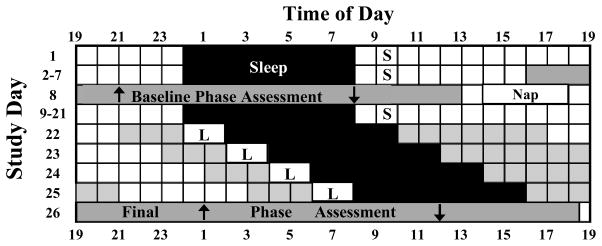
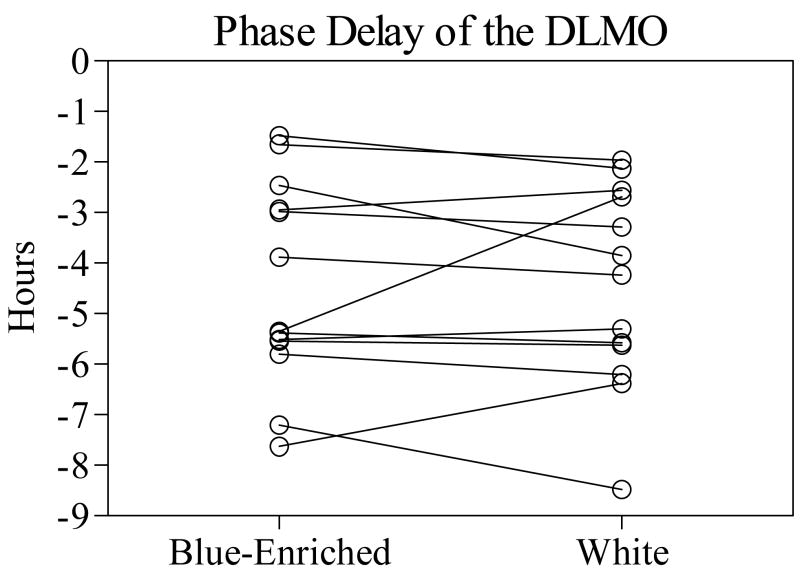
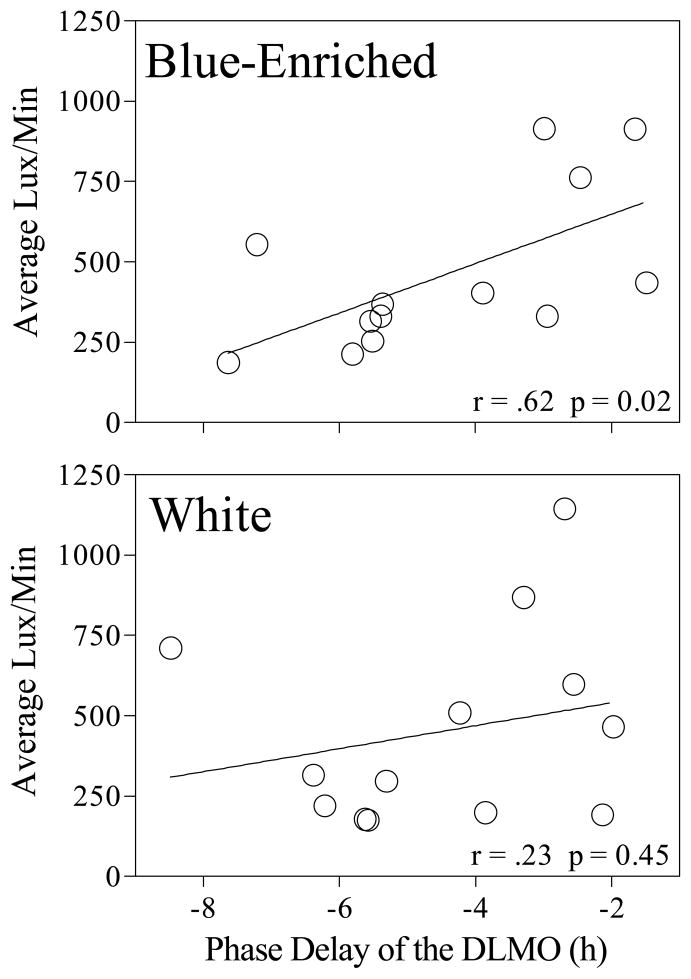
The human circadian system is maximally sensitive to short-wavelength (blue) light. In a previous study we found no difference between the magnitude of phase advances produced by bright white versus bright blue-enriched light using light boxes in a practical protocol that could be used in the real world. Since the spectral sensitivity of the circadian system may vary with a circadian rhythm, we tested whether the results of our recent phase-advancing study hold true for phase delays. In a within-subjects counterbalanced design, this study tested whether bright blue-enriched polychromatic light (17000 K, 4000 lux) could produce larger phase delays than bright white light (4100 K, 5000 lux) of equal photon density (4.2x10(15) photons/cm(2)/sec). Healthy young subjects (n = 13) received a 2 h phase delaying light pulse before bedtime combined with a gradually delaying sleep/dark schedule on each of 4 consecutive treatment days. On the first treatment day the light pulse began 3 h after the dim light melatonin onset (DLMO). An 8 h sleep episode began at the end of the light pulse. Light treatment and the sleep schedule were delayed 2 h on each subsequent treatment day. A circadian phase assessment was conducted before and after the series of light treatment days to determine the time of the DLMO and DLMOff. Phase delays in the blue-enriched and white conditions were not significantly different (DLMO: -4.45+/-2.02 versus -4.48+/-1.97 h; DLMOff: -3.90+/-1.97 versus -4.35+/-2.39 h, respectively). These results indicate that at light levels commonly used for circadian phase shifting, blue-enriched polychromatic light is no more effective than the white polychromatic lamps of a lower correlated color temperature (CCT) for phase delaying the circadian clock.
Conflict of interest statement
Declaration of Interest: MRS has received consulting fees from Respironics, Inc. CIE has no conflicts of interest.
Figures
References
-
- Berson DM, Dunn FA, Takao M. Phototransduction by retinal ganglion cells that set the circadian clock. Science. 2002;295:1070–1073. - PubMed
-
- Bierman A, Klein T, Rea M. The daysimeter: a device for measuring optical radiation as a stimulus for the human circadian system. Measure Sci Technol. 2005;16:2292–2299.
-
- Boivin DB, James FO. Circadian adaptation to night-shift work by judicious light and darkness exposure. J Biol Rhythms. 2002;17:556–567. - PubMed
-
- Campbell SS. Effects of times bright-light exposure on shift-work adaptation in middle-aged subjects. Sleep. 1995;18:408–416. - PubMed
Publication types
MeSH terms
Substances
Grants and funding
LinkOut - more resources
Full Text Sources
Medical
