


Persistence of the metabolic syndrome and its influence on carotid artery intima media thickness in overweight Latino children
- PMID: 19446812
- PMCID: PMC3767145
- DOI: 10.1016/j.atherosclerosis.2009.03.013
Persistence of the metabolic syndrome and its influence on carotid artery intima media thickness in overweight Latino children
Abstract
Objective: The objective of this study was to examine the influence of persistence of the metabolic syndrome (Mets) and its individual components over a 3-year period on carotid intima media thickness (CIMT) in overweight Latino children.
Methods: Ninety-seven healthy male and female overweight Latino children (mean age at baseline: 11.0+/-1.8 years) were assessed for MetS on four annual evaluations and classified according to the persistence of MetS: NEVER (0 annual visits with the MetS, n=53), INTERMITTENT (1 or 2 visits with the MetS, n=28), and PERSISTENT (3 or 4 visits with the MetS, n=16). CIMT was measured with high-resolution B-mode ultrasound (7.9+/-0.7 months after the most recent MetS assessment; mean age: 14.6+/-1.8 years).
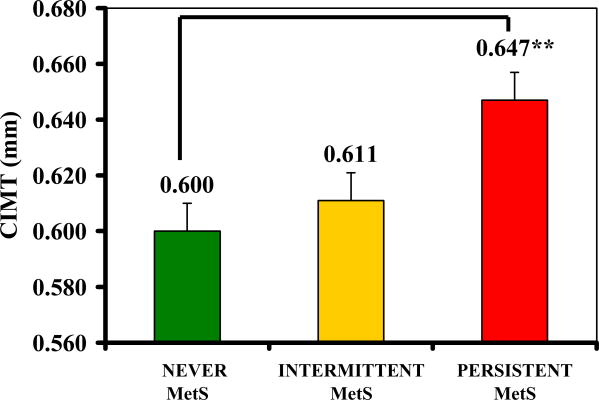
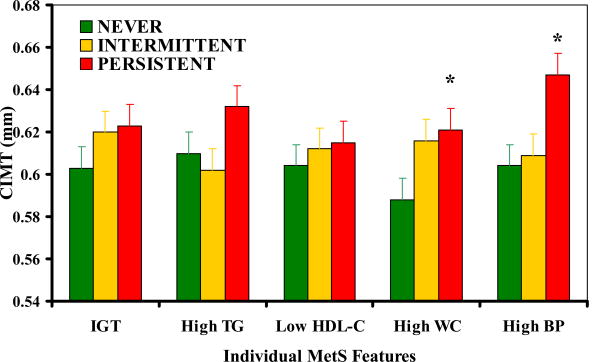
Results: PERSISTENT MetS was associated with significantly higher CIMT (0.647+/-0.018mm compared to 0.600+/-0.007mm in those who NEVER had MetS, p<0.01). This difference remained significant after controlling for gender, baseline age, total fat mass, total lean tissue mass and insulin sensitivity. PERSISTENT high waist circumference and PERSISTENT high blood pressure were also significantly associated with higher mean CIMT, but these differences were no longer significant after controlling for total fat and lean tissue mass. Baseline systolic blood pressure and 2-h glucose were significantly related to CIMT independent of all other MetS components (p<0.05).
Conclusions: Persistence of the MetS over a 3-year period was uniquely associated with increased CIMT during childhood. Children with hypertension, persistent abdominal adiposity or impaired glucose tolerance may also be at higher risk for elevated CIMT.
Figures
References
-
- Dekker JM, Girman C, Rhodes T, Nijpels G, Stehouwer CD, Bouter LM, Heine RJ. MetS and 10-year cardiovascular disease risk in the Hoorn Study. Circulation. 2005;112:666–673. - PubMed
-
- Hunt KJ, Resendez RG, Williams K, Haffner SM, Stern MP. National Cholesterol Education Program versus World Health Organization MetS in relation to all-cause and cardiovascular mortality in the San Antonio Heart Study. Circulation. 2004;110:1251–1257. - PubMed
-
- Chen W, Srinivasan SR, Li S, Xu J, Berenson GS. MetS variables at low levels in childhood are beneficially associated with adulthood cardiovascular risk: the Bogalusa Heart Study. Diabetes Care. 2005;28:126–131. - PubMed
-
- Raitakari OT, Juonala M, Kahonen M, Taittonen L, Laitinen T, Maki-Torkko N, Jarvisalo MJ, Uhari M, Jokinen E, Ronnemaa T, Akerblom HK, Viikari JS. Cardiovascular risk factors in childhood and carotid artery intima-media thickness in adulthood: the Cardiovascular Risk in Young Finns Study. Jama. 2003;290:2277–2283. - PubMed
-
- Flegal KM, Ogden CL, Carroll MD. Prevalence and trends in overweight in Mexican-american adults and children. Nutr Rev. 2004;62:S144–148. - PubMed
Publication types
MeSH terms
Grants and funding
LinkOut - more resources
Full Text Sources
Medical
