


Motor behavior activates Bergmann glial networks
- PMID: 19447095
- PMCID: PMC2820366
- DOI: 10.1016/j.neuron.2009.03.019
Motor behavior activates Bergmann glial networks
Abstract
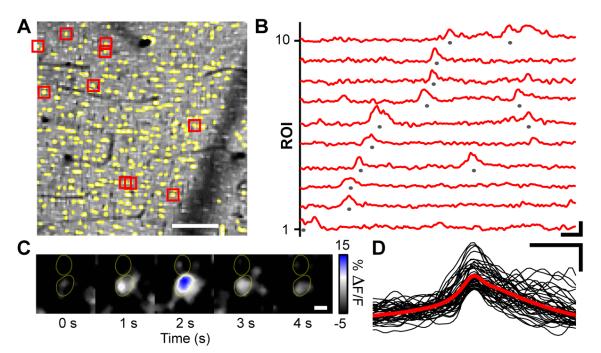
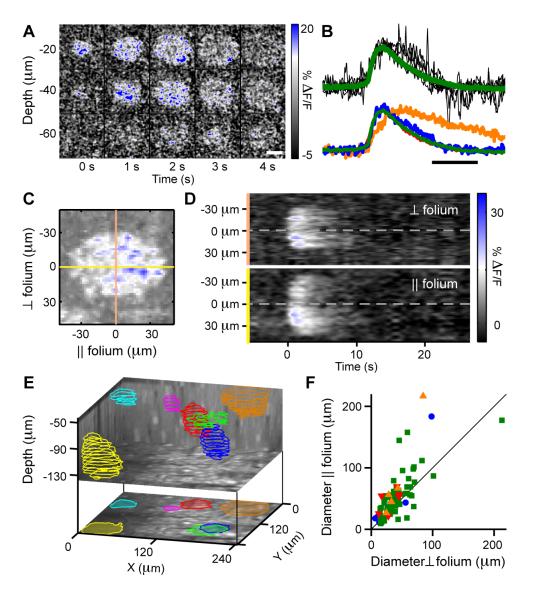
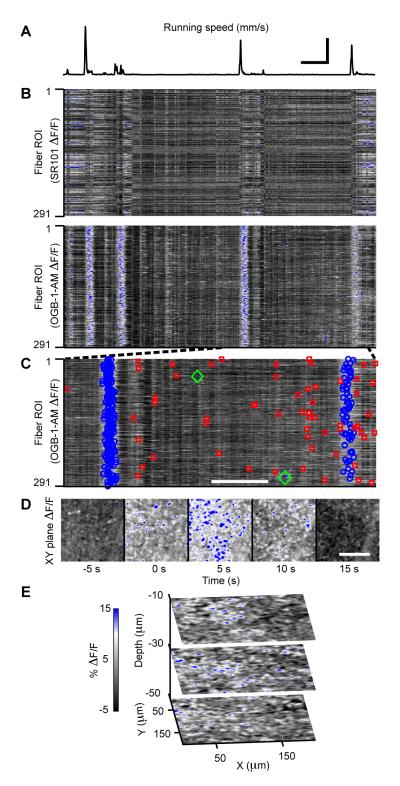
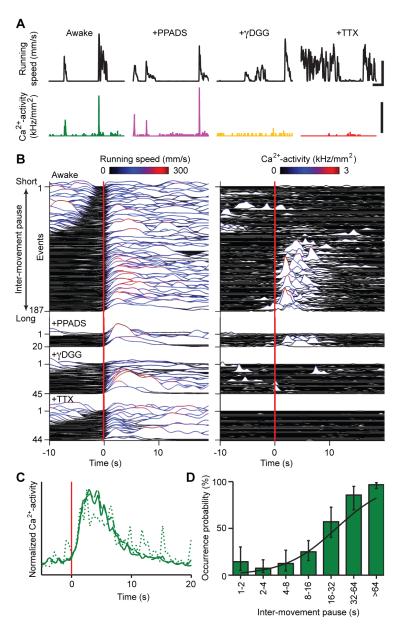
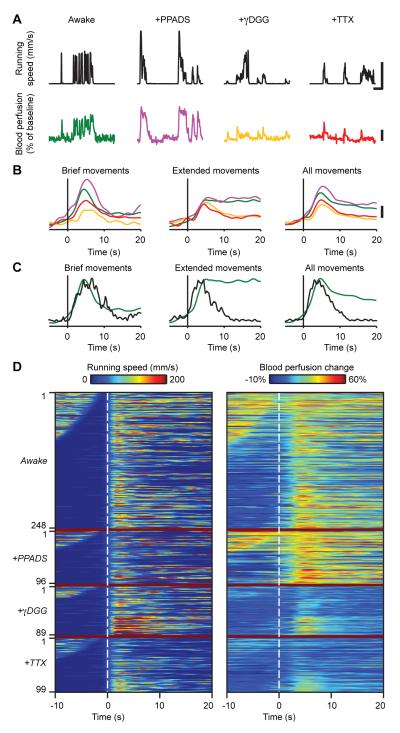
Although it is firmly established that neuronal activity is a prime determinant of animal behavior, relationships between astrocytic excitation and animal behavior have remained opaque. Cerebellar Bergmann glia are radial astrocytes that are implicated in motor behavior and exhibit Ca(2+) excitation. However, Ca(2+) excitation in these cells has not previously been studied in behaving animals. Using two-photon microscopy we found that Bergmann glia exhibit three forms of Ca(2+) excitation in awake, behaving mice. Two of these are ongoing within the cerebellar vermis. During locomotor performance concerted Ca(2+) excitation arises in networks of at least hundreds of Bergmann glia extending across several hundred microns or more. Concerted Ca(2+) excitation was abolished by anesthesia or blockade of either neural activity or glutamatergic transmission. Thus, large networks of Bergmann glia can be activated by specific animal behaviors and undergo excitation of sufficient magnitude to potentially initiate macroscopic changes in brain dynamics or blood flow.
Figures


References
-
- Apps R, Garwicz M. Anatomical and physiological foundations of cerebellar information processing. Nature Reviews Neuroscience. 2005;6:297–311. - PubMed
-
- Bekar L, Libionka W, Tian GF, Xu Q, Torres A, Wang X, Lovatt D, Williams E, Takano T, Schnermann J, et al. Adenosine is crucial for deep brain stimulation-mediated attenuation of tremor. Nat Med. 2008;14:75–80. - PubMed
-
- Charles AC, Merrill JE, Dirksen ER, Sanderson MJ. Intercellular Signaling in Glial-Cells - Calcium Waves and Oscillations in Response to Mechanical Stimulation and Glutamate. Neuron. 1991;6:983–992. - PubMed
Publication types
MeSH terms
Grants and funding
LinkOut - more resources
Full Text Sources
Other Literature Sources
Miscellaneous
