. 2009 Jun 2;106(22):8912-7.
doi: 10.1073/pnas.0903860106. Epub 2009 May 15.

Reprogramming of murine fibroblasts to induced pluripotent stem cells with chemical complementation of Klf4

Affiliations

Reprogramming of murine fibroblasts to induced pluripotent stem cells with chemical complementation of Klf4

Costas A Lyssiotis et al. Proc Natl Acad Sci U S A. .

Abstract

Ectopic expression of defined transcription factors can reprogram somatic cells to induced pluripotent stem (iPS) cells, but the utility of iPS cells is hampered by the use of viral delivery systems. Small molecules offer an alternative to replace virally transduced transcription factors with chemical signaling cues responsible for reprogramming. In this report we describe a small-molecule screening platform applied to identify compounds that functionally replace the reprogramming factor Klf4. A series of small-molecule scaffolds were identified that activate Nanog expression in mouse fibroblasts transduced with a subset of reprogramming factors lacking Klf4. Application of one such molecule, kenpaullone, in lieu of Klf4 gave rise to iPS cells that are indistinguishable from murine embryonic stem cells. This experimental platform can be used to screen large chemical libraries in search of novel compounds to replace the reprogramming factors that induce pluripotency. Ultimately, such compounds may provide mechanistic insight into the reprogramming process.


Conflict of interest statement

Conflict of interest: R.J. is an advisor to Stemgent and Fate.

Figures
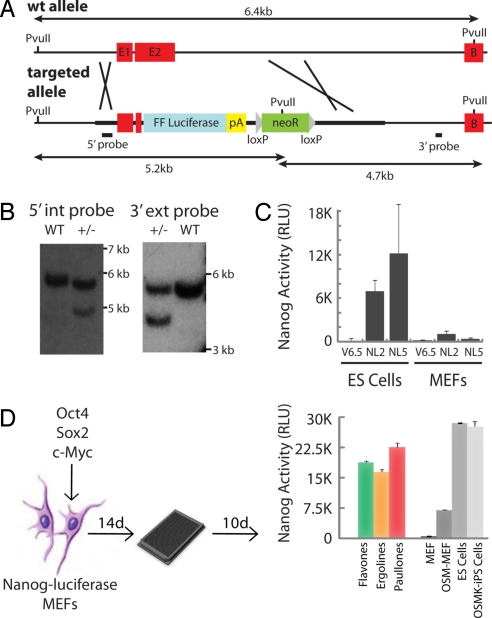
Fig. 1.
Fig. 1.
NL screening platform. (A) Scheme for targeting the firefly (FF) luciferase gene to the Nanog locus. (B) Southern blot hybridization analysis of the NL targeted allele. The targeted allele–specific 5.2-kb and 4.7-kb PvuII fragments were detected with the 5′ internal and 3′ external probes, respectively, shown in (A). (C) NL activity of correctly targeted ES cell clones (NL2 and NL5) versus NL-MEFs. Differentiated NL tissue shows a significant reduction in luciferase expression. V6.5 ES cells and MEFs are provided as a luciferase-negative control. (D) Small-molecule screening strategy. NL-MEFs were transduced with a reduced reprogramming cocktail (Oct4, Sox2, and c-Myc [OSM]), expanded for 2 weeks, plated into 1,536-well plates, treated with compound, and assayed for luciferase expression 10 days after plating: flavones (7-hydroxyflavone, 20 μM), ergolines (lysergic acid ethylamide, 2 μM), and paullones (kenpaullone, 5 μM). Nanog activity is reported in relative light units (RLUs) and was read in a 96-well (B) or 384-well (D) format. Error bars indicate SD (n = 3).
Fig. 2.
Fig. 2.
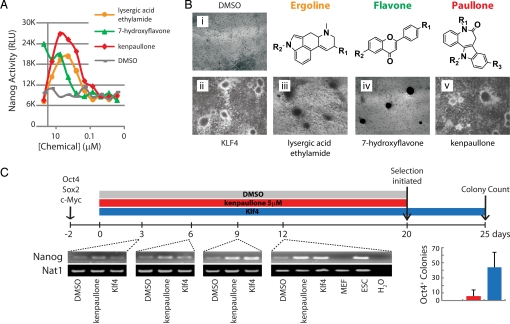
Activity of lead chemical scaffolds. (A) Dose-dependent Nanog activation of a lead compound from each chemical class: lysergic acid ethylamide (ergolines), 7-hydroxyflavone (flavones), and kenpaullone (paullones). Above 10 μM, kenpaullone and lysergic acid ethylamide are toxic. (B) OSM-MEFs took on colony morphology upon application of lead compounds (i, DMSO; ii, Klf4; iii, 7-hydroxyflavone 20 μM; iv, lysergic acid ethylamide 2 μM; v, kenpaullone 5 μM). (C) O4N-MEFs were transduced with OSM on day -2 and treated with DMSO, retrovirally delivered Klf4, or kenpaullone 2 days later (day 0). RT-PCR of samples collected at days 3, 6, 9, and 12 confirmed the reactivation of Nanog observed using NL-MEFs. At day 20, kenpaullone and DMSO were removed, and neomycin was added to the culture media to initiate selection of iPS cells. Neomycin-resistant colonies (indicating reactivation of endogenous Oct4) were counted at day 25. Kenpaullone is shown in red; Klf4, in blue. Error bars indicate SD (n = 4 wells of a 6-well plate). Dose–response curves are representative of at least 6 independent experiments and were read in a 384-well format. Images were captured at × 40 magnification.
Fig. 3.
Fig. 3.
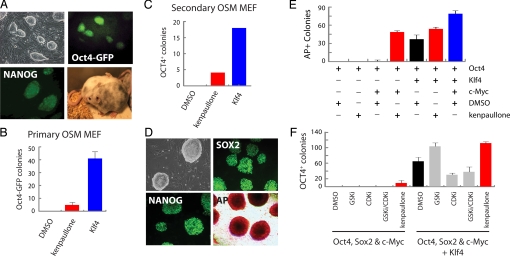
Characterization of iPS cells derived with kenpaullone. (A) iPS cells generated with OSM and 5 μM kenpaullone express the pluripotency-associated markers Oct4 and Nanog from their endogenous loci and are capable of contributing to chimeric mice. (B) Chemical complementation of Klf4 with kenpaullone is less efficient than retroviral delivery of Klf4, based on the number of colonies (per 10,000 MEFs) that express GFP from the endogenous Oct4 locus. Error bars indicate SD (n = 3). (C) Secondary MEFs harboring proviral copies of OSM were treated with kenpaullone (5 μM) or retrovirally delivered Klf4. Colonies were scored based on expression of OCT4. (D) Kenpaullone-treated Oct4/c-Myc-NPCs gave rise to iPS cells that expressed pluripotency-associated proteins (Nanog, Sox2, and AP) from endogenous loci. (E) NPCs were transduced with Oct4 +/− Klf4 and c-Myc and treated with kenpaullone (5 μM) or vehicle control. Data represent colonies that expressed AP after 8 days (per 100,000 NPCs). Error bars indicate SD (n = 3). (F) O4N-MEFs were transduced with OSM +/− Klf4 and treated with a GSK-3β–specific inhibitor (GSKi; CHIR99021, 3 μM), a general CDK inhibitor (CDKi; purvalanol A, 3 μM), both the GSKi and the CDKi, or kenpaullone. Colonies were scored for neomycin resistance (per 50,000 MEFs) at day 25. Error bars indicate SD (n = 4).

References

    1. Maherali N, et al. Directly reprogrammed fibroblasts show global epigenetic remodeling and widespread tissue contribution. Cell Stem Cell. 2007;1:55–70. - PubMed
    1. Okita K, Ichisaka T, Yamanaka S. Generation of germline-competent induced pluripotent stem cells. Nature. 2007;448:313–317. - PubMed
    1. Takahashi K, Yamanaka S. Induction of pluripotent stem cells from mouse embryonic and adult fibroblast cultures by defined factors. Cell. 2006;126:663–676. - PubMed
    1. Wernig M, et al. In vitro reprogramming of fibroblasts into a pluripotent ES cell–like state. Nature. 2007;448:318–324. - PubMed
    1. Jaenisch R, Young R. Stem cells, the molecular circuitry of pluripotency and nuclear reprogramming. Cell. 2008;132:567–582. - PMC - PubMed

Publication types