. 2009 May 15;34(3):387-93.
doi: 10.1016/j.molcel.2009.04.016.

TFIIH kinase places bivalent marks on the carboxy-terminal domain of RNA polymerase II

Affiliations

TFIIH kinase places bivalent marks on the carboxy-terminal domain of RNA polymerase II

Md Sohail Akhtar et al. Mol Cell. .

Abstract

Posttranslational modifications of the carboxy-terminal domain (CTD) of the largest subunit of RNA polymerase II (Pol II) specify a molecular recognition code that is deciphered by proteins involved in RNA biogenesis. The CTD is comprised of a repeating heptapeptide (Y(1)S(2)P(3)T(4)S(5)P(6)S(7)). Recently, phosphorylation of serine 7 was shown to be important for cotranscriptional processing of two snRNAs in mammalian cells. Here we report that Kin28/Cdk7, a subunit of the evolutionarily conserved TFIIH complex, is a Ser7 kinase. The ability of Kin28/Cdk7 to phosphorylate Ser7 is particularly surprising because this kinase functions at promoters of protein-coding genes, rather than being restricted to promoter-distal regions of snRNA genes. Kin28/Cdk7 is also known to phosphorylate Ser5 residues of the CTD at gene promoters. Taken together, our results implicate the TFIIH kinase in placing bivalent Ser5 and Ser7 marks early in gene transcription. These bivalent CTD marks, in concert with cues within nascent transcripts, specify the cotranscriptional engagement of the relevant RNA processing machinery.


Figures
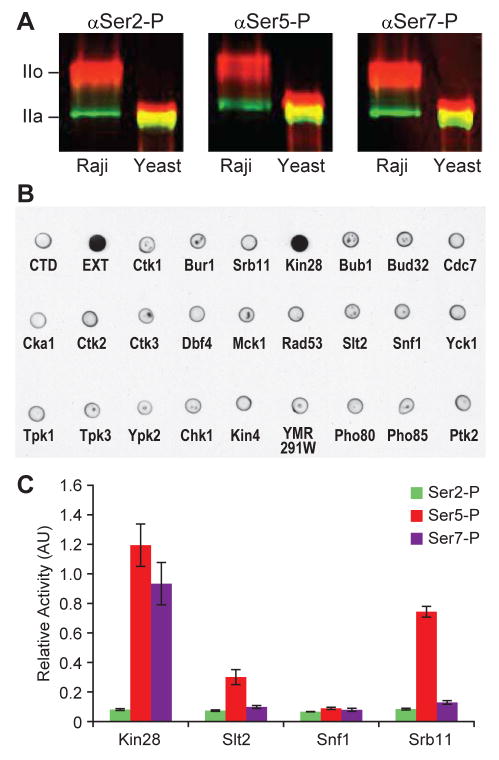
Figure 1
Figure 1. Kin28 phosphorylates the Ser7 of Pol II CTD
(A) Western blot of protein extracted from human T-cell line (Raji cells) and yeast. Dual labeling was performed with antibody to Rpb1 (green) and phospho-CTD (red). mAbs αSer2-P, αSer5-P and αSer7-P recognize the phosphorylated Ser2, Ser5 and Ser7 of the CTD. (B) Dot blot probing Ser7-P marks on GST-CTD phosphorylated by individually purified yeast nuclear kinases. GST-CTD unphosphorylated (−) and phosphorylated by yeast cell extract (EXT) are used as negative and positive controls respectively. (C) ELISA of synthetic CTD peptide phosphorylated by purified yeast Kin28, Slt2, Snf1 and Srb11 probed with αSer2-P (green), αSer5-P (red) and αSer7-P (purple) antibodies. The measurements were taken in triplicate and the error bars in this and all the subsequent figures correspond to SD.
Figure 2
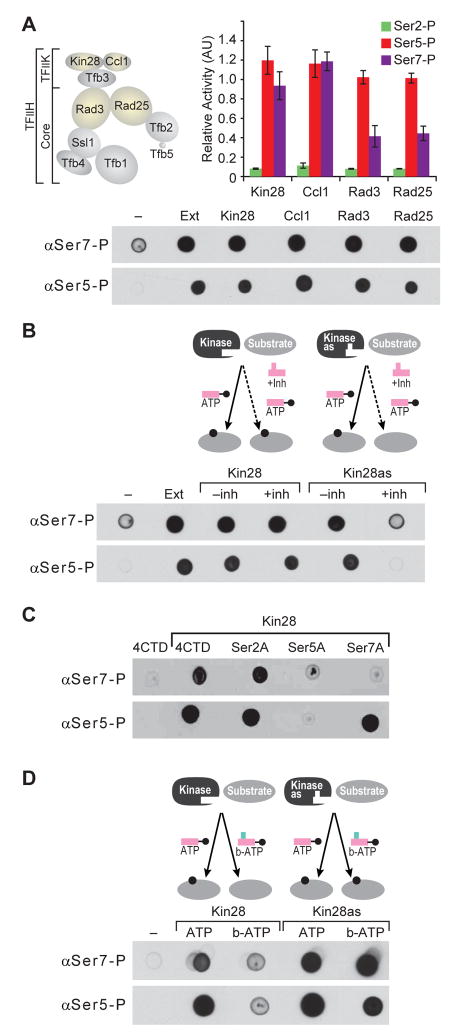
Figure 2. TFIIH-associated Kin28 phosphorylates the Ser7 of Pol II CTD
(A) The schematic diagram (top left) shows the different subunits of TFIIK and the core TFIIH complex. Dot blot and ELISA of GST-CTD phosphorylated by TFIIH purified using TAP-tagged Kin28, Ccl1, Rad3 or Rad25. (B) The diagram (top) illustrates the docking of ATP into the catalytic pocket of wild type kinase. Dot blot (bottom) of GST-CTD phosphorylated by Kin28 and its analog sensitive mutant Kin28as (Kin28-L83G) in the presence and absence of an inhibitor was probed with αSer5-P and αSer7-P antibodies. (C) Dot blot of GST-CTD and its various mutants at positions 2, 5, and 7 phosphorylated by purified Kin28 and probed with αSer5-P and αSer7-P antibodies. (D) The diagram (top) illustrates the ability of Kin28as to use of the ATP analog (N6-benzyl ATP) as a co-factor. Dot blot (bottom) of GST-CTD phosphorylated by Kin28 and Kin28as in presence and absence of the N6- benzyl ATP was probed with αSer5-P and αSer7-P antibodies.
Figure 3
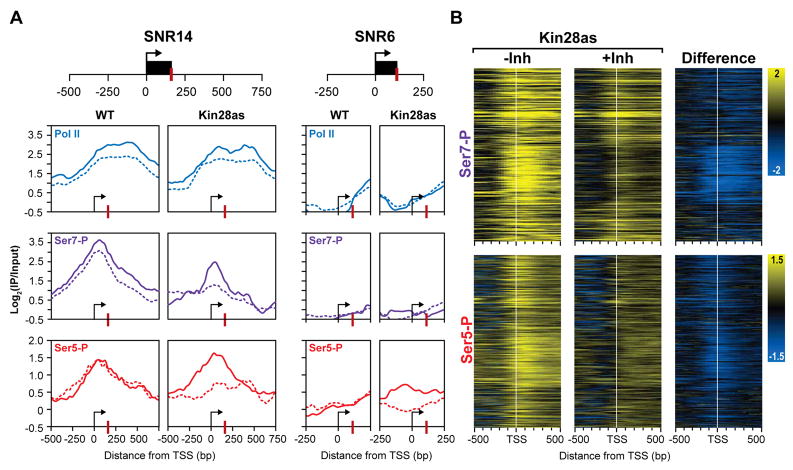
Figure 3. In vivo inhibition of Kin28 affects the Ser7 phosphorylation pattern
(A) ChIP-chip profiles for two snRNAs (remaining three are in the supplemental figures). The occupancy profiles of Pol II (blue), Ser7-P (purple) and Ser5-P (red) at SNR14 and SNR6 (control) are shown. Uninhibited profiles are shown as solid lines and profiles in chemically inhibited cells are shown as dashed lines. TSS and 3′ processing sites are marked by an arrow and a red bar respectively. All x-axes are shown as the distance in base pairs relative to the TSS and y-axes are shown on a log2 scale for ChIP-chip enrichment (IP/input). (B) Heat maps of 308 protein-coding genes showing Ser7-P and Ser5-P occupancy profiles over a 1kb region centered over the TSS (white bar) for the Kin28as strain with and without inhibition. The change in profiles upon inhibition is shown on the right. Yellow profiles indicate enrichment and blue profiles indicate depletion of the phosphorylated CTD.
Figure 4
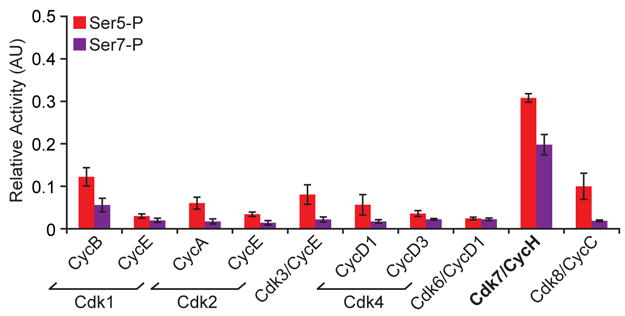
Figure 4. Mammalian Cdk7 phosphorylates the Ser7 of Pol II CTD
ELISA of a synthetic CTD peptide (four repeats) phosphorylated by purified mammalian kinases and their corresponding cyclins were probed with αSer5-P (red) and αSer7-P (purple) antibodies.

References

    1. Ahn SH, Kim M, Buratowski S. Phosphorylation of serine 2 within the RNA Polymerase II C-terminal domain couples transcription and 3′ end processing. Mol Cell. 2004;13:67–76. - PubMed
    1. Ansari AZ, Ogirala A, Ptashne M. Transcriptional activating regions target attached substrates to a cyclin-dependent kinase. Proc Natl Acad Sci USA. 2005;102:2346–2349. - PMC - PubMed
    1. Baillat D, Hakimi MA, Näär AM, Shilatifard A, Cooch N, Shiekhattar R. Integrator, a multiprotein mediator of small nuclear RNA processing, associates with the C-terminal repeat of RNA Polymerase II. Cell. 2005;123:265–276. - PubMed
    1. Bishop AC, Ubersax JA, Petsch DT, Matheos DP, Gray NS, Blethrow J, Shimizu E, Tsien JZ, Schultz PG, Rose MD, et al. A chemical switch for inhibitor-sensitive alleles of any protein kinase. Nature. 2000;407:395–401. - PubMed
    1. Bishop AC, Buzko O, Shokat KM. Magic bullets for protein kinases. Trends Cell Biol. 2001;11:167–172. - PubMed

Publication types

MeSH terms