. 2009 Aug;56(2):264-73.
doi: 10.1016/j.yhbeh.2009.05.005. Epub 2009 May 18.

Androgens enhance plasticity of an electric communication signal in female knifefish, Brachyhypopomus pinnicaudatus

Affiliations

Androgens enhance plasticity of an electric communication signal in female knifefish, Brachyhypopomus pinnicaudatus

Susan J Allee et al. Horm Behav. 2009 Aug.

Abstract

Sex steroids were initially defined by their actions shaping sexually dimorphic behavioral patterns. More recently scientists have begun exploring the role of steroids in determining sex differences in behavioral plasticity. We investigated the role of androgens in potentiating circadian, pharmacological, and socially-induced plasticity in the amplitude and duration of electric organ discharges (EODs) of female gymnotiform fish. We first challenged female fish with injections of serotonin (5-HT) and adrenocorticotropic hormone (ACTH), and with social encounters with female and male conspecifics to characterize females' pre-implant responses to each treatment. Each individual was then implanted with a pellet containing dihydrotestosterone (DHT) concentrations of 0.0, 0.03, 0.1, 0.3, or 1.0 mg 10 g(-1) body weight. We then repeated all challenges and compared each female's pre- and post-implant responses. The highest implant dose enhanced EOD duration modulations in response to all challenge types, responses to male challenge were also greater at the second highest dose, and responses to ACTH challenge were enhanced in females receiving all but the smallest dose (and blank) implants. Alternatively, amplitude modulations were enhanced only during female challenges and only when females received the highest DHT dose. Our results highlight the differential regulation of EOD duration and amplitude, and suggest that DHT enhanced the intrinsic plasticity of the electrogenic cells that produce the EOD rather than modifying behavioral phenotypes. The relative failure of DHT to enhance EOD amplitude plasticity also implies that factors other than androgens are involved in regulating/promoting male-typical EOD circadian rhythms and waveform modulations displayed in social contexts.


Figures
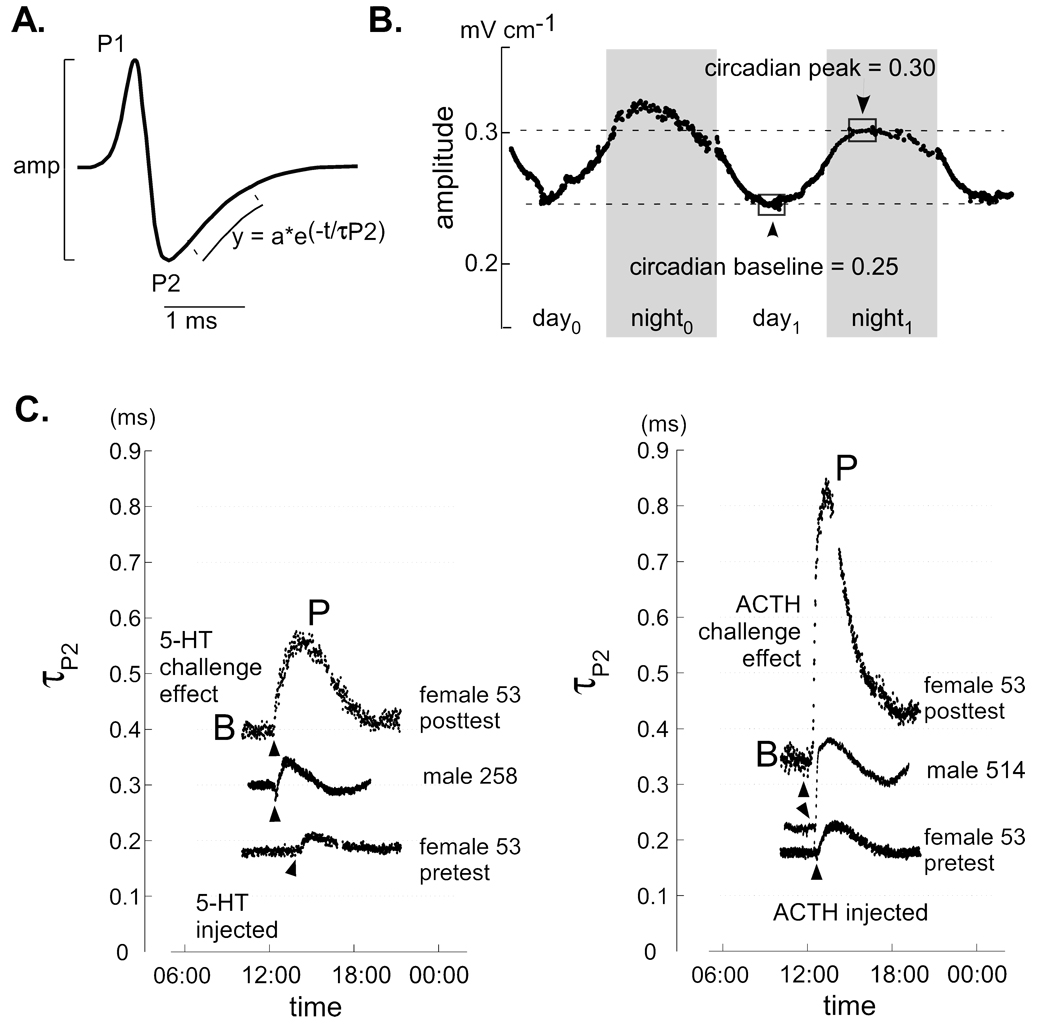
Figure 1
Figure 1
(A) Brachyhypopomus pinnicaudatus produces a biphasic sinusoidal EOD that is characterized by the peak-to-peak amplitude (mV cm−1 at 10 cm) and duration (ms). The duration of the second phase (P2) is particularly variable, as quantified by the parameter τP2, the time constant of an inverse exponential function fit to the decay segment of P2. (B) Our automated recording system collects approximately nine EODs per minute whenever the focal fish is centered in the measurement tank. We extracted daily baseline and nightly peak values from a 24-hour period to calculate the magnitude of day-night oscillation in EOD amplitude and τP2. Each dot represents an individual EOD which wobbles relative to immediately preceding and subsequent EODs. We took representative values of peak and baseline EODs, shown here in boxes, rather than taking the lowest low and highest high values. As the figure depicts, baseline and peak values trend downward over time, therefore circadian oscillation data used to explore DHT effects were collected one day before the first pretest challenge and one day before the posttest challenge. (C) Responses to all challenges for both amplitude and τP2 were calculated by determining peak (P) challenge responses and subtracting circadian baseline (B) values using methods and data analysis programming described in detail in Stoddard et al. (2003). τP2 response to 5-HT and ACTH are shown here to illustrate changes in the waveform in response to challenge before and after DHT implants.
Figure 2
Figure 2
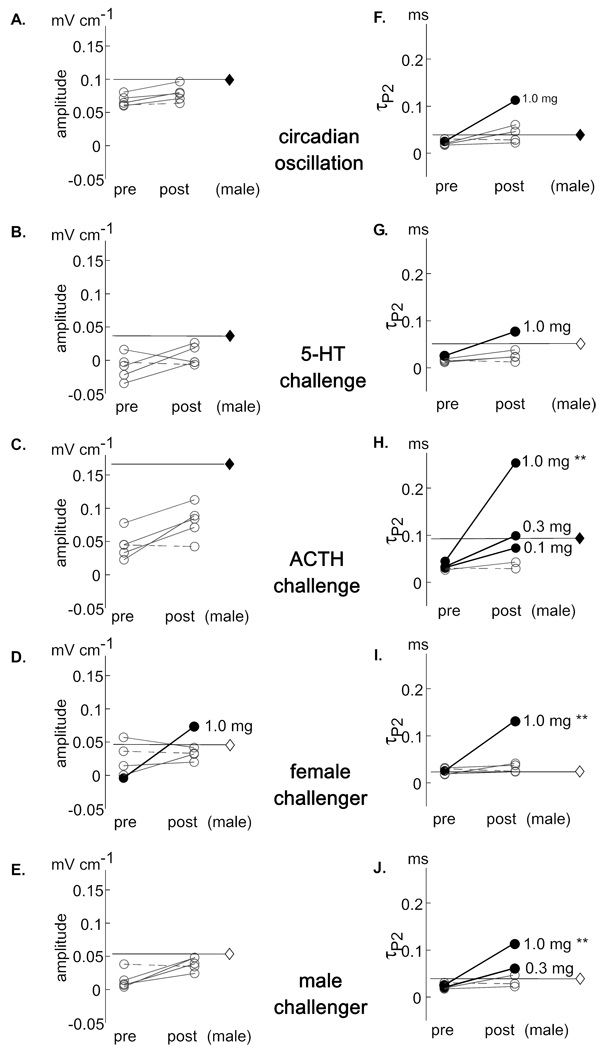
DHT effects on females’ EOD responses to challenge and relation to male EOD responses. Solid circles and bolded lines indicate DHT dose groups where RMLA uncovered significant differences pretest versus posttest. Gray lines and open circles indicate no significant difference pretest versus posttest. Dotted gray lines indicate sham-implanted females. Diamonds indicate mean male responses: solid diamonds indicate male responses were significantly greater compared to pooled pretest female responses and open diamonds indicate we found no evidence of sexual dimorphisms in response to that challenge. Posttest female responses that ANOVA indicated were significantly greater than male responses are marked with **. DHT did not enhance the magnitude of amplitude circadian oscillation (A), amplitude response to 5-HT (B), ACTH (C), or male challengers (E). Amplitude responses to both pharmacological challenges and magnitudes of circadian oscillation were sexually dimorphic. No sexual dimorphisms were apparent in amplitude responses to either social challenge, yet the highest dose of DHT enhanced female amplitude response to female challengers (D). We found a similar pattern of sexually dimorphic responses in waveform τP2: males produced greater circadian oscillations (F) and response to ACTH challenge (H), but not to 5-HT (G) or either social challenge (I & J). The highest DHT dose enhanced female τP2 responsiveness to all challenge types. Posttest female τP2 responses to ACTH were supra-masculinized and all implant doses produced a response except the sham implants and the 0.03mg 10g−1 dose (H). The high DHT dose also supra-exaggerated posttest female τP2 responses to both female and male challengers despite our findings that no natural sexual dimorphisms exist in response to these challenges.

References

    1. Adkins-Regan E. Adler N. Neuroendocrinology of Reproduction. New York: Plenum Press; 1981. Early organizational effects of hormones: An evolutionary perspective; pp. 159–221.
    1. Adkins-Regan E. Hormonal mechanisms of mate choice. Am. Zool. 1998;38:166–178.
    1. Allee SJ, et al. Opposing actions of 5HT1A and 5HT2-like serotonin receptors on modulations of the electric signal waveform in the electric fish Brachyhypopomus pinnicaudatus. Horm. Behav. 2008;53:481–488. - PMC - PubMed
    1. Andersson MB. Princeton, N.J: Princeton University Press; 1994. Sexual selection.
    1. Arnold AP, Breedlove SM. Organizational and activational effects of sex steroids on brain and behavior: a reanalysis. Horm. Behav. 1985;19:469–498. - PubMed

Publication types