


Hundreds of microsatellites for genotyping Plasmodium yoelii parasites
- PMID: 19450732
- PMCID: PMC2787103
- DOI: 10.1016/j.molbiopara.2009.03.011
Hundreds of microsatellites for genotyping Plasmodium yoelii parasites
Abstract
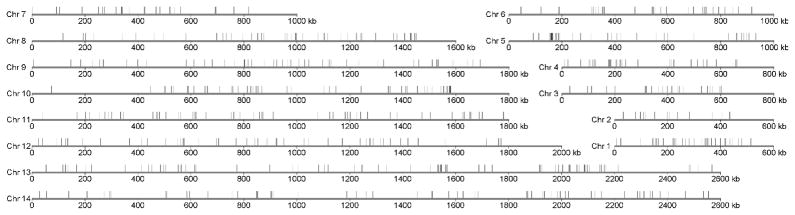
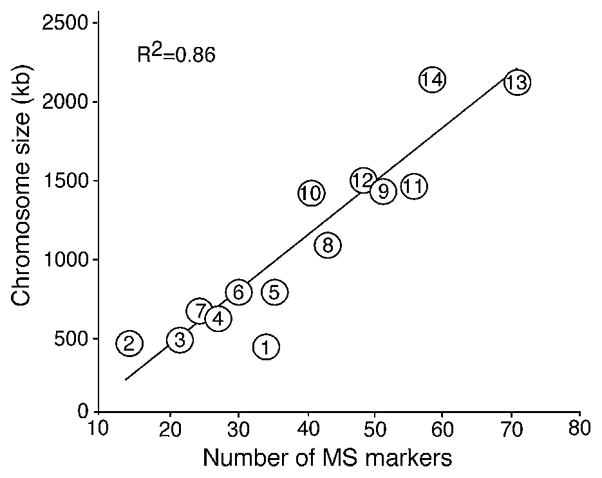
Genetic crosses have been employed to study various traits of rodent malaria parasites and to locate loci that contribute to drug resistance, immune protection, and disease virulence. Compared with human malaria parasites, genetic crossing of rodent malaria parasites is more easily performed; however, genotyping methods using microsatellites (MSs) or large-scale single nucleotide polymorphisms (SNPs) that have been widely used in typing Plasmodium falciparum are not available for rodent malaria species. Here we report a genome-wide search of the Plasmodium yoelii yoelii (P. yoelii) genome for simple sequence repeats (SSRs) and the identification of nearly 600 polymorphic MS markers for typing the genomes of P. yoelii and Plasmodium berghei. The MS markers are randomly distributed across the 14 physical chromosomes assembled from genome sequences of three rodent malaria species, although some variations in the numbers of MS expected according to chromosome size exist. The majority of the MS markers are AT-rich repeats, similar to those found in the P. falciparum genome. The MS markers provide an important resource for genotyping, lay a foundation for developing linkage maps, and will greatly facilitate genetic studies of P. yoelii.
Figures
References
-
- Carter R, Voller A. The distribution of enzyme variation in populations of Plasmodium falciparum in Africa. Trans R Soc Trop Med Hyg. 1975;69(4):371–6. - PubMed
-
- Walliker D. Genetic factors in malaria parasites and their effect on host-parasite relationships. In: Taylor AE, Muller R, editors. Genetic aspects of host-parasite relationships. Oxford: Blackwell; 1976. pp. 25–44.
-
- Wellems TE, Panton LJ, Gluzman IY, do Rosario VE, Gwadz RW, Walker-Jonah A, et al. Chloroquine resistance not linked to mdr-like genes in a Plasmodium falciparum cross. Nature. 1990;345(6272):253–5. - PubMed
-
- Grech K, Martinelli A, Pathirana S, Walliker D, Hunt P, Carter R. Numerous, robust genetic markers for Plasmodium chabaudi by the method of amplified fragment length polymorphism. Mol Biochem Parasitol. 2002;123(2):95–104. - PubMed
Publication types
MeSH terms
Substances
Grants and funding
LinkOut - more resources
Full Text Sources
Medical
