. 2009 Jun 2;106(22):8969-74.
doi: 10.1073/pnas.0810883106. Epub 2009 May 18.

A central role for venom in predation by Varanus komodoensis (Komodo Dragon) and the extinct giant Varanus (Megalania) priscus

Affiliations

A central role for venom in predation by Varanus komodoensis (Komodo Dragon) and the extinct giant Varanus (Megalania) priscus

Bryan G Fry et al. Proc Natl Acad Sci U S A. .

Abstract

The predatory ecology of Varanus komodoensis (Komodo Dragon) has been a subject of long-standing interest and considerable conjecture. Here, we investigate the roles and potential interplay between cranial mechanics, toxic bacteria, and venom. Our analyses point to the presence of a sophisticated combined-arsenal killing apparatus. We find that the lightweight skull is relatively poorly adapted to generate high bite forces but better adapted to resist high pulling loads. We reject the popular notion regarding toxic bacteria utilization. Instead, we demonstrate that the effects of deep wounds inflicted are potentiated through venom with toxic activities including anticoagulation and shock induction. Anatomical comparisons of V. komodoensis with V. (Megalania) priscus fossils suggest that the closely related extinct giant was the largest venomous animal to have ever lived.


Conflict of interest statement

The authors declare no conflict of interest.

Figures

Fig. 1.
Fig. 1.
Finite element models of (A) Varanus komodoensis and (B) Crocodylus porosus, assembled from computed tomography (CT) data and solved (C--H) to show stress distributions (Von Mises) under a range of loading cases and to determine maximal bite forces. (C and D), anterior bite; E and F, prey pull; G and H, axial twist.
Fig. 2.
Fig. 2.
Anatomical investigation of the Varanus komodoensis venom system. (A) Magnetic resonance imaging of the V. komodoensis head showing the protein-secreting mandibular venom gland, with the 6 compartments colored in alternating red and pink (C1–C6), and the mucus-secreting infralabial gland in yellow (L). (B) Longitudinal MRI section showing the large duct emerging separately from each compartment of the mandibular venom gland and threading between the mucus lobes of the infralabial gland to terminate between successive teeth (black oval areas). (C) Transverse MRI section showing the large central lumen of the mandibular venom gland and individual lobes of the labial gland. (D) Transverse histology of Masson's Trichrome-stained section showing the intratubular lumina of the mandibular venom gland that feed into the large central lumen. (E) Transverse histology of Masson's Trichrome-stained section of a mucus infralabial gland showing numerous tightly packed internal lobules (note that the ∼6 large dark folds are histology artifacts).
Fig. 3.
Fig. 3.
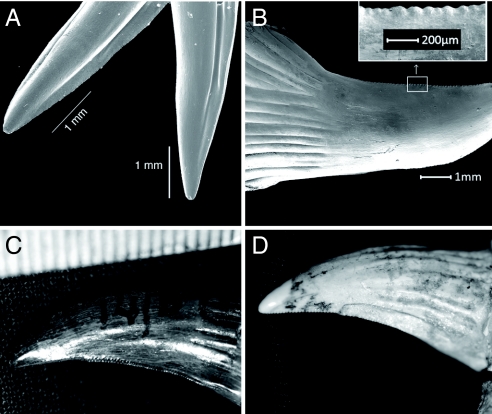
Scanning electron microscope views. (A) Both medial and anterior grooves (Left) and a sharp cutting edge at the bottom of a grooved Heloderma suspectum tooth (Right). (B) The structure and serrations of a Varanus komodoensis tooth. The Inset shows a magnified image of the serrations along the posterior (cutting) edge of the tooth. The length of the tooth does not show the presence of a discrete groove often associated with venom delivery systems. The maxillary teeth of the extinct Varanus (Megalania) priscus [C (QMF14/871) and D (QMF12370)] show clear similarity to those of V. komodoensis in overall shape and type of serration. V. (Megalania) priscus differs from V. komodoensis by possessing labial and lingual grooves that run from the base of the tooth (dorsal of the plicidentine) toward the tooth tip.
Fig. 4.
Fig. 4.
The depressor effect of Varanus komodoensis crude venom (A and B) or natriuretic toxin C on the blood pressure of anesthetized rats. The relaxant effect of V. komodoensis venom (D and E) or natriuretic toxin F on rat precontracted aorta is shown. The effects of the natriuretic toxin from V. varius are shown in C and F for comparison.

References

    1. Diamond J. Did Komodo dragons evolve to eat pygmy elephants? Nature. 1987;326:832.
    1. Moreno K, et al. Cranial performance in the Komodo dragon (Varanus komodoensis) as revealed by high-resolution 3-D finite element analysis. J Anat. 2008;212:736–746. - PMC - PubMed
    1. Bourke J, Wroe S, Moreno K, McHenry C, Clausen P. Effects of gape and tooth position on bite force and skull stress in the Dingo (Canis lupus dingo) using a 3-dimensional finite element approach. PLoS ONE. 2008;3:e2200. - PMC - PubMed
    1. Auffenberg W. Behavioral Ecology of the Komodo Monitor. Gainesville, FL: Univ Press Florida; 1981.
    1. Montgomery JM, Gillespie D, Sastrawan P, Fredeking TM, Stewart GL. Aerobic salivary bacteria in wild and captive Komodo dragons. J Wildl Dis. 2002;38:545–551. - PubMed

Publication types

LinkOut - more resources