


Biochemical markers of bone turnover, hip bone loss, and fracture in older men: the MrOS study
- PMID: 19453262
- PMCID: PMC2791517
- DOI: 10.1359/jbmr.090526
Biochemical markers of bone turnover, hip bone loss, and fracture in older men: the MrOS study
Abstract
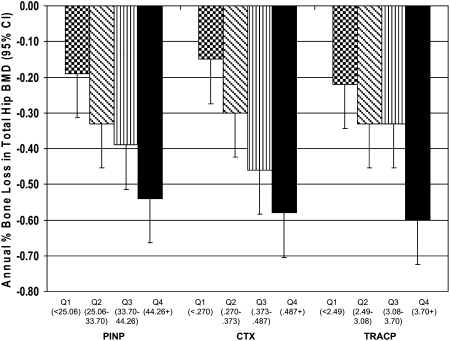
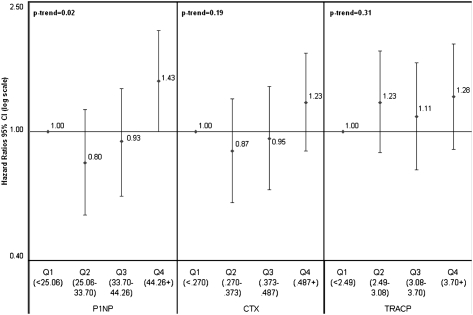
We used data from the Osteoporotic Fractures in Men (MrOS) study to test the hypothesis that men with higher levels of bone turnover would have accelerated bone loss and an elevated risk of fracture. MrOS enrolled 5995 subjects >65 yr; hip BMD was measured at baseline and after a mean follow-up of 4.6 yr. Nonspine fractures were documented during a mean follow-up of 5.0 yr. Using fasting serum collected at baseline and stored at -190 degrees C, bone turnover measurements (type I collagen N-propeptide [PINP]; beta C-terminal cross-linked telopeptide of type I collagen [betaCTX]; and TRACP5b) were obtained on 384 men with nonspine fracture (including 72 hip fractures) and 947 men selected at random. Among randomly selected men, total hip bone loss was 0.5%/yr among those in the highest quartile of PINP (>44.3 ng/ml) and 0.3%/yr among those in the lower three quartiles (p = 0.01). Fracture risk was elevated among men in the highest quartile of PINP (hip fracture relative hazard = 2.13; 95% CI: 1.23, 3.68; nonspine relative hazard = 1.57, 95% CI: 1.21, 2.05) or betaCTX (hip fracture relative hazard = 1.76, 95 CI: 1.04, 2.98; nonspine relative hazard = 1.29, 95% CI: 0.99, 1.69) but not TRACP5b. Further adjustment for baseline hip BMD eliminated all associations between bone turnover and fracture. We conclude that higher levels of bone turnover are associated with greater hip bone loss in older men, but increased turnover is not independently associated with the risk of hip or nonspine fracture.
Figures

References
-
- Ebeling PR. Clinical practice. Osteoporosis in men. N Engl J Med. 2008;358:1474–1482. - PubMed
-
- Mellstrom D, Johnell O, Ljunggren O, Eriksson AL, Lorentzon M, Mallmin H, Holmberg A, Redlund-Johnell I, Orwoll E, Ohlsson C. Free testosterone is an independent predictor of BMD and prevalent fractures in elderly men: MrOS Sweden. J Bone Miner Res. 2006;21:529–535. - PubMed
-
- Riggs BL, Khosla S, Melton LJI. A unitary model for involutional osteoporosis: Estrogen deficiency causes both Type I and Type II osteoporosis in postmenopausal women and contributes to bone loss in aging man. J Bone Miner Res. 1998;13:763–773. - PubMed
-
- Szulc P, Uusi-Rasi K, Claustrat B, Marchand F, Beck TJ, Delmas PD. Role of sex steroids in the regulation of bone morphology in men. The MINOS study. Osteoporos Int. 2004;15:909–917. - PubMed
-
- Olszynski WP, Shawn Davison K, Adachi JD, Brown JP, Cummings SR, Hanley DA, Harris SP, Hodsman AB, Kendler D, McClung MR, Miller PD, Yuen CK. Osteoporosis in men: Epidemiology, diagnosis, prevention, and treatment. Clin Ther. 2004;26:15–28. - PubMed
Publication types
MeSH terms
Substances
Grants and funding
- U01 AR45632/AR/NIAMS NIH HHS/United States
- K24 AR051895/AR/NIAMS NIH HHS/United States
- U01 AR45647/AR/NIAMS NIH HHS/United States
- U01 AR45614/AR/NIAMS NIH HHS/United States
- U01 AR045654/AR/NIAMS NIH HHS/United States
- U01 AG27810/AG/NIA NIH HHS/United States
- U01 AR045583/AR/NIAMS NIH HHS/United States
- U01 AG042140/AG/NIA NIH HHS/United States
- U01 AR045647/AR/NIAMS NIH HHS/United States
- UL1 RR24140/RR/NCRR NIH HHS/United States
- R01 AR052862/AR/NIAMS NIH HHS/United States
- R01 AR52862/AR/NIAMS NIH HHS/United States
- U01 AR045614/AR/NIAMS NIH HHS/United States
- U01 AR45654/AR/NIAMS NIH HHS/United States
- U01 AG027810/AG/NIA NIH HHS/United States
- UL1 RR024140/RR/NCRR NIH HHS/United States
- U01 AG45583/AG/NIA NIH HHS/United States
- U01 AG18197/AG/NIA NIH HHS/United States
- U01 AG018197/AG/NIA NIH HHS/United States
- U01 AR066160/AR/NIAMS NIH HHS/United States
- U01 AR045632/AR/NIAMS NIH HHS/United States
LinkOut - more resources
Full Text Sources
Medical
