


Comparing induction at an early and late step in signal transduction mediating indirect defence in Brassica oleracea
- PMID: 19454598
- PMCID: PMC2692015
- DOI: 10.1093/jxb/erp125
Comparing induction at an early and late step in signal transduction mediating indirect defence in Brassica oleracea
Abstract
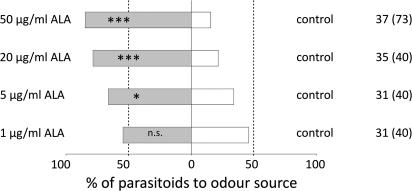
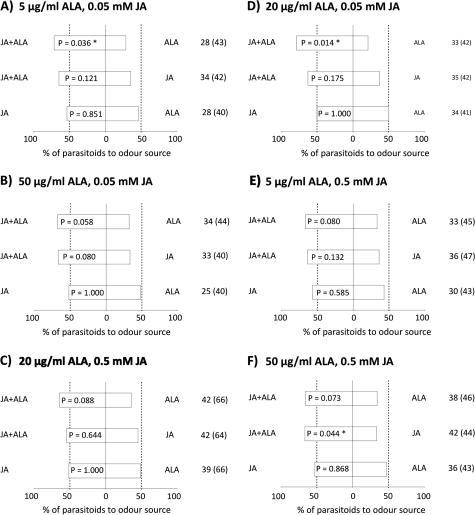
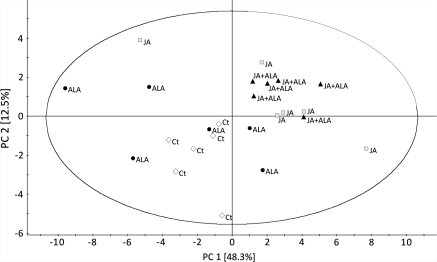
The induction of plant defences involves a sequence of steps along a signal transduction pathway, varying in time course. In this study, the effects of induction of an early and a later step in plant defence signal transduction on plant volatile emission and parasitoid attraction are compared. Ion channel-forming peptides represent a class of inducers that induce an early step in signal transduction. Alamethicin (ALA) is an ion channel-forming peptide mixture from the fungus Trichoderma viride that can induce volatile emission and increase endogenous levels of jasmonic acid (JA) and salicylic acid in plants. ALA was used to induce an early step in the defence response in Brussels sprouts plants, Brassica oleracea var. gemmifera, and to study the effect on volatile emission and on the behavioural response of parasitoids to volatile emission. The parasitoid Cotesia glomerata was attracted to ALA-treated plants in a dose-dependent manner. JA, produced through the octadecanoid pathway, activates a later step in induced plant defence signal transduction, and JA also induces volatiles that are attractive to parasitoids. Treatment with ALA and JA resulted in distinct volatile blends, and both blends differed from the volatile blends emitted by control plants. Even though JA treatment of Brussels sprouts plants resulted in higher levels of volatile emission, ALA-treated plants were as attractive to C. glomerata as JA-treated plants. This demonstrates that on a molar basis, ALA is a 20 times more potent inducer of indirect plant defence than JA, although this hormone has more commonly been used as a chemical inducer of plant defence.
Figures

Comment in
-
Emerging complexity: jasmonate-induced volatiles affect parasitoid choice.J Exp Bot. 2009;60(9):2451-3. doi: 10.1093/jxb/erp197. Epub 2009 Jun 4. J Exp Bot. 2009. PMID: 19498010 No abstract available.
References
-
- Agrawal AA. Induced responses to herbivory and increased plant performance. Science. 1998;279:1201–1202. - PubMed
-
- Arimura GI, Kost C, Boland W. Herbivore-induced, indirect plant defences. Biochimica et Biophysica Acta. 2005;1734:91–111. - PubMed
-
- Arimura GI, Ozawa R, Kugimiya S, Takabayashi J, Bohlmann J. Herbivore-induced defense response in a model legume. Two-spotted spider mites induce emission of (E)-β-ocimene and transcript accumulation of (E)-beta-ocimene synthase in Lotus japonicus. Plant Physiology. 2004;135:1976–1983. - PMC - PubMed
-
- Blaakmeer A, Geervliet JBF, Van Loon JJA, Posthumus MA, Van Beek TA, De Groot A. Comparative headspace analysis of cabbage plants damaged by two species of Pieris caterpillars: consequences for in-flight host location by Cotesia parasitoids. Entomologia Experimentalis et Applicata. 1994;73:175–182.
