


Cutting edge: Highly alloreactive dual TCR T cells play a dominant role in graft-versus-host disease
- PMID: 19454656
- PMCID: PMC3196624
- DOI: 10.4049/jimmunol.0900638
Cutting edge: Highly alloreactive dual TCR T cells play a dominant role in graft-versus-host disease
Abstract
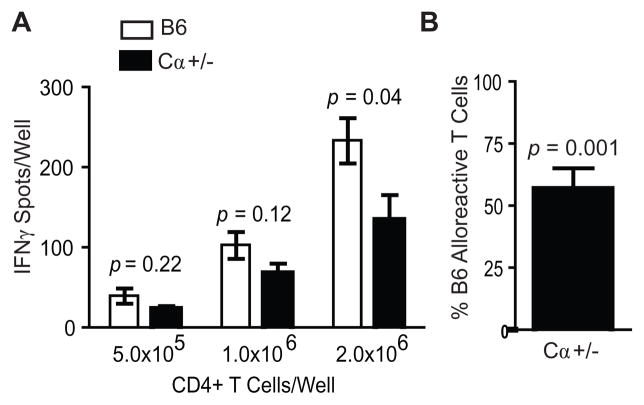
Alloreactivity is the response of T cells to MHC molecules not encountered during thymic development. A small population (1-8%) of peripheral T cells in mice and humans express two TCRs due to incomplete allelic exclusion of TCRalpha, and we hypothesized they are highly alloreactive. FACS analysis of mouse T cell MLR revealed increased dual TCR T cells among alloreactive cells. Quantitative assessment of the alloreactive repertoire demonstrated a nearly 50% reduction in alloreactive T cell frequency among T cells incapable of expressing a secondary TCR. We directly demonstrated expansion of the alloreactive T cell repertoire at the single cell level by identifying a dual TCR T cell with distinct alloreactivities for each TCR. The importance of dual TCR T cells is clearly demonstrated in a parent-into-F(1) model of graft-vs-host disease, where dual TCR T cells comprised up to 60% of peripheral activated T cells, demonstrating a disproportionate contribution to disease.
Figures



References
-
- Zerrahn J, Held W, Raulet DH. The MHC reactivity of the T cell repertoire prior to positive and negative selection. Cell. 1997;88:627–636. - PubMed
-
- Huseby ES, White J, Crawford F, Vass T, Becker D, Pinilla C, Marrack P, Kappler JW. How the T cell repertoire becomes peptide and MHC specific. Cell. 2005;122:247–260. - PubMed
-
- Bevan M. High determinant density may explain the phenomenon of alloreactivity. Immunol Today. 1984;5:128–130. - PubMed
-
- Ignatowicz L, Kappler J, Marrack P. The repertoire of T cells shaped by a single MHC/peptide ligand. Cell. 1996;84:521–529. - PubMed
-
- Felix NJ, Donermeyer DL, Horvath S, Walters JJ, Gross ML, Suri A, Allen PM. Alloreactive T cells respond specifically to multiple distinct peptide-MHC complexes. Nat Immunol. 2007;8:388–397. - PubMed
Publication types
MeSH terms
Substances
Grants and funding
LinkOut - more resources
Full Text Sources
Other Literature Sources
Research Materials
