


PIRSF family classification system for protein functional and evolutionary analysis
- PMID: 19455212
- PMCID: PMC2674652
PIRSF family classification system for protein functional and evolutionary analysis
Abstract
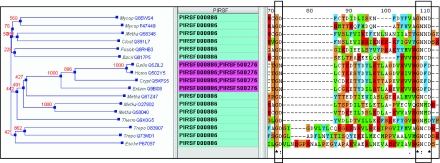
The PIRSF protein classification system (http://pir.georgetown.edu/pirsf/) reflects evolutionary relationships of full-length proteins and domains. The primary PIRSF classification unit is the homeomorphic family, whose members are both homologous (evolved from a common ancestor) and homeomorphic (sharing full-length sequence similarity and a common domain architecture). PIRSF families are curated systematically based on literature review and integrative sequence and functional analysis, including sequence and structure similarity, domain architecture, functional association, genome context, and phyletic pattern. The results of classification and expert annotation are summarized in PIRSF family reports with graphical viewers for taxonomic distribution, domain architecture, family hierarchy, and multiple alignment and phylogenetic tree. The PIRSF system provides a comprehensive resource for bioinformatics analysis and comparative studies of protein function and evolution. Domain or fold-based searches allow identification of evolutionarily related protein families sharing domains or structural folds. Functional convergence and functional divergence are revealed by the relationships between protein classification and curated family functions. The taxonomic distribution allows the identification of lineage-specific or broadly conserved protein families and can reveal horizontal gene transfer. Here we demonstrate, with illustrative examples, how to use the web-based PIRSF system as a tool for functional and evolutionary studies of protein families.
Keywords: Domain architecture; Functional convergence; Functional divergence; Genome context; Protein family classification; Taxonomic distribution.
Figures




References
-
- Aravind L, Mazumder R, Vasudevan S, et al. Trends in protein evolution inferred from sequence and structure analysis. Curr Opin Struct Biol. 2002;12:392–9. - PubMed
-
- Ausmees N, Mayer R, Weinhouse H, et al. Genetic data indicate that proteins containing the GGDEF domain possess diguanylate cyclase activity. FEMS Microbiol Lett. 2001;204:163–7. - PubMed
Grants and funding
LinkOut - more resources
Full Text Sources
Other Literature Sources
Molecular Biology Databases