


Waiting for total knee replacement surgery: factors associated with pain, stiffness, function and quality of life
- PMID: 19457252
- PMCID: PMC2694153
- DOI: 10.1186/1471-2474-10-52
Waiting for total knee replacement surgery: factors associated with pain, stiffness, function and quality of life
Abstract
Background: Recent evidences show that education and rehabilitation while waiting for knee replacement have positive effects on the patients' health status. Identification of factors associated with worse pain, function and health-related quality of life (HRQoL) while waiting for surgery could help develop pre-surgery rehabilitation interventions that target specifically these factors and prioritize patients that may benefit the most from them. The objectives of this study were to measure pain, stiffness, function and HRQoL in patients at enrolment on waiting lists for knee replacement and to identify demographic, clinical, socioeconomic and psychosocial characteristics associated with these outcomes.
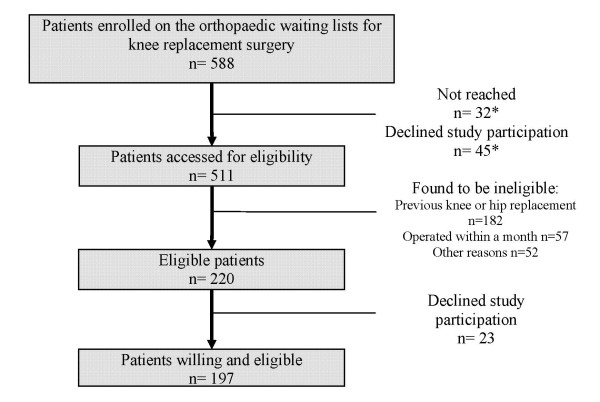
Methods: This study is part of a broader study measuring the effects of pre-surgery wait in patients scheduled for knee replacement. From 02/2006 to 09/2007, 197 patients newly scheduled for total knee replacement were recruited from the waiting lists of three university hospitals in Quebec City, Canada. Pain, stiffness and function were measured with the Western Ontario and McMaster Osteoarthritis Index (WOMAC) and HRQoL was measured with the SF-36 Health Survey. Stepwise multiple regression analysis was used to assess the strength of the associations between the independent variables and the WOMAC and SF-36 scores.
Results: The scores of all eight HRQoL physical and mental domains of the SF-36 were significantly lower than aged matched Canadian normative data (p < 0.05). Contralateral knee pain, higher psychological distress, higher body mass index (BMI) and the use of a walking aid were significantly associated with worse function (p < 0.05) and contributed to 22% of the variance of the WOMAC function score (multiple r = 0.47). A higher BMI, the use of a walking aid, contralateral knee pain and advanced age were significantly associated with worse physical function (p < 0.05) and contributed to 17% of the variance of the SF-36 HRQoL physical functioning score (multiple r = 0.41).
Conclusion: Patients waiting for knee replacement have poor function and HRQoL. Characteristics that were found to be associated with these outcomes could help develop pre-surgery rehabilitation program and prioritize patients that may benefit the most from them. Such programs could include interventions to reduce psychological distress, therapeutic exercises targeting both knees and weight loss management.
Figures
References
-
- The Canadian Institute for Health Information . Canadian Joint Replacement Registry (CJRR) 2007 Annual Report: Hip and Total Knee Replacements in Canada. Ottawa, Ont: CIHI; 2008.
-
- The Canadian Institute for Health Information . Surgical Volume Trends, 2008 – Within and Beyond Wait Time Priority Areas. Ottawa, Ont: CIHI; 2008.
-
- Noseworthy T, Sanmartin C, Bohm E, Conner-Spady B, DeCoster C, Dumbar M, Lorenzetti D, McLaren L, McGurran J. Towards establishing evidence-based benchmarks for acceptable waiting times for joint replacement surgery-Report 2. Calgary: University of Calgary; 2005. p. 56.
Publication types
MeSH terms
LinkOut - more resources
Full Text Sources
Medical
