


Modulation of human immunodeficiency virus type 1 protease autoprocessing by charge properties of surface residue 69
- PMID: 19457992
- PMCID: PMC2708634
- DOI: 10.1128/JVI.00473-09
Modulation of human immunodeficiency virus type 1 protease autoprocessing by charge properties of surface residue 69
Abstract
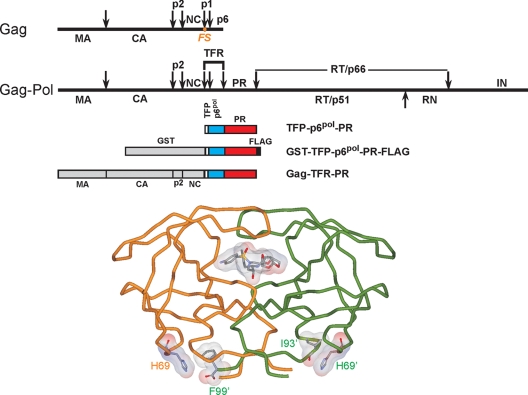
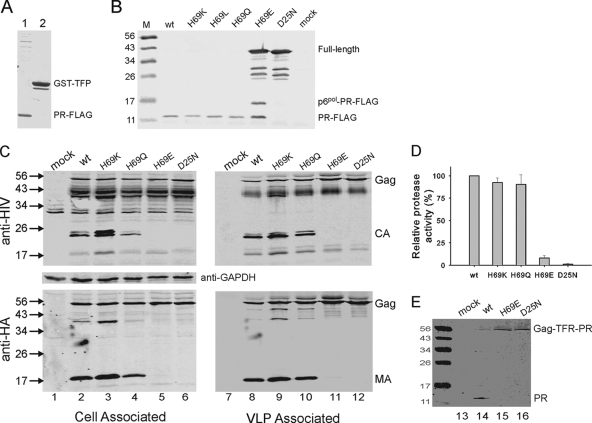
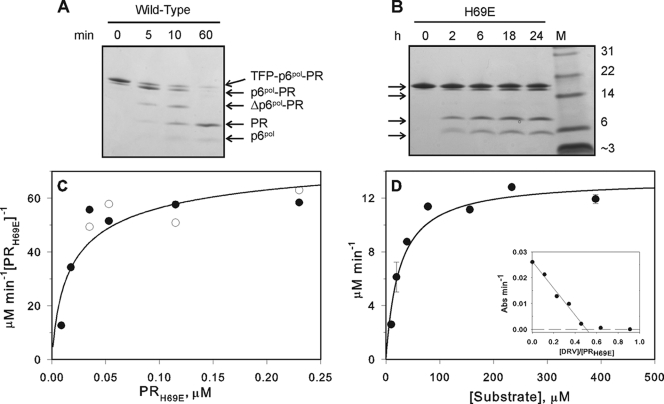
Mature, fully active human immunodeficiency virus protease (PR) is liberated from the Gag-Pol precursor via regulated autoprocessing. A chimeric protease precursor, glutathione S-transferase-transframe region (TFR)-PR-FLAG, also undergoes N-terminal autocatalytic maturation when it is expressed in Escherichia coli. Mutation of the surface residue H69 to glutamic acid, but not to several neutral or basic amino acids, impedes protease autoprocessing in bacteria and mammalian cells. Only a fraction of mature PR with an H69E mutation (PR(H69E)) folds into active enzymes, and it does so with an apparent Kd (dissociation constant) significantly higher than that of the wild-type protease, corroborating the marked retardation of the in vitro N-terminal autocatalytic processing of TFR-PR(H69E) and suggesting a folding defect in the precursor.
Figures
References
-
- Barre-Sinoussi, F., J. C. Chermann, F. Rey, M. T. Nugeyre, S. Chamaret, J. Gruest, C. Dauguet, C. Axler-Blin, F. Vezinet-Brun, C. Rouzioux, W. Rozenbaum, and L. Montagnier. 1983. Isolation of a T-lymphotropic retrovirus from a patient at risk for acquired immune deficiency syndrome (AIDS). Science 220868-871. - PubMed
-
- Cherry, E., C. Liang, L. Rong, Y. Quan, P. Inouye, X. Li, N. Morin, M. Kotler, and M. A. Wainberg. 1998. Characterization of human immunodeficiency virus type-1 (HIV-1) particles that express protease-reverse transcriptase fusion proteins. J. Mol. Biol. 28443-56. - PubMed
Publication types
MeSH terms
Substances
Grants and funding
LinkOut - more resources
Full Text Sources
Research Materials
