. 2009 Sep;50(9):4509-15.
doi: 10.1167/iovs.08-2916. Epub 2009 May 20.

Collision judgment when using an augmented-vision head-mounted display device

Affiliations

Collision judgment when using an augmented-vision head-mounted display device

Gang Luo et al. Invest Ophthalmol Vis Sci. 2009 Sep.

Abstract

Purpose: A device was developed to provide an expanded visual field to patients with tunnel vision by superimposing minified edge images of the wide scene, in which objects appear closer to the heading direction than they really are. Experiments were conducted in a virtual environment to determine whether users would overestimate collision risks.

Methods: Given simulated scenes of walking or standing with intention to walk toward a given direction (intended walking) in a shopping mall corridor, participants (12 normally sighted and 7 with tunnel vision) reported whether they would collide with obstacles appearing at different offsets from variable walking paths (or intended directions), with and without the device. The collision envelope (CE), a personal space based on perceived collision judgments, and judgment uncertainty (variability of response) were measured. When the device was used, combinations of two image scales (5x minified and 1:1) and two image types (grayscale or edge images) were tested.

Results: Image type did not significantly alter collision judgment (P > 0.7). Compared to the without-device baseline, minification did not significantly change the CE of normally sighted subjects for simulated walking (P = 0.12), but increased CE by 30% for intended walking (P < 0.001). Their uncertainty was not affected by minification (P > 0.25). For the patients, neither CE nor uncertainty was affected by minification (P > 0.13) in both walking conditions. Baseline CE and uncertainty were greater for patients than normally sighted subjects in simulated walking (P = 0.03), but the two groups were not significantly different in all other conditions.

Conclusions: Users did not substantially overestimate collision risk, as the x5 minified images had only limited impact on collision judgments either during walking or before starting to walk.


Figures
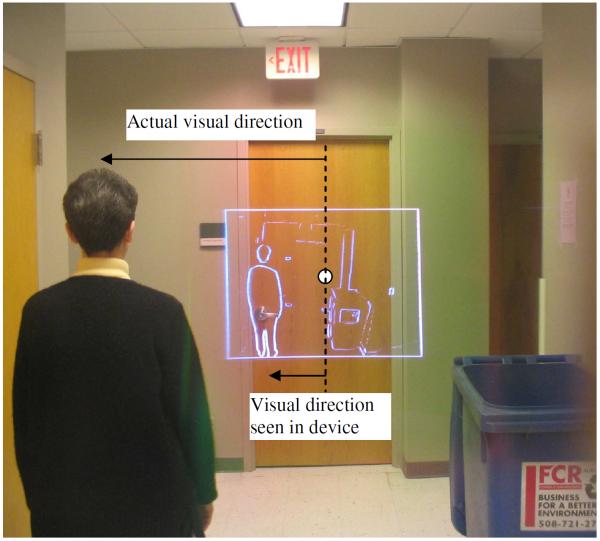
Figure 1
Figure 1
A photograph captured through an augmented-vision HMD spectacle lens. From the superimposed edge image (16°×12°), a patient with tunnel vision looking ahead can detect the woman and the trash bin that otherwise would not be seen. Note the presented visual directions of these potential obstacles may be much closer to current gaze point (marked by a white circle) than they really are.
Figure 2
Figure 2
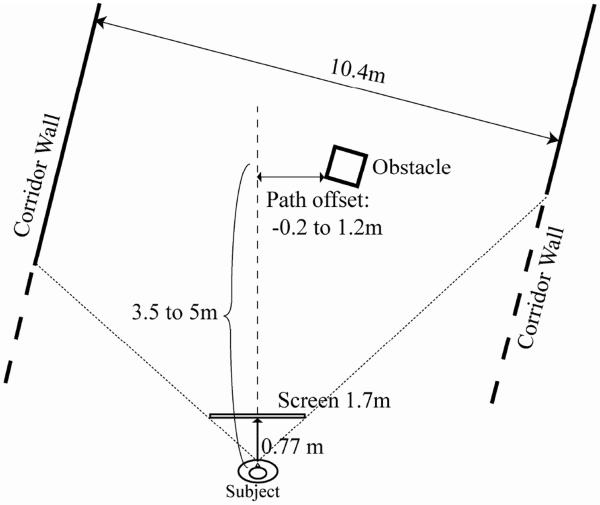
Illustration of the experimental layout for one trial. Participants “walked” or “intended to walk” a zig-zag path in a virtual shopping mall corridor. Each trial consisted of one straight segment of the path. Obstacles appeared at variable offsets from the walking path. Participants reported whether they would make contact with the obstacles if they continued walking in the same direction (simulated-walk experiment), or were going to walk towards a marked direction (intended-walk experiment).
Figure 3
Figure 3
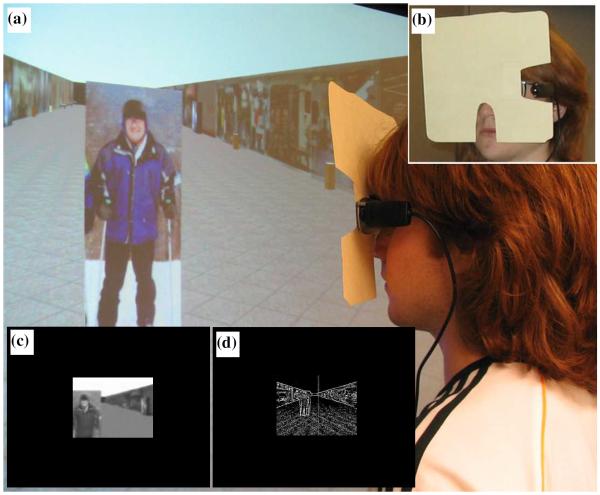
(a) A participant wearing the augmented-vision device. (b) The see-through view of both eyes was blocked when using the device and the camera was exposed through the cut out. (c) A typical view in the simulated-walk experiment when using the device in 1:1 grayscale image mode. Note the limited field of view (16°×12°). (d) View in the intended-walk experiment when using the device in its minified edge image mode. Note the vertical line indicating the intended direction of heading. The field of view of the device was 16°×12°.
Figure 4
Figure 4
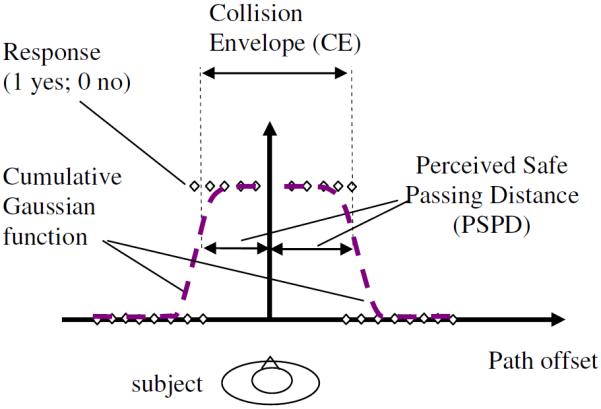
Illustration of the calculation of perceived safe passing distance (PSPD) and collision envelope (CE) based on participants' collision judgment responses. Cumulative Gaussian functions were fitted to the response data separately for the right and left obstacles. CE is the sum of PSPD for both sides.
Figure 5
Figure 5
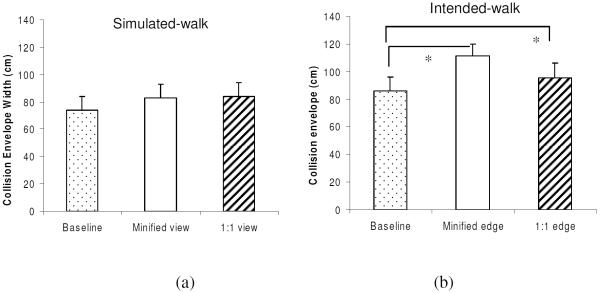
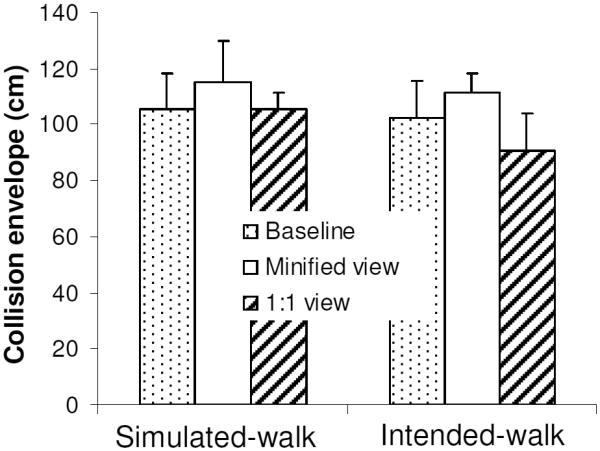
The CE of normally-sighted subjects without the augmented-vision device (baseline) and with the device in 5× minified and natural scales. (a) Simulated-walk experiment (n=12): Image type had no effect, so data for edge and grayscale images were combined here. CE with the device was not significantly different from that without it. (b) Intended-walk experiment (n=12): CE when using the device in minified edge-image mode significantly increased by 30%, and in 1:1 scaled edge-image mode increased by 11% compared to baseline. Error bars are standard error of the mean.
Figure 6
Figure 6
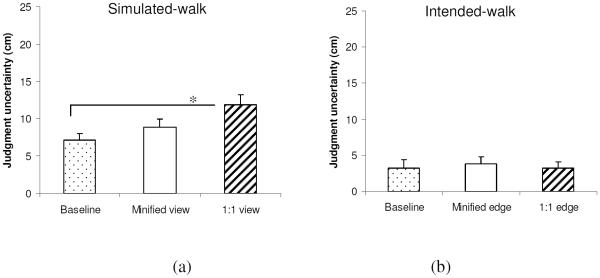
Judgment uncertainty of normally sighted subjects with and without the augmented-vision device in the (a) simulated-walk (n=12) and (b) intended-walk experiments (n=12). A lower the value indicates a more consistent collision judgment. The only significant change from baseline was the 4.8 cm uncertainty increase when using the device in the natural scale mode in the simulated-walk experiment. Overall, the judgment uncertainty was significantly lower in the intended-walk experiment than in the simulated-walk experiment. Error bars are standard error of mean.
Figure 7
Figure 7
CE of the tunnel-vision patients (n=7) without using the augmented-vision device (baseline) and with the device in minified or natural scales. CE based on minified edge images was not significantly different from the baseline in either the simulated-walk or the intended-walk experiment. Error bars are standard error of mean.
Figure 8
Figure 8
Judgment uncertainty of the tunnel-vision patients (n=7) with and without the augmented-vision device in the simulated-walk and intended-walk experiments. The uncertainty was significantly larger in the simulated-walk than in the intended-walk experiment. Error bars are standard error of mean.
Figure 9
Figure 9
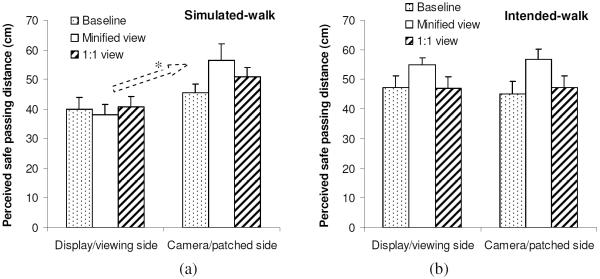
Perceived safe passing distance (PSPD) of all subjects in the (a) simulated-walk (n=19) and (b) intended-walk experiments (n=19). PSPD was asymmetric in the simulated-walk experiment but not in the intended-walk experiment. PSPD was not different between left and right eyes used in either experiment. Error bars are standard error of mean.
Figure 10
Figure 10
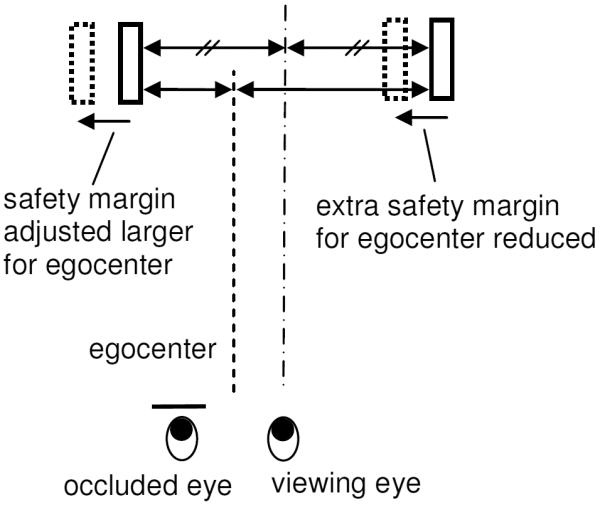
Explanation of the asymmetric PSPD in the simulated-walk experiment. The solid-line rectangles represent two obstacles at equal path offset for the viewing eye (dot-dash line). Since the obstacle on the occluded eye side is actually closer to the egocenter (shown as a dashed line), the participant might require a larger safety margin to this side. Similarly, the safety margin on the viewing eye side may be reduced, as the obstacle on this side is further from the egocenter. Thus, obstacles with a symmetric path offset for the egocenter (illustrated by the dotted-line rectangles) appear asymmetric from the viewing eye.

References

    1. Szlyk JP, Fishman GA, Alexander KR, Revelins BI, Derlacki DJ, Anderson RJ. Relationship between difficulty in performing daily activities and clinical measures of visual function in patients with retinitis pigmentosa. Arch Ophthalmol. 1997;115:53–59. - PubMed
    1. Turano KA, Geruschat DR, Stahl JW, Massof RW. Perceived visual ability for independent mobility in persons with retinitis pigmentosa. Invest Ophthalmol Vis Sci. 1999;40:865–877. - PubMed
    1. Turano KA, Rubin GS, Quigley HA. Mobility performance in glaucoma. Invest Ophthalmol Vis Sci. 1999;40:2803–2809. - PubMed
    1. Noe G, Ferraro J, Lamoureux E, Rait J, Keeffe JE. Associations between glaucomatous visual field loss and participation in activities of daily living. Clin Exp Ophthalmol. 2003;31:482–486. - PubMed
    1. Kozlowski JM, Jalkh AE. An improved negative-lens field expander for patients with concentric field constriction. Am J Optom Physiol Opt. 1985;103:326. - PubMed

Publication types

MeSH terms