. 2009 Nov;104(6):695-706.
doi: 10.1007/s00395-009-0036-0. Epub 2009 May 21.

Prevention of vasa vasorum neovascularization attenuates early neointima formation in experimental hypercholesterolemia

Affiliations

Prevention of vasa vasorum neovascularization attenuates early neointima formation in experimental hypercholesterolemia

Mario Gössl et al. Basic Res Cardiol. 2009 Nov.

Abstract

Vasa vasorum (VV) neovascularization is a key feature of early atherosclerosis and adds substantial endothelial exchange-surface to the coronary vessel wall. Thus, it is conceivable that VV neovascularization favors the entry of pro-inflammatory and pro-atherosclerotic blood components into the coronary vessel wall. We sought to investigate the effects of Thalidomide (Th), a potent anti-angiogenic drug on vasa vasorum (VV) neovascularization, vessel wall inflammation, and neointima formation in early experimental atherosclerosis. Female domestic swine, 3 months old, were fed normal (N, n = 12) or high-cholesterol diet (HC, n = 12) for 3 months. In each group six pigs were randomized to 200 mg Thalidomide daily for the diet period (N + Th, HC + Th). LADs were scanned with micro-CT (20 microm cubic voxel size) to determine VV spatial density (#/mm2). Fresh-frozen coronary tissue was used for western blotting (VEGF, TNF-alpha, LOX-1, Ikappabetaalpha and Gro-alpha) and electrophoretic mobility shift assay (EMSA, NFkappabeta). Treatment with Thalidomide preserved VV spatial density [2.7 +/- 0.3 (N), 6.4 +/- 0.7 (HC), 3.5 +/- 0.8 (HC + Th); p = ns HC + Th vs. N] and inhibited the expression of VEGF, TNF-alpha and LOX-1, but not NFkappabeta activity in the coronary vessel wall. Immunofluorescence analyses revealed co-localization of vWF but not SMA and NFkappabeta, TNF-alpha as well as VEGF in HC and HC + Th coronaries. Intima-media thickness was significantly inhibited in HC + Th compared to HC. Serum levels of hs-CRP and TNF-alpha did not differ among the groups. Our study supports a role of VV neovascularization in the development of and a therapeutic potential for anti-angiogenic intervention in early atherosclerosis.


Figures
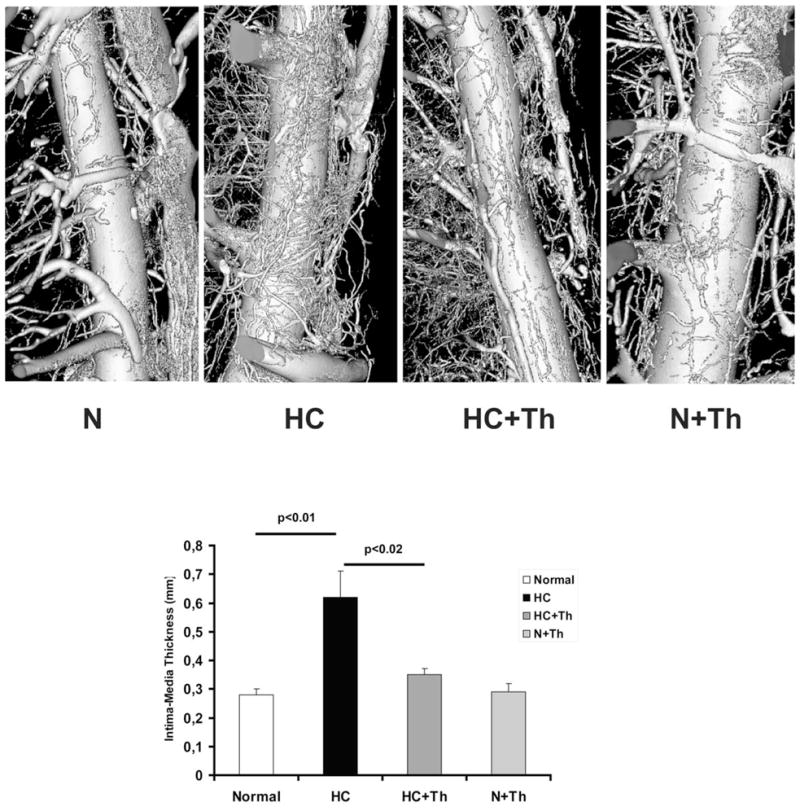
Figure 1
Figure 1
Upper panel: Volume rendered micro-CT images of coronary arteries and their vasa vasorum. Coronaries from hypercholesterolemic (HC) animals exhibit significant vasa vasorum neovascularization in comparison to coronaries from normal (N) and Thalidomide treated animals (HC+Th and N+Th). The lower panel shows a bar graph of the histologically quantified intima-media thickening in all four groups. Chronic administration of Thalidomide prevented intima-media thickening in the hypercholesterolemic animals.
Figure 2
Figure 2
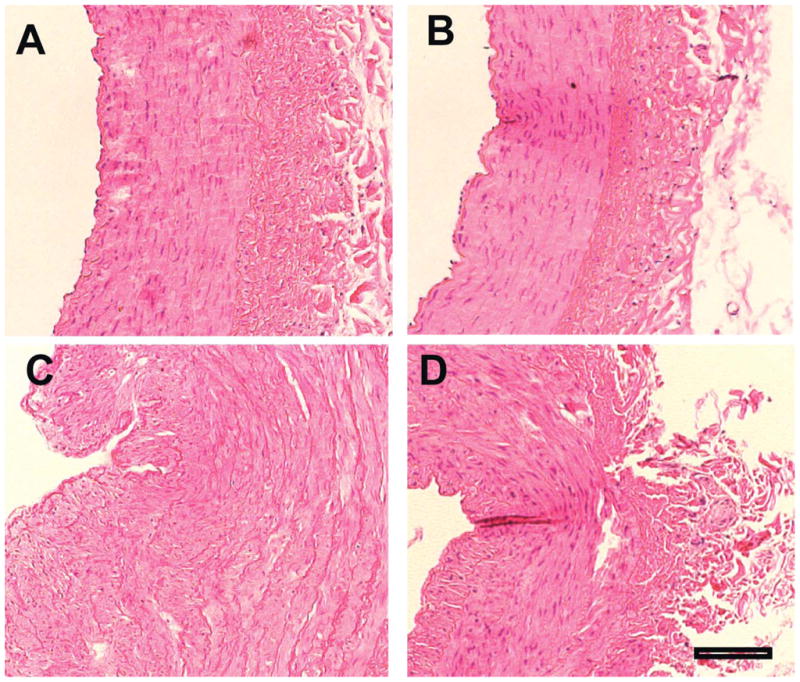
Histology (H&E stains, representative examples from each study group). A. Normal, B. Normal + Thalidomide, C. Hypercholesterolemia, D. Hypercholesterolemia plus Thalidomide. Treatment with Thalidomide significantly inhibited intima-media thickening in hypercholesterolemic coronary arteries (D) compared to animals on hypercholesterolemic diet alone (C). Scale: 100μm.
Figure 3
Figure 3
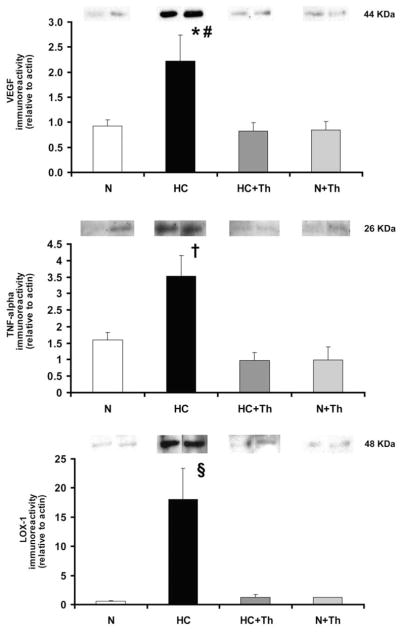
Western blot analysis of the local expression of VEGF, TNF- α , and the receptor of oxidized LDL (LOX-1) in coronary artery tissue. Thalidomide treatment significantly decreased the expression of VEGF (top panel) and TNF-α (mid panel) in the coronary vessel wall. In addition, the expression of the LOX-1 receptor was significantly blunted (bottom panel). * p<0.05 vs. N, # p< 0.02 vs. HC+Th/N+Th (in upper panel), † p<0.001 vs. N and HC+Th/N+Th (in mid panel), § p<0.01 vs. N and HC+Th/N+Th (in lower panel).
Figure 4
Figure 4
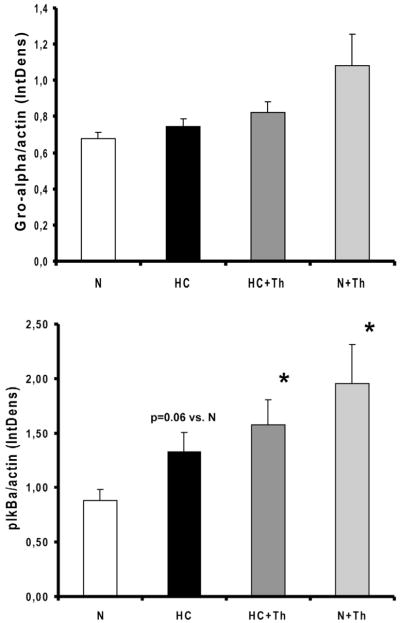
Upper panel. Western Blot analysis of phosphorylated inhibitory kappB kinase-alpha (IkB-alpha, n=4 in all groups) showed increased expression in HC, HC+Th and N+Th animals (* p<0.05). Lower panel. Western Blot analysis of growth related oncogene protein-alpha (Gro-alpha, n=4 in N, HC and N+Th and n=5 in HC+Th) demonstrated no significant differences between all groups (N vs. N+Th, p=0.06).
Figure 5
Figure 5
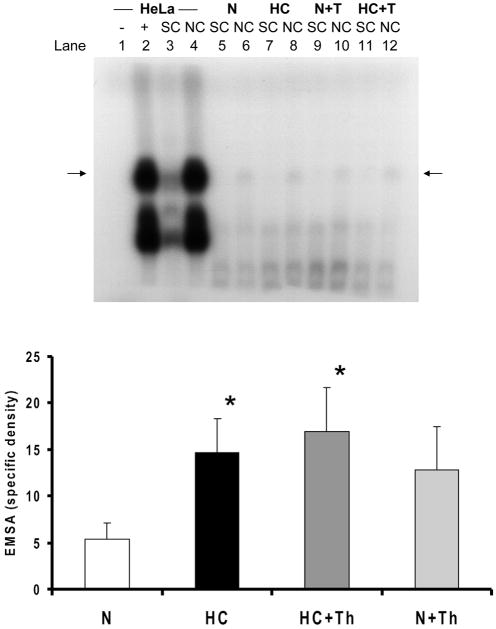
Upper panel shows a representative electrophoretic mobility shift assay (EMSA) for NFkB on HeLa cells (first 3 lanes, lane 1 without tissue) and coronary artery samples (lanes 5–12, SC = specific competitor, NS = non-specific competitor). Lower panel highlights the quantitative results as the difference between non-specific and specific competitor. Compared with normal controls (N), nuclear translocation of NFkB is increased in coronary arteries from animals on a high-cholesterol diet without (HC) or with thalidomide treatment (HC+T) for 12 weeks as well as in animals on a normal diet with thalidomide treatment (N+T) for 12 weeks (*p<0.05 vs. N).
Figure 6
Figure 6
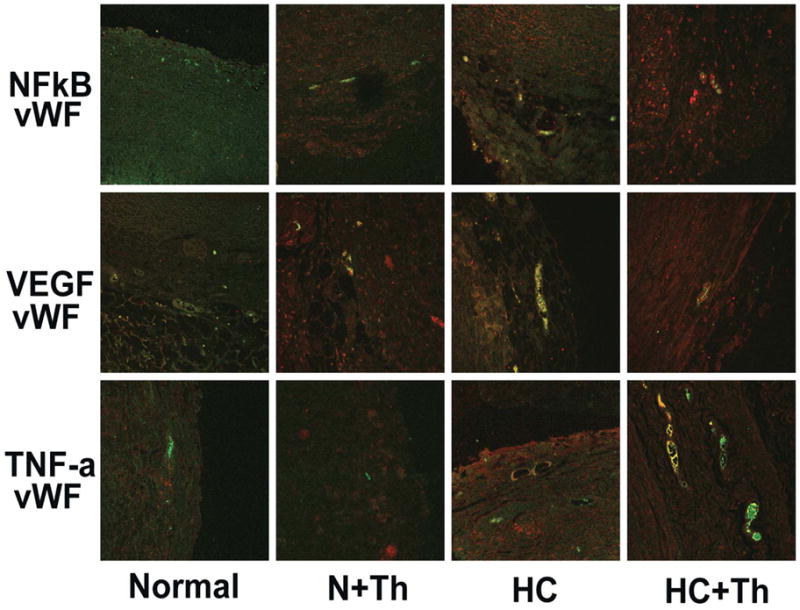
Co-localization of NFkB p65, VEGF and TNF-α with vWF. A, D, G are NFkB p65, VEGF, and TNF-α, respectively. B, E, and H are vWF. C, F, I are overlays of A and B, D and E, and G and H. Scale: 50μm.
Figure 7
Figure 7
Co-localization of each NFkB, VEGF and TNF-α with vWF. Except for VEGF-vWF in the N+Th group there was no further co-localization found in the N and N+Th groups. Both HC and HC+Th groups showed co-localization of all four markers.

References

    1. Aydogan S, Celiker U, Turkcuoglu P, Ilhan N, Akpolat N. The effect of thalidomide on vascular endothelial growth factor and tumor necrosis factor-alpha levels in retinal ischemia/reperfusion injury. Graefes Arch Clin Exp Ophthalmol. 2008;246:363–368. - PubMed
    1. Caunt M, Hu L, Tang T, Brooks PC, Ibrahim S, Karpatkin S. Growth-regulated oncogene is pivotal in thrombin-induced angiogenesis. Cancer Res. 2006;66:4125–4132. - PubMed
    1. Chade AR, Best PJ, Rodriguez-Porcel M, Herrmann J, Zhu X, Sawamura T, Napoli C, Lerman A, Lerman LO. Endothelin-1 receptor blockade prevents renal injury in experimental hypercholesterolemia. Kidney Int. 2003;64:962–969. - PubMed
    1. Chew M, Zhou J, Daugherty A, Eriksson T, Ellermann-Eriksen S, Hansen PR, Falk E. Thalidomide inhibits early atherogenesis in apoE-deficient mice. APMIS. 2003;(Suppl):113–116. - PubMed
    1. D'Amato RJ, Loughnan MS, Flynn E, Folkman J. Thalidomide is an inhibitor of angiogenesis. Proc Natl Acad Sci U S A. 1994;91:4082–4085. - PMC - PubMed

Publication types

MeSH terms