


Hepatic P450 enzyme activity, tissue morphology and histology of mink (Mustela vison) exposed to polychlorinated dibenzofurans
- PMID: 19458992
- PMCID: PMC2700875
- DOI: 10.1007/s00244-008-9241-3
Hepatic P450 enzyme activity, tissue morphology and histology of mink (Mustela vison) exposed to polychlorinated dibenzofurans
Abstract
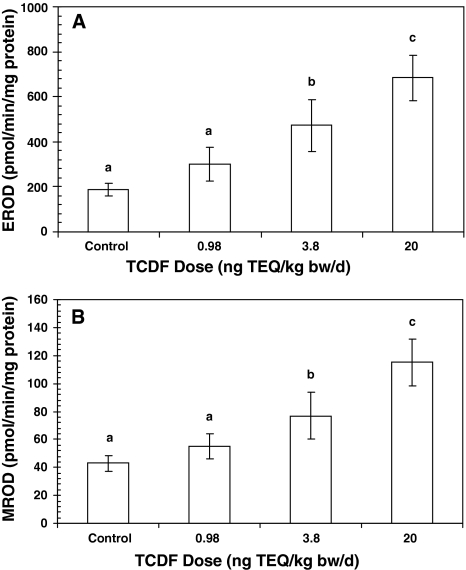
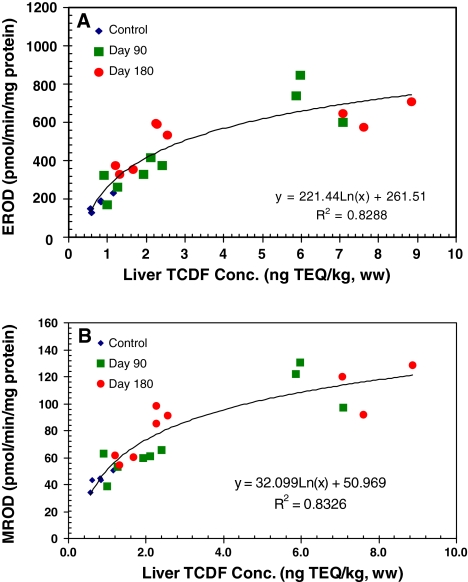
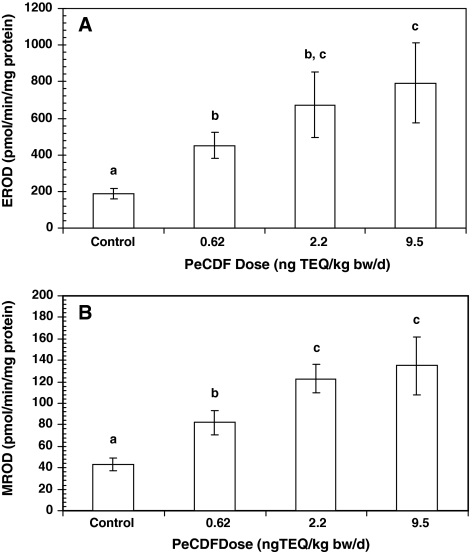
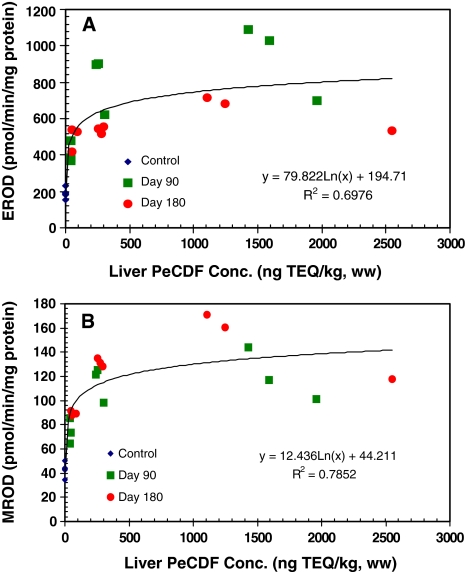
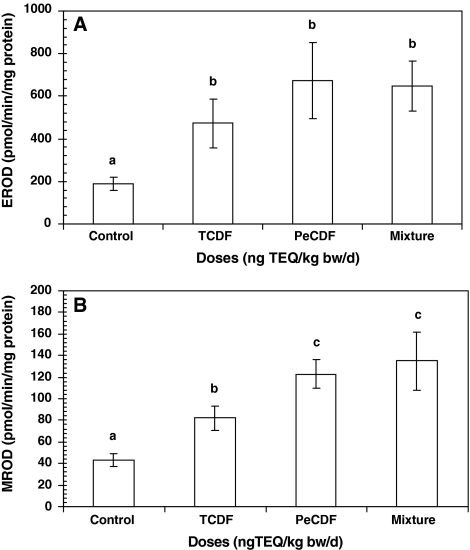
Dose- and time-dependent effects of environmentally relevant concentrations of 2,3,7,8-tetrachlorodibenzo-p-dioxin equivalents (TEQ) of 2,3,7,8-tetrachlorodibenzofuran (TCDF), 2,3,4,7,8-pentachlorodibenzofuran (PeCDF), or a mixture of these two congeners on hepatic P450 enzyme activity and tissue morphology, including jaw histology, of adult ranch mink were determined under controlled conditions. Adult female ranch mink were fed either TCDF (0.98, 3.8, or 20 ng TEQ(TCDF)/kg bw/day) or PeCDF (0.62, 2.2, or 9.5 ng TEQ(PeCDF)/kg bw/day), or a mixture of TCDF and PeCDF (4.1 ng TEQ(TCDF)/kg bw/day and 2.8 ng TEQ(PeCDF)/kg bw/day, respectively) for 180 days. Doses used in this study were approximately eight times greater than those reported in a parallel field study. Activities of the cytochrome P450 1A enzymes, ethoxyresorufin O-deethylase (EROD) and methoxyresorufin O-deethylase (MROD) were significantly greater in livers of mink exposed to TCDF, PeCDF, and a mixture of the two congeners; however, there were no significant histological or morphological effects observed. It was determined that EROD and MROD activity can be used as sensitive biomarkers of exposure to PeCDF and TCDF in adult female mink; however, under the conditions of this study, the response of EROD/MROD induction occurred at doses that were less than those required to cause histological or morphological changes.
Figures

References
-
- {'text': '', 'ref_index': 1, 'ids': [{'type': 'DOI', 'value': '10.1016/j.envres.2006.04.005', 'is_inner': False, 'url': 'https://doi.org/10.1016/j.envres.2006.04.005'}, {'type': 'PubMed', 'value': '16716289', 'is_inner': True, 'url': 'https://pubmed.ncbi.nlm.nih.gov/16716289/'}]}
- Basu N, Scheuhammer AM, Bursian SJ, Elliott J, Rouvinen-Watt K, Chan HM (2007) Mink as a sentinel species in environmental health. Environ Res 103:130–144. doi:10.1016/j.envres.2006.04.005 - PubMed
-
- {'text': '', 'ref_index': 1, 'ids': [{'type': 'DOI', 'value': '10.1897/04-241R.1', 'is_inner': False, 'url': 'https://doi.org/10.1897/04-241r.1'}, {'type': 'PubMed', 'value': '15779768', 'is_inner': True, 'url': 'https://pubmed.ncbi.nlm.nih.gov/15779768/'}]}
- Beckett KJ, Millsap SD, Blankenship AL, Zwiernik MJ, Giesy JP, Bursian SJ (2005) Squamous epithelial lesion of the mandibles and maxillae of wild mink (Mustela vison) naturally exposed to polychlorinated biphenyls. Environ Toxicol Chem 24:674–677. doi:10.1897/04-241R.1 - PubMed
-
- {'text': '', 'ref_index': 1, 'ids': [{'type': 'DOI', 'value': '10.1007/s00244-007-9002-8', 'is_inner': False, 'url': 'https://doi.org/10.1007/s00244-007-9002-8'}, {'type': 'PubMed', 'value': '17674079', 'is_inner': True, 'url': 'https://pubmed.ncbi.nlm.nih.gov/17674079/'}]}
- Beckett KJ, Yamini B, Bursian SJ (2008) The effects of 3,3′,4,4′5-pentachlorobiphenyl (PCB 126) on mink (Mustela vison) reproduction and kit survivability and growth. Arch Environ Contam Toxicol 54:123–129. doi:10.1007/s00244-007-9002-8 - PubMed
-
- {'text': '', 'ref_index': 1, 'ids': [{'type': 'DOI', 'value': '10.1016/j.ecoenv.2007.08.017', 'is_inner': False, 'url': 'https://doi.org/10.1016/j.ecoenv.2007.08.017'}, {'type': 'PubMed', 'value': '18054078', 'is_inner': True, 'url': 'https://pubmed.ncbi.nlm.nih.gov/18054078/'}]}
- Blankenship AL, Kay DP, Zwiernik MJ et al (2008) Toxicity reference values for mink exposed to 2,3,7,8-tetrachlorodibenzo-p-dioxin. Ecotoxicol Environ Safety 69:325–349. doi:10.1016/j.ecoenv.2007.08.017 - PubMed
-
- None
- Brewster DW, Birnbaum LS (1987) 2,3,4,7,8-Pentachlorodibenzofuran (PCDF): toxicokinetics and metabolism in the rat. Environ Health Perspect 75:147–148
Publication types
MeSH terms
Substances
LinkOut - more resources
Full Text Sources
