


Case Reports
doi: 10.1111/j.1540-8167.2009.01485.x.
Epub 2009 May 4.
Alternating cycle length during supraventricular tachycardia: what is the mechanism?
Affiliations
- PMID: 19460077
- PMCID: PMC3073145
- DOI: 10.1111/j.1540-8167.2009.01485.x
Item in Clipboard
Case Reports
Alternating cycle length during supraventricular tachycardia: what is the mechanism?
J Cardiovasc Electrophysiol.
2009 Sep.
No abstract available
Figures

Intracardiac tracings of a regularly irregular narrow-complex tachycardia with QRS alternans and cycle length alternans. Cycle length variability results from alternating VA intervals. HIS = His bundle catheter; P = proximal; D = distal; CS = coronary sinus catheter.

Diagnostic maneuver performed during tachycardia. During an attempt to entrain the tachycardia, ventricular pacing was performed at a rate slightly faster than the tachycardia's shorter cycle length. Tachycardia continues, but no effect on atrial cycle length was observed. After a few paced beats, the tachycardia terminates. HIS = His bundle catheter; P = proximal; D = distal; CS = coronary sinus catheter; RVA = RV catheter.
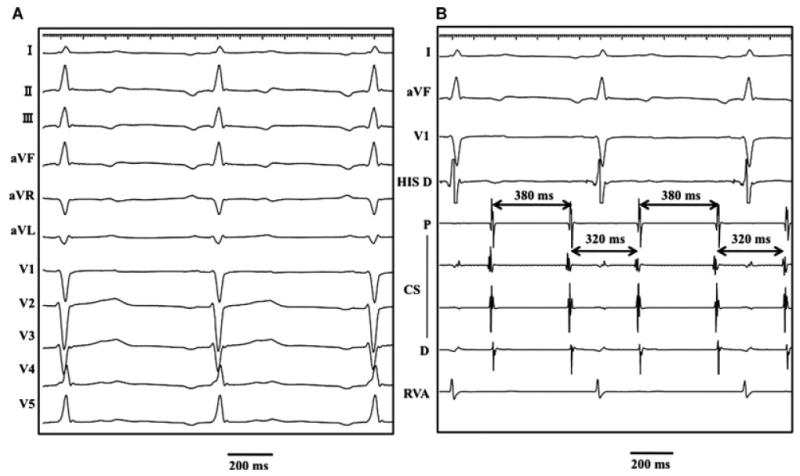
(A) Surface electrocardiogram of the second tachycardia after isoproterenol infusion stopped. 2:1 AV relationship is present. A–A intervals show cycle length alternans, while V–V intervals are constant. (B) Surface and intracardiac tracings of the same tachycardia depicted in A. 2:1 AV relationship is seen. HIS = His bundle catheter; P = proximal; D = distal; CS = coronary sinus catheter; RVA = RV catheter.
References
-
- Csanadi Z, Klein GJ, Yee R, Thakur RK, Li H. Effect of dual atrioventricular node pathways on atrioventricular reentrant tachycardia. Circulation. 1995;91:2614–2618. - PubMed
-
- Tai CT, Chen SA, Chiang CE, Lee SH, Chiou CW, Ueng KC, Wen ZC, Chen YJ, Chang MS. Multiple anterograde atrioventricular node pathways in patients with atrioventricular node reentrant tachycardia. J Am Coll Cardiol. 1996;28:725–731. - PubMed
-
- Otomo K, Nagata Y, Uno K, Fujiwara H, Iesaka Y. Irregular atypical atrioventricular nodal reentrant tachycardia: Incidence, electrophysiological characteristics, and effects of slow pathway ablation. Heart Rhythm. 2007;4:1507–1522. - PubMed
-
- Arya A, Kottkamp H, Piorkowski C, Schirdewahn P, Tanner H, Kobza R, Dorszewski A, Gerds-Li JH, Hindricks G. Differentiating atrioventricular nodal reentrant tachycardia from tachycardia via concealed accessory pathway. Am J Cardiol. 2005;95:875–878. - PubMed
Publication types
MeSH terms
Grants and funding
LinkOut - more resources
Full Text Sources
