


doi: 10.1016/j.mito.2009.02.001.
Epub 2009 Feb 11.
NDUFS4: creation of a mouse model mimicking a Complex I disorder
Affiliations
- PMID: 19460290
- PMCID: PMC2783808
- DOI: 10.1016/j.mito.2009.02.001
Item in Clipboard
NDUFS4: creation of a mouse model mimicking a Complex I disorder
Mitochondrion.
2009 Jun.
Abstract
The Complex I NADH dehydrogenase-ubiquinone-FeS 4 (NDUFS4) subunit gene is involved in proper Complex I function such that the loss of NDUFS4 decreases Complex I activity resulting in mitochondrial disease. Therefore, a mouse model harboring a point mutation in the NDUFS4 gene was created. An embryonic lethal phenotype was observed in homozygous (NDUFS4(-/-)) mutant fetuses. Mitochondrial function was impaired in heterozygous animals based on oxygen consumption, and Complex I activity in NDUFS4 mouse mitochondria. Decreased Complex I activity with unaltered Complex II activity, along with an accumulation of lactate, were consistent with Complex I disorders in this mouse model.
Figures
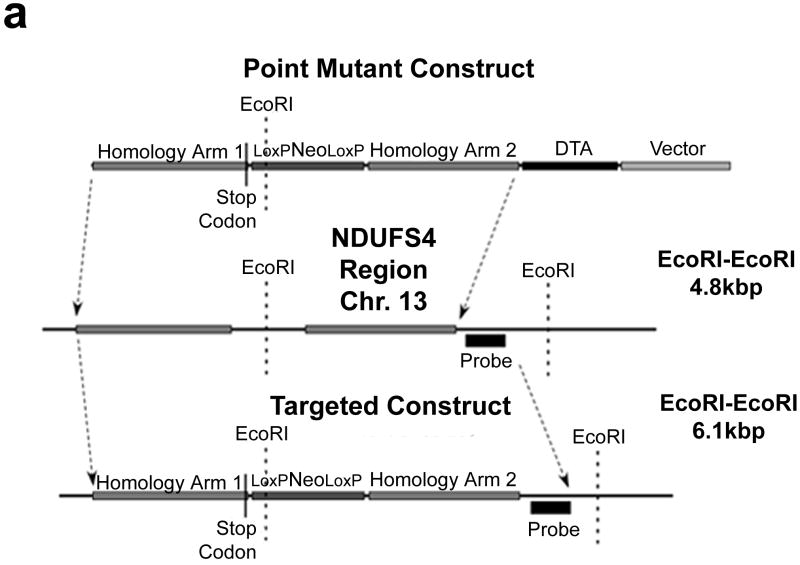
Schematic of the NDUFS4 Point Mutant Construction. The NDUFS4 point mutant construct gene targeting strategy is depicted. Successful homologous targeting to the NDUFS4 gene of ES cells is determined by Southern blotting of EcoRI-digested DNA using a probe specific for the region of DNA just downstream of the NDUFS4 gene (4.8kb band for wild-type, 6.1kb band for the recombinant mutant).

Southern Blot Analysis of the NDUFS4 Targeting Vector. (a) A representative Southern blot analysis of mouse DNA digested with EcoRI. Lanes 1-2 represent wild-type mice (NDUFS4 +/+) as there is a single band at 4.8 kb. Lanes 3-4 represent heterozygous recombinant (NDUFS4 +/-) mice as there are two bands (NDUFS4 wild-type at 4.8 kb, NDUFS4 recombinant at 6.1 kb). (b) The NDUFS4 recombinant band is notably of lesser intensity than the wild-type band as shown by quantification.

Blue Native Gel Electrophoresis and Silver Staining for NDUFS4. (a) Heart mitochondrial proteins were separated on blue native gels to identify mitochondrial complexes I-V (complex II not visible as it is very close to the dye front). NDUFS4 +/+ and NDUFS4 +/- lanes were turned 90° counter-clockwise in order to generate a second dimension gel used for silver staining and NDUFS4 western blot shown in Figure 4. (b) Quantification of Complex I from the blue native gel shows equal intensity in all lanes.

Western Blot Analysis for NDUFS4 in Heart Mitochondria. As noted in Figure 3, a second dimension gel of a complex I band was generated for western blot analysis of NDUFS4 +/+ and NDUFS4 +/- heart mitochondria. (b, c) NDUFS4 +/+ and NDUFS4 +/- heart mitochondrial second dimension silver staining are respectively shown. Identification of the NDUFS4 wild-type band (18kDa) and the point mutant NDUFS4 truncated band (14.4kDa) in the silver stains is not discernable as there are many Complex I bands which overlap these two bands. (a, d) NDUFS4 +/+ and NDUFS4 +/- heart mitochondrial second dimension western blotting are respectively shown. The wild-type NDUFS4 band (18kDa) is identified in both the NDUFS4 +/+ and NDUFS4 +/- Complex I whereas the point mutant NDUFS4 truncated band (14.4kDa) is only detected in (d) the western blot of NDUFS4 +/- Complex I. (e) Quantification of the results displayed normalized to +/+ = 100. Wild-type and mutant respectively refer to the 18kDa and 14.4kDa bands.

Mouse Mitochondrial and Cytosolic Biochemical Analyses in NDUFS4 +/+ and NDUFS4+/- Mice. (a) Mitochondrial respiration using glutamate/malate as substrates or (b) succinate as a substrate. (c) Complex I activity, expressed as a RCR normalized to citrate synthase activity. (d) Complex II activity, expressed as a RCR normalized to citrate synthase activity. (e) Lactate dehydrogenase enzymatic activity calculated using Lambert Beer’s equation. (f) Lactate concentration using an L-lactate probe and colorimetric quantification against a standard lactate control set. RCR, Complex I and Complex II activity comparisons among three tissues were performed using a 2-way ANOVA with a post hoc Fisher’s LSD. Tests between NDUFS4 +/+ and NDUFS4 +/- were performed with a paired, one-tailed Student’s T-test. For each bar, n = 4 to 8. *P-value < 0.05. LDH and lactate comparisons were performed for heart and brain samples using a 2-way ANOVA with a post hoc Fisher’s LSD. Tests between NDUFS4 +/+ and NDUFS4 +/- were performed with a paired, one-tailed Student’s T-test. For each bar, n = 4 to 8. *P-value < 0.05.
References
-
- Agostino A, Invernizzi F, Tiveron C, Fagiolari G, Prelle A, Lamantea E, Giavazzi A, Battaglia G, Tatangelo L, Tiranti V, Zeviani M. Constitutive knockout of Surf1 is associated with high embryonic lethality, mitochondrial disease and cytochrome c oxidase deficiency in mice. Hum Mol Genet. 2003;12:399–413. - PubMed
-
- Aure K, Fayet G, Leroy JP, Lacene E, Romero NB, Lombes A. Apoptosis in mitochondrial myopathies is linked to mitochondrial proliferation. Brain. 2006;129:1249–1259. - PubMed
-
- Bonora E, Porcelli AM, Gasparre G, Biondi A, Ghelli A, Carelli V, Baracca A, Tallini G, Martinuzzi A, Lenaz G, Rugolo M, Romeo G. Defective oxidative phosphorylation in thyroid oncocytic carcinoma is associated with pathogenic mitochondrial DNA mutations affecting complexes I and III. Cancer Res. 2006;66:6087–6096. - PubMed
-
- Brookes PS, Pinner A, Ramachandran A, Coward L, Barnes S, Kim H, Darley-Usmar VM. High throughput two-dimensional blue-native electrophoresis: a tool for functional proteomics of mitochondria and signaling complexes. Proteomics. 2002;2:969–977. - PubMed
-
- Budde SM, van den Heuvel LP, Janssen AJ, Smeets RJ, Buskens CA, DeMeirleir L, Van Coster R, Baethmann M, Voit T, Trijbels JM, Smeitink JA. Combined enzymatic complex I and III deficiency associated with mutations in the nuclear encoded NDUFS4 gene. Biochem Biophys Res Commun. 2000;275:63–68. - PubMed
Publication types
MeSH terms
Substances
Grants and funding
LinkOut - more resources
Full Text Sources
Medical
Molecular Biology Databases
Miscellaneous
