


Ventilator-associated pneumonia in patients undergoing major heart surgery: an incidence study in Europe
- PMID: 19463176
- PMCID: PMC2717444
- DOI: 10.1186/cc7896
Ventilator-associated pneumonia in patients undergoing major heart surgery: an incidence study in Europe
Abstract
Introduction: Patients undergoing major heart surgery (MHS) represent a special subpopulation at risk for nosocomial infections. Postoperative infection is the main non-cardiac complication after MHS and has been clearly related to increased morbidity, use of hospital resources and mortality. Our aim was to determine the incidence, aetiology, risk factors and outcome of ventilator-associated pneumonia (VAP) in patients who have undergone MHS in Europe.
Methods: Our study was a prospective study of patients undergoing MHS in Europe who developed suspicion of VAP. During a one-month period, participating units submitted a protocol of all patients admitted to their units who had undergone MHS.
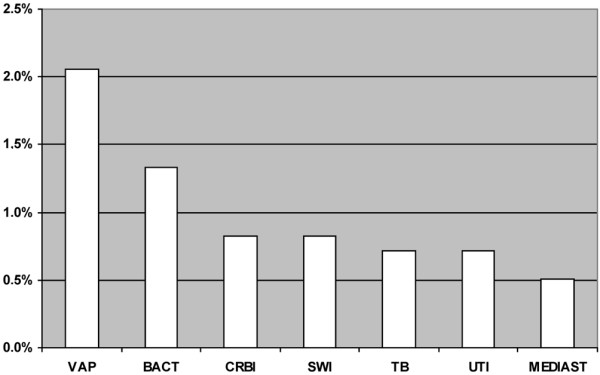
Results: Overall, 25 hospitals in eight different European countries participated in the study. The number of patients intervened for MHS was 986. Fifteen patients were excluded because of protocol violations. One or more nosocomial infections were detected in 43 (4.4%) patients. VAP was the most frequent nosocomial infection (2.1%; 13.9 episodes per 1000 days of mechanical ventilation). The microorganisms responsible for VAP in this study were: Enterobacteriaceae (45%), Pseudomonas aeruginosa (20%), methicillin-resistant Staphylococcus aureus (10%) and a range of other microorganisms. We identified the following significant independent risk factors for VAP: ascending aorta surgery (odds ratio (OR) = 6.22; 95% confidence interval (CI) = 1.69 to 22.89), number of blood units transfused (OR = 1.08 per unit transfused; 95% CI = 1.04 to 1.13) and need for re-intervention (OR = 6.65; 95% CI = 2.10 to 21.01). The median length of stay in the intensive care unit was significantly longer (P < 0.001) in patients with VAP than in patients without VAP (23 days versus 2 days). Death was significantly more frequent (P < 0.001) in patients with VAP (35% versus 2.3%).
Conclusions: Patients undergoing aortic surgery and those with complicated post-intervention courses, requiring multiple transfusions or re-intervention, constitute a high-risk group probably requiring more active preventive measures.
Figures
References
-
- Vincent JL, Bihari DJ, Suter PM, Bruining HA, White J, Nicolas-Chanoin MH, Wolff M, Spencer RC, Hemmer M. The prevalence of nosocomial infection in intensive care units in Europe. Results of the European Prevalence of Infection in Intensive Care (EPIC) Study. EPIC International Advisory Committee. JAMA. 1995;274:639–644. doi: 10.1001/jama.274.8.639. - DOI - PubMed
-
- George DL. Epidemiology of nosocomial pneumonia in intensive care unit patients. Clin Chest Med. 1995;16:29–44. - PubMed
Publication types
MeSH terms
LinkOut - more resources
Full Text Sources
Medical
