


Worldwide patterns of haplotype diversity at 9p21.3, a locus associated with type 2 diabetes and coronary heart disease
- PMID: 19463184
- PMCID: PMC2689443
- DOI: 10.1186/gm51
Worldwide patterns of haplotype diversity at 9p21.3, a locus associated with type 2 diabetes and coronary heart disease
Abstract
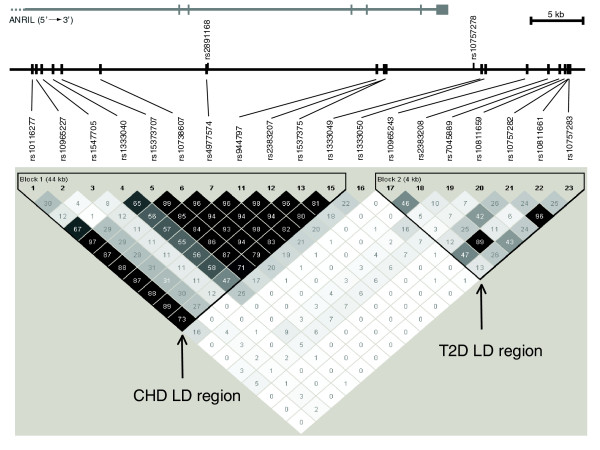
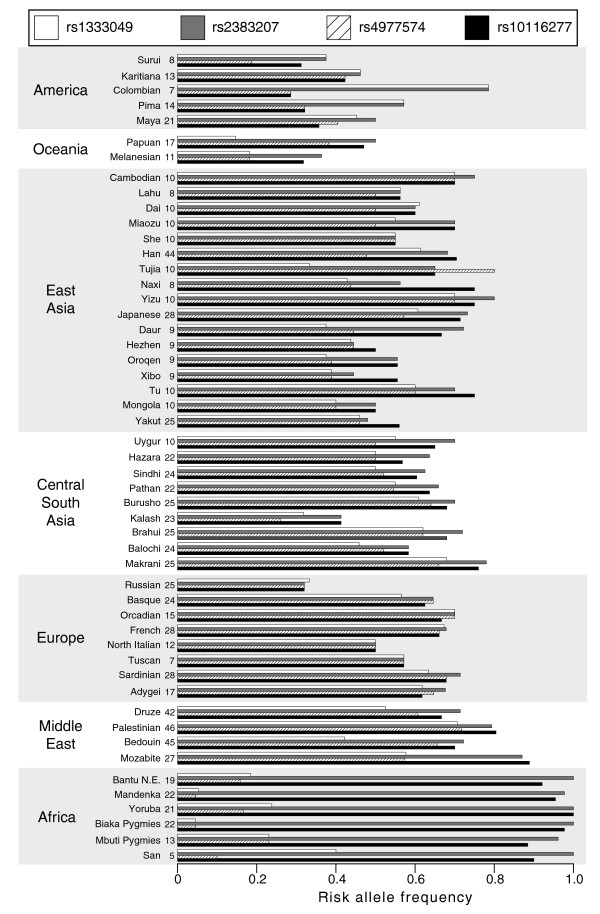
A 100 kb region on 9p21.3 harbors two major disease susceptibility loci: one for type 2 diabetes (T2D) and one for coronary heart disease (CHD). The single nucleotide polymorphisms (SNPs) associated with these two diseases in Europeans reside on two adjacent haplotype blocks with independent effects on disease. To help delimit the regions that likely harbor the disease-causing variants in populations of non-European origin, we studied the haplotype diversity and allelic history of the 9p21.3 region using 938 unrelated individuals from 51 populations (Human Genome Diversity Panel). We used SNP data from Illumina's 650Y SNP arrays supplemented with five additional SNPs within the region of interest. Haplotype frequencies were analyzed with the EM algorithm implemented in PLINK. For the T2D locus, the TT risk haplotype of SNPs rs10811661 and rs10757283 was present at similar frequencies in all global populations, while a shared 6-SNP haplotype that carries the protective C allele of rs10811661 was found at a frequency of 2.9% in Africans and 41.3% in East Asians and was associated with low haplotype diversity. For the CHD locus, all populations shared a core risk haplotype spanning >17.5 kb, which shows dramatic increase in frequency between African (11.5%) and Middle Eastern (63.7%) populations. Interestingly, two SNPs (rs2891168 and rs10757278) tagging this CHD risk haplotype are most strongly associated with CHD disease status according to independent clinical fine-mapping studies. The large variation in linkage disequilibrium patterns identified between the populations demonstrates the importance of allelic background data when selecting SNPs for replication in global populations. Intriguingly, the protective allele for T2D and the risk allele for CHD show an increase in frequency in non-Africans compared to Africans, implying different population histories for these two adjacent disease loci.
Figures
References
-
- Helgadottir A, Thorleifsson G, Manolescu A, Gretarsdottir S, Blondal T, Jonasdottir A, Jonasdottir A, Sigurdsson A, Baker A, Palsson A, Masson G, Gudbjartsson DF, Magnusson KP, Andersen K, Levey AI, Backman VM, Matthiasdottir S, Jonsdottir T, Palsson S, Einarsdottir H, Gunnarsdottir S, Gylfason A, Vaccarino V, Hooper WC, Reilly MP, Granger CB, Austin H, Rader DJ, Shah SH, Quyyumi AA. A common variant on chromosome 9p21 affects the risk of myocardial infarction. Science. 2007;316:1491–1493. doi: 10.1126/science.1142842. - DOI - PubMed
-
- Larson MG, Atwood LD, Benjamin EJ, Cupples LA, D'Agostino RB Sr, Fox CS, Govindaraju DR, Guo CY, Heard-Costa NL, Hwang SJ, Murabito JM, Newton-Cheh C, O'Donnell CJ, Seshadri S, Vasan RS, Wang TJ, Wolf PA, Levy D. Framingham Heart Study 100K project: genome-wide associations for cardiovascular disease outcomes. BMC Med Genet. 2007;8(Suppl 1):S5. doi: 10.1186/1471-2350-8-S1-S5. - DOI - PMC - PubMed
-
- McPherson R, Pertsemlidis A, Kavaslar N, Stewart A, Roberts R, Cox DR, Hinds DA, Pennacchio LA, Tybjaerg-Hansen A, Folsom AR, Boerwinkle E, Hobbs HH, Cohen JC. A common allele on chromosome 9 associated with coronary heart disease. Science. 2007;316:1488–1491. doi: 10.1126/science.1142447. - DOI - PMC - PubMed
-
- Samani NJ, Erdmann J, Hall AS, Hengstenberg C, Mangino M, Mayer B, Dixon RJ, Meitinger T, Braund P, Wichmann HE, Barrett JH, Konig IR, Stevens SE, Szymczak S, Tregouet DA, Iles MM, Pahlke F, Pollard H, Lieb W, Cambien F, Fischer M, Ouwehand W, Blankenberg S, Balmforth AJ, Baessler A, Ball SG, Strom TM, Braenne I, Gieger C, Deloukas P. Genomewide association analysis of coronary artery disease. N Engl J Med. 2007;357:443–453. doi: 10.1056/NEJMoa072366. - DOI - PMC - PubMed
Grants and funding
LinkOut - more resources
Full Text Sources
