


Factors associated with poorer prognosis for patients undergoing primary percutaneous coronary intervention during off-hours: biology or systems failure?
- PMID: 19463384
- PMCID: PMC2774122
- DOI: 10.1016/j.jcin.2008.08.020
Factors associated with poorer prognosis for patients undergoing primary percutaneous coronary intervention during off-hours: biology or systems failure?
Abstract
Objectives: We sought to determine whether poorer outcomes in patients undergoing primary percutaneous coronary intervention (PCI) for ST-segment elevation myocardial infarction (MI) during off-hours are related to delays in treatment, circadian changes in biology, or differences in operator-related quality of care.
Background: Previous investigation has suggested that patients undergoing primary PCI during off-hours are more likely to have adverse cardiac events than routine-hours patients, but the reasons for this remain poorly defined.
Methods: Clinical, angiographic, and procedural characteristics were compared in consecutive patients (n = 685) undergoing primary PCI in the National Heart, Lung, and Blood Institute Dynamic Registry between 1997 and 2006 that were classified as occurring during routine-hours (07:00 to 18:59) or off-hours (19:00 to 06:59). The primary end points were in-hospital death, MI, and target vessel revascularization.
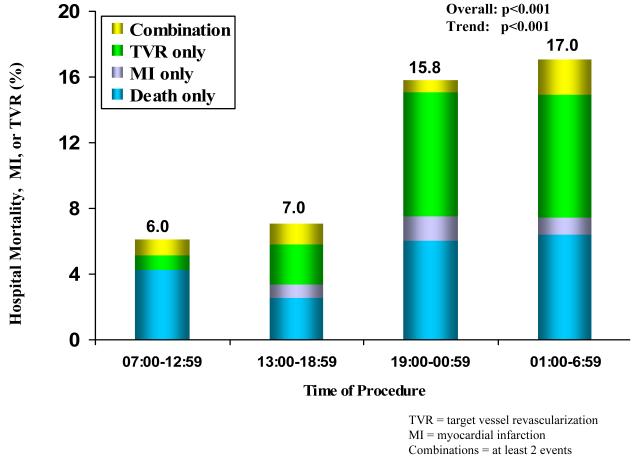
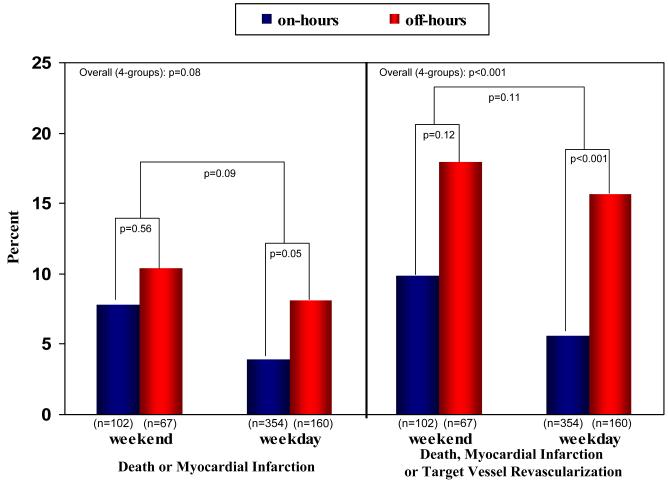
Results: Median time from symptom onset to PCI was similar (off-hours 3.4 h vs. routine-hours 3.3 h). Patients presenting in off-hours were more likely to present with cardiogenic shock and multivessel coronary artery disease but were equally likely to present with complete occlusion of the infarct-related artery. Procedural complications including dissection were more frequent in off-hours patients. In-hospital death, MI, and target vessel revascularization were significantly higher in off-hours patients (adjusted odds ratio [OR]: 2.66, p = 0.001), and differences in outcomes were worse even if the procedure was immediately successful (adjusted OR: 2.58, p = 0.005, adjusting for angiographic success). Patients undergoing PCI on weekends had better outcomes during the daytime than nighttime.
Conclusions: Patients undergoing primary PCI for acute MI during off-hours are at significantly higher risk for in-hospital death, MI, and target vessel revascularization. These findings appear related to both diurnal differences in presentation and lesion characteristics, as well as differences in procedural complication and success rates that extend beyond differences in symptom-to-balloon time.
Figures
Comment in
-
Physicians ... wake up!JACC Cardiovasc Interv. 2008 Dec;1(6):689-91. doi: 10.1016/j.jcin.2008.08.019. JACC Cardiovasc Interv. 2008. PMID: 19463385 No abstract available.
-
Cross-talk between primary percutaneous coronary intervention, arterial inflammation, and light/dark patterns.JACC Cardiovasc Interv. 2009 Apr;2(4):368; author reply 368-9. doi: 10.1016/j.jcin.2009.01.007. JACC Cardiovasc Interv. 2009. PMID: 19463454 No abstract available.
References
-
- Keeley EC, Hillis LD. Primary PCI for myocardial infarction with ST-segment elevation. N Engl J Med. 2007 Jan 4;356(1):47–54. - PubMed
-
- Grines CL, Browne KF, Marco J, et al. A comparison of immediate angioplasty with thrombolytic therapy for acute myocardial infarction: the Primary Angioplasty in Myocardial Infarction Study Group. N Engl J Med. 1993;328:673–9. - PubMed
-
- GUSTO IIb Substudy Investigators A clinical trial comparing primary coronary angioplasty with tissue plasminogen activtor for acute myocardial infarction: the Global Use of Strategies to Open Occluded Coronary Arteries in Acute Coronary Syndromes (GUSTO IIb) N Engl J Med. 1997;336:1621–8. - PubMed
-
- Keeley EC, Boura JA, Grines CL. Primary angioplasty versus intravenous thrombolytic therapy for acute myocardial infarction: a quantitative review of 23 randomized trials. Lancet. 2003;361:13–20. - PubMed
-
- Pinto DS, Kirtane AJ, Nallamothu BK, Murphy SA, Cohen DJ, Laham RJ, Cutlip DE, Bates ER, Frederick PD, Miller DP, Carrozza JP, Antman EM, Cannon CP, Gibson CM. Hospital Delays in Reperfusion for ST-Elevation Myocardial Infarction: Implications When Selecting a Reperfusion Strategy. Circulation. 2006;114:2019–2025. - PubMed
Publication types
MeSH terms
Substances
Grants and funding
LinkOut - more resources
Full Text Sources
Medical
Miscellaneous
