


Defining chronic obstructive pulmonary disease in older persons
- PMID: 19464159
- PMCID: PMC2739264
- DOI: 10.1016/j.rmed.2009.04.019
Defining chronic obstructive pulmonary disease in older persons
Abstract
Objective: To develop a more age-appropriate spirometric definition of chronic obstructive pulmonary disease (COPD) among older persons.
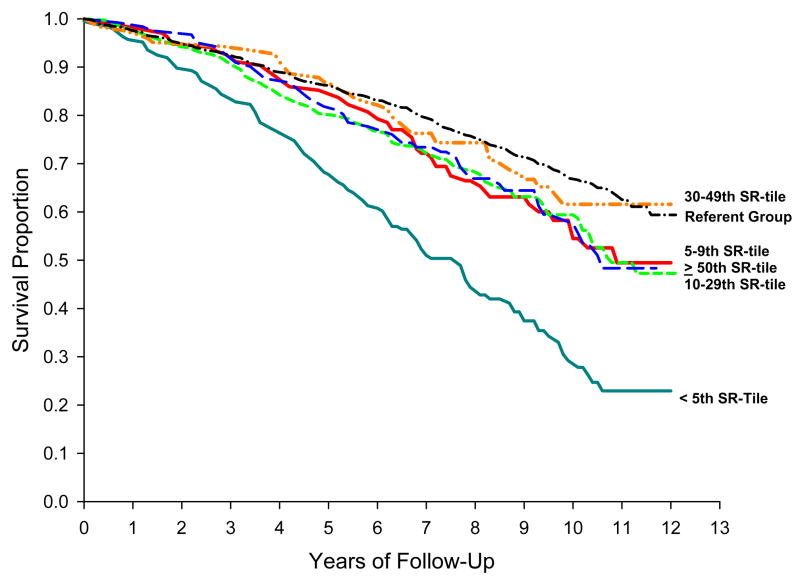
Methods: Using data from the Third National Health and Nutrition Examination Survey (NHANES III), we developed a two-part spirometric definition of COPD in older persons, aged 65-80 years, that 1) determines a cut-point for the ratio of forced expiratory volume in 1 s to forced vital capacity (FEV1/FVC) based on mortality risk; and 2) among persons below this critical FEV1/FVC threshold, determines cut-points for the FEV1, expressed as a standardized residual percentile (SR-tile) and based on the prevalence of respiratory symptoms and mortality risk. Measurements included spirometry, health questionnaires, and mortality (National Death Index).
Results: There were 2480 older participants with a mean age of 71.7 years; 1372 (55.4%) had a smoking history, 1097 (44.2%) had respiratory symptoms and, over the course of 12-years, 868 (35.0%) had died. Among participants with an FEV1/FVC<.70 and FEV1<5th SR-tile, representing 7.7% of the cohort, the risk of death was doubled (adjusted hazard ratio, 2.01; 95% confidence interval [CI], 1.60-2.54). Among participants with an FEV1/FVC<.70 and FEV1<10th SR-tile, representing 13.4% of the cohort, the prevalence of respiratory symptoms was elevated (adjusted odds ratio, 2.44; CI, 1.79-3.33).
Conclusion: In a large, nationally representative sample of community-living older persons, defining COPD based on an FEV1/FVC<.70, with FEV1 cut-points at the 10th and 5th SR-tiles, identifies individuals with an increased prevalence of respiratory symptoms and an increased risk of death, respectively.
Figures
References
-
- Viegi G, Pistelli F, Sherrill DL, Maio S, Baldacci S, Carrozzi L. Definition, epidemiology and natural history of COPD. Eur Respir J. 2007;30:993–1013. - PubMed
-
- West JB. Pulmonary pathophysiology: the essentials. 6. Baltimore: Lippincott Williams and Wilkins; 2003.
-
- Miller MR, Hankinson J, Brusasco V, et al. Standardisation of spirometry. Eur Respir J. 2005;26:319–38. - PubMed
-
- GOLD executive summary. Global strategy for the diagnosis, management, and prevention of chronic obstructive pulmonary disease. Am J Respir Crit Care Med. 2007;176:532–55. - PubMed
-
- Celli BR, Halbert RJ, Nordyke RJ, Schau B. Airway obstruction in never smokers: results from the third national health and nutrition examination survey. Am J Med. 2005;118:1364–72. - PubMed
Publication types
MeSH terms
Grants and funding
LinkOut - more resources
Full Text Sources
Other Literature Sources
Medical
Research Materials
