Task completion time: Objective tool for assessment of technical skills in laparoscopic simulator for urology trainees
- PMID: 19468356
- PMCID: PMC2684221
- DOI: 10.4103/0970-1591.38601
Task completion time: Objective tool for assessment of technical skills in laparoscopic simulator for urology trainees
Abstract
Context: Laparoscopic surgical simulation is a valuable training tool for urology trainees.
Aims: We assessed the validity of task completion time (TCT) as an objective tool for practicing and acquiring technical skills in a simulated laparoscopy environment.
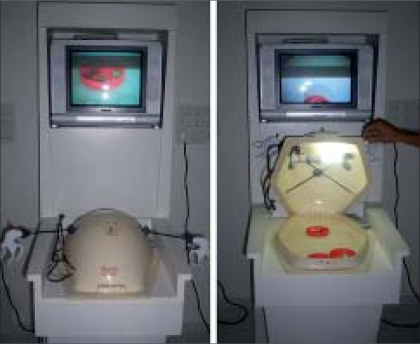
Materials and methods: Fifteen participants comprising postgraduate urology trainees from first to third year (n = 12), urology fellow (n = 1) and consultants (n = 2) underwent basic laparoscopic training on the "Beetle Universal" endotrainer. Training included 10 attempts each comprising four tasks; placing a ball in a cup (Task 1), threading five rings (Task 2), threading five balls (Task 3) and tying a suture (Task 4). Individual task (IT) time was measured. The TCT was defined as sum of IT time for a single attempt.
Statistical analysis used: Statistical analysis was done by Pearson's correlation coefficient and student's t test using SPSS software 10.
Results: The average TCT for the first attempt to complete the four tasks by the participants was 76.5 +/- 13.0 min (range 38 to 92.5, skew -1.8), compared to the 10(th) attempt 33 +/- 4.23 min (range 25 to 38.5, skew -0.5). There was statistically significant correlation (r = mean -0.91, range -0.97 to -.83, skew -0.5), (P = < 0.001) between the number of attempts and decreasing TCT for all participants. Correlation decreased when TCT between the sixth to 10(th) attempt was compared (r = mean -0.67, range -0.99 to 0.76).
Conclusions: The TCT is practical, easy and a valid objective tool for assessing acquired technical skills of urology trainees in a laparoscopic simulated environment.
Keywords: Beetle universal; endotrainer; laparoscopy; simulation; task completion time.
Conflict of interest statement
Figures


References
-
- Kommu SS, Dickinson AJ, Rane A. Optimizing outcomes in laparoscopic urologic training: Toward a standardized global consensus. J Endourol. 2007;21:378–85. - PubMed
-
- Traynor O. Se01 the emerging role of simulation in surgical training. ANZ J Surg. 2007;77:A77.
-
- McDougall EM. Validation of surgical simulators. J Endourol. 2007;21:244–7. - PubMed
-
- Ahlberg G, Enochsson L, Gallagher AG, Hedman L, Hogman C, McClusky DA, 3rd, et al. Proficiency-based virtual reality training significantly reduces the error rate for residents during their first 10 laparoscopic cholicystectomies. Am J Surg. 2007;193:797–804. - PubMed
-
- Rassweiler J, Klein J, Teber D, Schulze M, Frede T. Mechanical simulators for training for laparoscopic surgery in urology. J Endourol. 2007;21:252–62. - PubMed