MurF inhibitors with antibacterial activity: effect on muropeptide levels
- PMID: 19470511
- PMCID: PMC2715636
- DOI: 10.1128/AAC.00166-09
MurF inhibitors with antibacterial activity: effect on muropeptide levels
Abstract
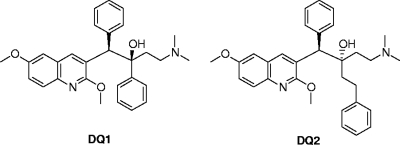
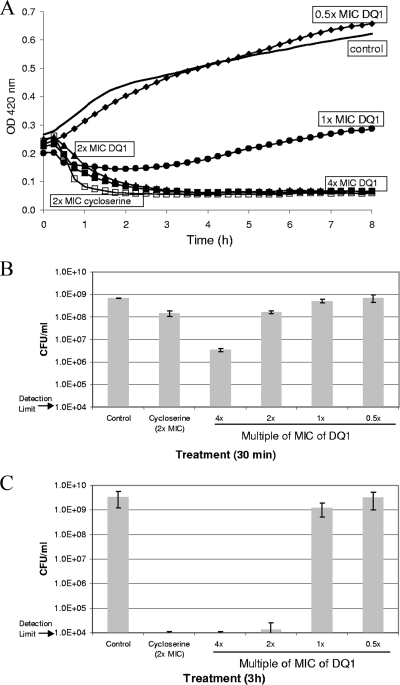
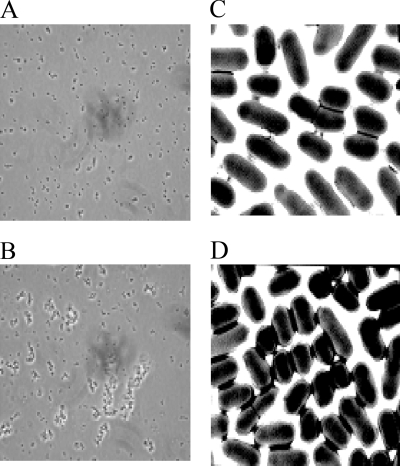
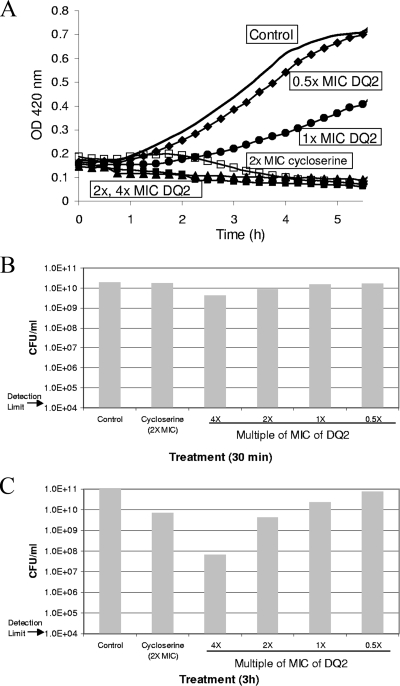
MurF catalyzes the last cytoplasmic step of bacterial cell wall synthesis and is essential for bacterial survival. Our previous studies used a pharmacophore model of a MurF inhibitor to identify additional inhibitors with improved properties. We now present the characterization of two such inhibitors, the diarylquinolines DQ1 and DQ2. DQ1 inhibited Escherichia coli MurF (50% inhibitory concentration, 24 microM) and had modest activity (MICs, 8 to 16 microg/ml) against lipopolysaccharide (LPS)-defective E. coli and wild-type E. coli rendered permeable with polymyxin B nonapeptide. DQ2 additionally displayed activity against gram-positive bacteria (MICs, 8 to 16 microg/ml), including methicillin (meticillin)-susceptible and -resistant Staphylococcus aureus isolates and vancomycin-susceptible and -resistant Enterococcus faecalis and Enterococcus faecium isolates. Treatment of LPS-defective E. coli cells with >or=2x MIC of DQ1 resulted in a 75-fold-greater accumulation of the MurF substrate compared to the control, a 70% decline in the amount of the MurF product, and eventual cell lysis, consistent with the inhibition of MurF within bacteria. DQ2 treatment of S. aureus resulted in similar effects on the MurF substrate and product quantities. At lower levels of DQ1 (<or=1x MIC), the level of accumulation of the substrate was less pronounced (15-fold greater compared to the amount for the control). However, a 50% increase in the amount of the MurF product compared to the control was reproducibly observed, consistent with the possible upregulation of muropeptide biosynthesis upon partial inhibition of this pathway. The overexpression of cloned MurF appeared to partly alleviate the DQ1-mediated inhibition of muropeptide synthesis. The identification of MurF inhibitors such as DQ1 and DQ2 that disrupt cell wall biosynthesis suggests that MurF remains a viable target for an antibacterial agent.
Figures
References
-
- Anderson, M. S., S. S. Eveland, H. R. Onishi, and D. L. Pompliano. 1996. Kinetic mechanism of the Escherichia coli UDPMurNAc-tripeptide d-alanyl-d-alanine-adding enzyme: use of a glutathione S-transferase fusion. Biochemistry 35:16264-16269. - PubMed
-
- Andries, K., P. Verhasselt, J. Guillemont, H. W. H. Goehlmann, J.-M. Neefs, H. Winkler, J. Van Gestel, P. Timmerman, M. Zhu, E. Lee, P. Williams, D. de Chaffoy, E. Huitric, S. Hoffner, E. Cambau, C. Truffot-Pernot, N. Lounis, and V. Jarlier. 2005. A diarylquinoline drug active on the ATP synthase of Mycobacterium tuberculosis. Science 307:223-227. - PubMed
MeSH terms
Substances
LinkOut - more resources
Full Text Sources
Medical
Molecular Biology Databases