Review
doi: 10.1158/1940-6207.CAPR-09-0083.
Epub 2009 May 26.
Epigallocatechin 3-gallate and green tea catechins: United they work, divided they fail
Affiliations
- PMID: 19470792
- PMCID: PMC2822459
- DOI: 10.1158/1940-6207.CAPR-09-0083
Item in Clipboard
Review
Epigallocatechin 3-gallate and green tea catechins: United they work, divided they fail
Cancer Prev Res (Phila).
2009 Jun.
No abstract available
Conflict of interest statement
No potential conflicts of interest were disclosed.
Figures
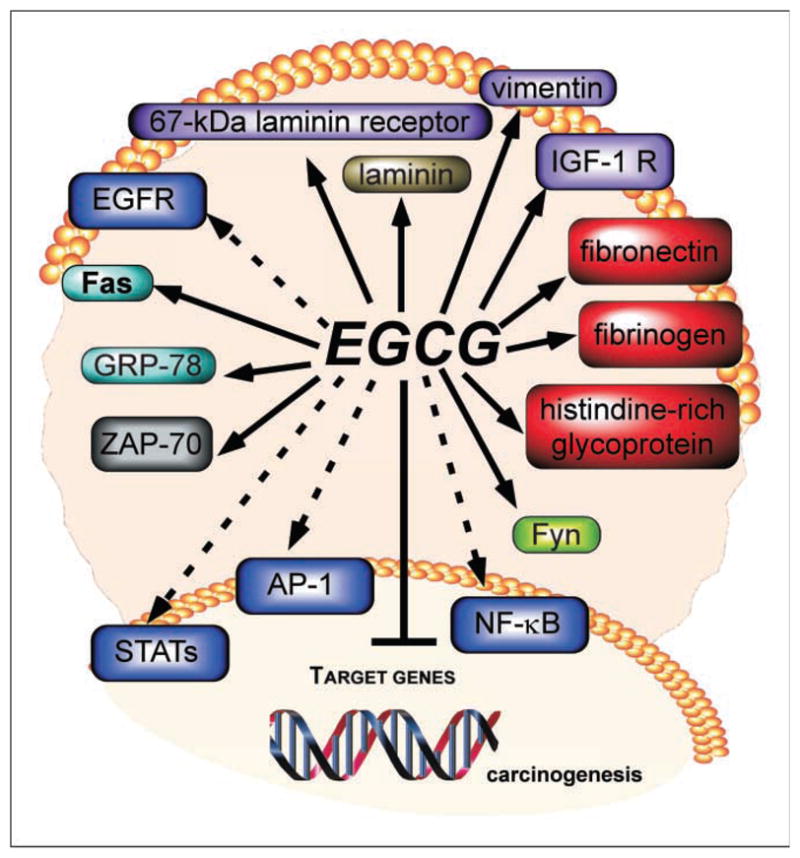
EGCG interacts with and binds numerous proteins to prevent carcinogenesis. EGCG has been reported to directly bind with the plasma proteins fibronectin, fibrinogen and histidine-rich glycoprotein, Fas, laminin and the 67 kDa laminin receptor, vimentin ZAP-70, Fyn, insulin-line growth factor-I receptor (IGF-IR), and glucose-regulated protein 78 (GRP-78; solid arrows). EGCG also indirectly targets a number of other oncogenic proteins including EGFR and the activator protein 1 (AP-1), signal transducers and activators of transcription (STAT), and nuclear factor κB (NF-κB) transcription factors. The net result is the inhibition of carcinogenesis in a variety of tissues.
Comment on
-
Lung cancer inhibitory effect of epigallocatechin-3-gallate is dependent on its presence in a complex mixture (polyphenon E).Cancer Prev Res (Phila). 2009 Jun;2(6):531-7. doi: 10.1158/1940-6207.CAPR-08-0185. Epub 2009 May 26. Cancer Prev Res (Phila). 2009. PMID: 19470785
References
-
- Dreosti IE, Wargovich MJ, Yang CS. Inhibition of carcinogenesis by tea: the evidence from experimental studies. Crit Rev Food Sci Nutr. 1997;37:761–70. - PubMed
-
- Katiyar SK, Mukhtar H. Tea in chemoprevention of cancer: epidemiologic and experimental studies. Int J Oncol. 1996;8:221–38. - PubMed
-
- Yoshizawa S, Horiuchi T, Fukiji H, Yosida T, Oduad T, Sugimura T. Antitumor promoting activity of (−)-epigallocatechin gallate, the main constituent of “tannin” in green tea. Photother Res. 1987;1:44–7.
-
- Yang CS. Inhibition of carcinogenesis by tea. Nature. 1997;389:134–5. - PubMed
-
- Yang CS, Maliakal P, Meng X. Inhibition of carcinogenesis by tea. Annu Rev Pharmacol Toxicol. 2002;42:25–54. - PubMed
Publication types
MeSH terms
Substances
Grants and funding
LinkOut - more resources
Full Text Sources