


Youth with obesity and obesity-related type 2 diabetes mellitus demonstrate abnormalities in carotid structure and function
- PMID: 19470890
- PMCID: PMC2741387
- DOI: 10.1161/CIRCULATIONAHA.108.830380
Youth with obesity and obesity-related type 2 diabetes mellitus demonstrate abnormalities in carotid structure and function
Abstract
Background: Adults with obesity or type 2 diabetes mellitus (T2DM) are at higher risk for stroke and myocardial infarction. Increased carotid intima-media thickness (cIMT) and stiffness are associated with these adverse outcomes. We compared carotid arteries in youth who were lean, were obese, or had T2DM.
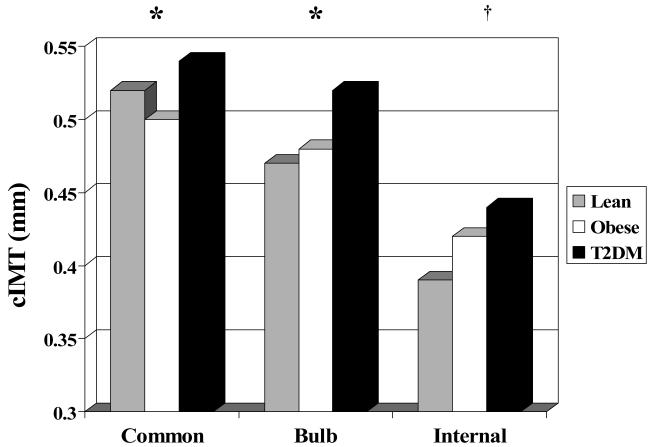
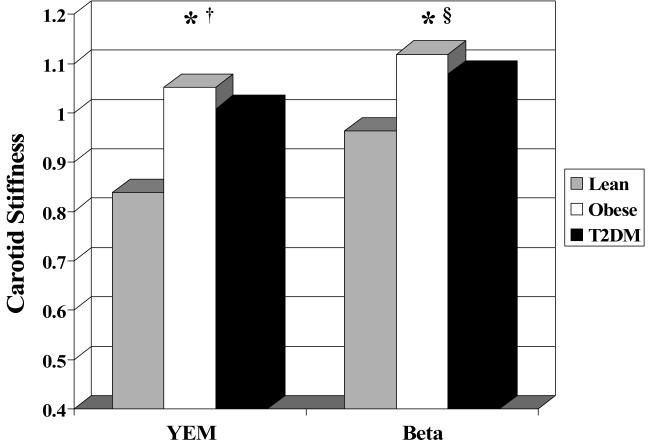
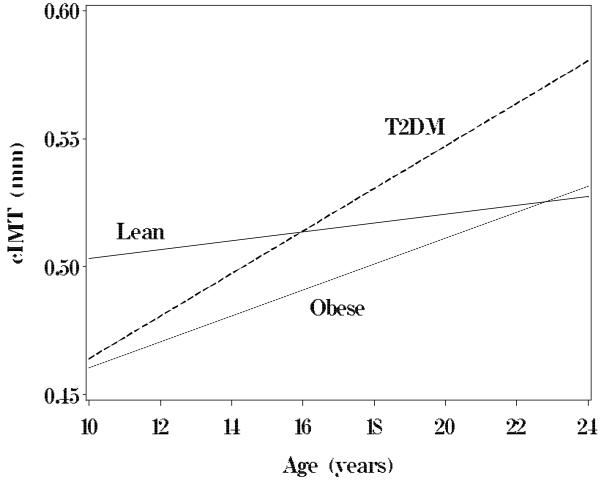
Methods and results: Carotid ultrasound for cIMT measurement was performed, the Young elastic modulus and beta stiffness index were calculated, and anthropometric and laboratory values and blood pressure were measured in 182 lean, 136 obese, and 128 T2DM youth (aged 10 to 24 years). Mean differences were evaluated by ANOVA. Independent determinants of cIMT, Young elastic modulus, and beta stiffness index were determined with general linear models. Cardiovascular risk factors worsened from lean to obese to T2DM groups. T2DM subjects had greater cIMT than that in lean and obese subjects for the common carotid artery and bulb. For the internal carotid artery, cIMT measurements in both obese and T2DM groups were thicker than in the lean group. The carotid arteries were stiffer in obese and T2DM groups than in the lean group. Determinants of cIMT were group, group x age interaction, sex, and systolic blood pressure for the common carotid artery (r2=0.17); age, race, and systolic blood pressure for the bulb (r2=0.16); and age, race, sex, systolic blood pressure, and total cholesterol for the internal carotid artery (r2=0.21). Age, systolic blood pressure, and diastolic blood pressure were determinants of all measures of carotid stiffness, with sex adding to the Young elastic modulus (r2=0.23), and body mass index Z score, group, and group x age interaction contributing to the beta stiffness index (r2=0.31; all P<0.0001).
Conclusions: Youth with obesity and T2DM have abnormalities in carotid thickness and stiffness that are only partially explained by traditional cardiovascular risk factors. These vascular changes should alert healthcare practitioners to address cardiovascular risk factors early to prevent an increase in the incidence of stroke and myocardial infarction.
Figures
References
-
- Ninomiya JK, L’Italien G, Criqui MH, Whyte JL, Gamst A, Chen RS. Association of the metabolic syndrome with history of myocardial infarction and stroke in the third national health and nutrition examination survey. Circulation. 2004;109:42–46. - PubMed
-
- Ali YS, Rembold KE, Weaver B, Wills MB, Tatar S, Ayers CR, Rembold CM. Prediction of major adverse cardiovascular events by age-normalized carotid intimal medial thickness. Atherosclerosis. 2006;187:186–190. - PubMed
-
- Zebekakis PE, Nawrot T, Thijs L, Balkestein EJ, van der Heijden-Spek J, Van Bortel LM, Struijker-Boudier HA, Safar ME, Staessen JA. Obesity is associated with increased arterial stiffness from adolescence until old age. Journal of Hypertension. 2005;23:1839–1846. - PubMed
-
- van Dijk RA, Bakker SJ, Scheffer PG, Heine RJ, Stehouwer CD. Associations of metabolic variables with arterial stiffness in type 2 diabetes mellitus: focus on insulin sensitivity and postprandial triglyceridaemia. European Journal of Clinical Investigation. 2003;33:307–315. - PubMed
Publication types
MeSH terms
Grants and funding
LinkOut - more resources
Full Text Sources
Medical
