Review
. 2009 Jun;12(6):703-10.
doi: 10.1038/nn.2330. Epub 2009 May 26.

Linking genes underlying deafness to hair-bundle development and function

Affiliations
Review

Linking genes underlying deafness to hair-bundle development and function

Christine Petit et al. Nat Neurosci. 2009 Jun.

Abstract

The identification of mutations underlying monogenic, early-onset forms of deafness in humans has provided unprecedented insight into the molecular mechanisms of hearing in the peripheral auditory system. The molecules involved in the development and function of the cochlea eluded characterization until recently owing to the scarcity of the principal cell types present. The genetic approach has circumvented this problem and succeeded in identifying proteins and deciphering some of the molecular complexes that operate in these cells. In combination with mouse models, the genetic approach is now revealing some of the principles underlying the development and physiology of the cochlea. Focusing on the hair bundle, the mechanosensory device of the sensory hair cell, we highlight recent advances in understanding the way in which the hair bundle is formed, how it operates as a mechanotransducer and how it processes sound. In particular, we discuss how these findings confer a central role on the various hair-bundle links in these processes.


Figures
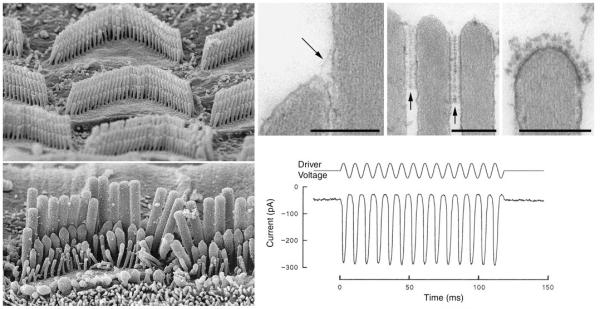
Figure 1
Figure 1. Hair bundle: Structure and Function
(a, b) Scanning electron micrographs of the hair bundles of OHCs (a) and IHCs (b) in the adult mouse cochlea. (c-e) Transmission electron micrographs of a tip link (arrow, c), horizontal top connectors (arrows, d) and a tectorial membrane attachment crown (e) from mouse OHCs. (f) Transducer currents (bottom trace) recorded from a mouse cochlear OHC in response to sinusoidal stimulation of the hair bundle with a piezo-electric driven fluid jet (upper trace; voltage to piezo driver). Current flows into the cells (downward deflection in lower trace) when the hair bundle is deflected in the direction of the tallest row of stereocilia. Currents plotted include contribution from inward holding current. Micrographs in a and b were kindly provided by Prof. A. Forge, UCL, images in c-e are from Goodyear et al, data in f are from Kros et al. Scale bars in c-e = 200 nm.
Figure 2
Figure 2. Hair-bundle development and hair-bundle phenotypes in mouse mutants
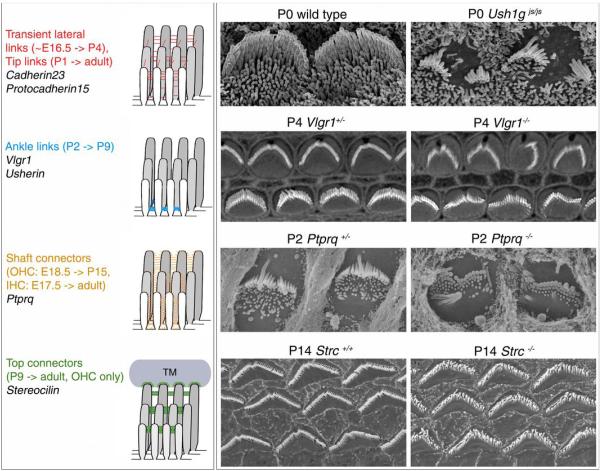
a) Cartoon summarising the link types present at the different stages of development and their distribution in the hair bundle. b, c) Scanning electron micrographs of OHC hair bundles in wild type (b) and sans (Ush1gjs/js) mutant (c) mice at P0. Note how the hair bundles are fragmented in several small clumps of stereocilia in the mutant. d, e) Rhodamine-phalloidin stained hair bundles of IHCs (bottom row) and OHCs (top row) in P4 mice heterozygous (d) or homozygous (e) for a functional null mutation in Vlgr1. Note the loss of a sharply-defined hair bundle in the mutant. f, g) Scanning electron micrographs IHC hair bundles in P2 mice heterozygous (f) or homozygous (g) for a null mutation in the gene encoding Ptprq. Note how many of the stereocilia are shorter and how some are fused in the mutant. h, i) Scanning electron micrographs of P14 OHC hair bundles from wild type mice (h) or mice homozygous (g) for a null mutation in the gene encoding stereocilin. Note how the tips of the stereocilia are not well aligned in the mutant. Images in h and g are from Verpy et el.,.

References

    1. Bregman AS. Auditory Scene Analysis: The Perceptual Organization of sound. MIT Press; Cambridge, Massachusetts: 1990.
    1. Moore BC, Tyler LK, Marslen-Wilson W, editors. The perception of speech: from sound to meaning, 917-1122. Royal Soc Publ; 2008. - PMC - PubMed
    1. Ohm GS. Über die Definition des Tones, nebst daran geknüpfter Theorie der Sirene und ähnlicher tonbildender Vorrichtungen. Annalen der Physik und Chemie. 1843;59:513–565.
    1. von Helmholtz H. Die Lehre von den Tonempfindungen als physiologische Grundlage fur die Theorie derMusik (On the Sensations of Tone as a Physiological Basis for the Theory of Music) F. Vieweg und Sohn; Braunschweig: 1862.
    1. Gold T. Hearing. II. The physical basis of the action of the cochlea. Proc R Soc Lond B Biol Sci. 1948;135:492–498.

Publication types

MeSH terms

LinkOut - more resources