


Bet-hedging as an evolutionary game: the trade-off between egg size and number
- PMID: 19474039
- PMCID: PMC2817213
- DOI: 10.1098/rspb.2009.0500
Bet-hedging as an evolutionary game: the trade-off between egg size and number
Abstract
Bet-hedging theory addresses how individuals should optimize fitness in varying and unpredictable environments by sacrificing mean fitness to decrease variation in fitness. So far, three main bet-hedging strategies have been described: conservative bet-hedging (play it safe), diversified bet-hedging (don't put all eggs in one basket) and adaptive coin flipping (choose a strategy at random from a fixed distribution). Within this context, we analyse the trade-off between many small eggs (or seeds) and few large, given an unpredictable environment. Our model is an extension of previous models and allows for any combination of the bet-hedging strategies mentioned above. In our individual-based model (accounting for both ecological and evolutionary forces), the optimal bet-hedging strategy is a combination of conservative and diversified bet-hedging and adaptive coin flipping, which means a variation in egg size both within clutches and between years. Hence, we show how phenotypic variation within a population, often assumed to be due to non-adaptive variation, instead can be the result of females having this mixed strategy. Our results provide a new perspective on bet-hedging and stress the importance of extreme events in life history evolution.
Figures
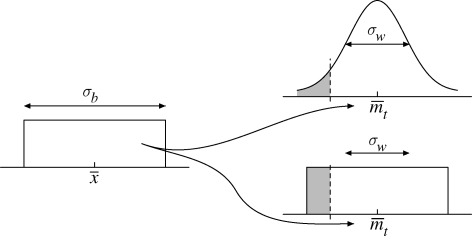
 , and σw, in the females’ ‘genome’. σb is the standard deviation in a uniform distribution with mean
  and corresponds to between year variation in the mean propagule size produced by each female. Every year, each female will ‘choose’ a value of her mean propagule size (
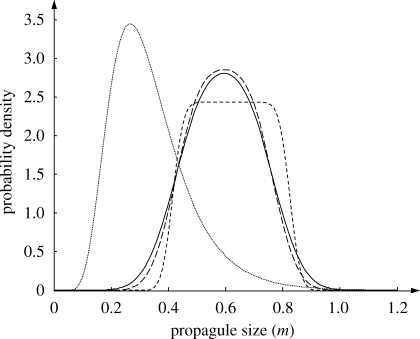
 ), and the distribution within the clutch around that mean has a standard deviation of σw, independently of whether she produces a clutch with normally or uniformly distributed propagule sizes. The dashed line corresponds to an arbitrary mmin, which varies from one time step to another. All propagule sizes smaller than mmin (grey area) will not survive.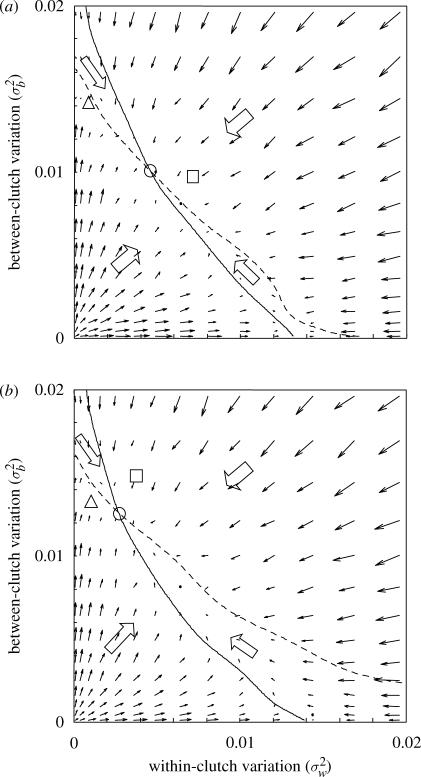
Comment in
-
Bet-hedging as an evolutionary game: the trade-off between egg size and number.Proc Biol Sci. 2010 Apr 22;277(1685):1149-51. doi: 10.1098/rspb.2009.1541. Epub 2009 Dec 16. Proc Biol Sci. 2010. PMID: 20018792 Free PMC article. No abstract available.
References
-
- Brown J. S., Venable D. L.1986Evolutionary ecology of seedbank annuals in temporally varying environments. Am. Nat. 127, 31–47 (doi:10.1086/284465) - DOI
-
- Charlesworth B.1971Selection in density-regulated populations. Ecology 52, 469–474 (doi:10.2307/1937629) - DOI
-
- Cohen D.1966Optimizing reproduction in a randomly varying environment. J. Theor. Biol. 12, 119–129 (doi:10.1016/0022-5193(66)90188-3) - DOI - PubMed
-
- Cooper W. S., Kaplan R. H.1982Adaptive ‘coin-flipping’: a decision-theoretical examination of natural selection for a random individual variation. J. Theor. Biol. 94, 135–151 (doi:10.1016/0022-5193(82)90336-8) - DOI - PubMed
-
- Crump M. L.1981Variation in propagule size as a function of environmental uncertainty for tree frogs. Am. Nat. 117, 724–737 (doi:10.1086/283755) - DOI
Publication types
MeSH terms
LinkOut - more resources
Full Text Sources
