. 2010 Jan 6;7(42):35-47.
doi: 10.1098/rsif.2009.0067. Epub 2009 May 27.

Towards a quantitative understanding of the within-host dynamics of influenza A infections

Affiliations

Towards a quantitative understanding of the within-host dynamics of influenza A infections

Andreas Handel et al. J R Soc Interface. .

Abstract

Although the influenza A virus has been extensively studied, a quantitative understanding of the infection dynamics is still lacking. To make progress in this direction, we designed several mathematical models and compared them with data from influenza A infections of mice. We find that the immune response (IR) plays an important part in the infection dynamics. Both an innate and an adaptive IR are required to provide adequate explanation of the data. In contrast, regrowth of epithelial cells did not seem to be an important mechanism on the time scale of the infection. We also find that different model variants for both innate and adaptive responses fit the data well, indicating the need for additional data to allow further model discrimination.


Figures
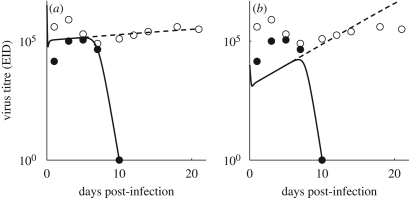
Figure 1.
Figure 1.
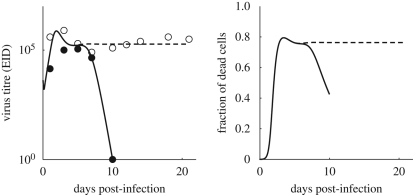
Data and model fit for the model with no epithelial cell regrowth (λ = 0) and no innate IR (ω = 0). (a) No limit on the virus inoculum. (b) Virus inoculum bound from above by V0 = 104. Open circles, nude mice; filled circles, wild-type mice.
Figure 2.
Figure 2.
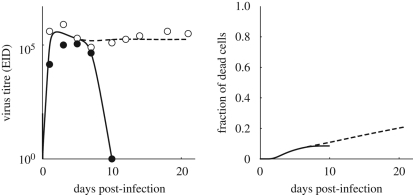
Data and model fit for the model including regrowth of epithelium (λ = 0.25 per day). Dashed curve, nude mice; solid curve, wild-type mice.
Figure 3.
Figure 3.
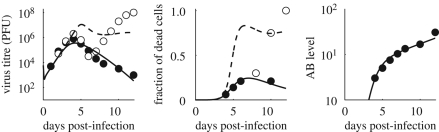
Data and model fit for the model including both an innate and adaptive IR. Best-fit parameters for the innate response are δ = 0.4, κ = 6.1 × 10⁻⁵. Cell regrowth is ignored (λ = 0). Dashed curve, nude mice; solid curve, wild-type mice.
Figure 4.
Figure 4.
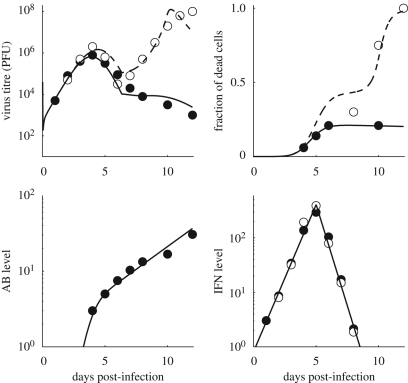
Best fit of the IN data, model without the innate IR. Symbols show data from the IN study (Iwasaki & Nozima 1977) for both immunocompetent mice (filled circles) and mice treated with anti-IgM antibody (open circles). For the antibody levels, we added values for IgM and IgA and ignored IgG since the latter was found not to have an effect on the infection dynamics (Iwasaki & Nozima 1977). Best-fit parameter values are k = 10.3, λ = 0.17; the other parameter values are given in table 2.
Figure 5.
Figure 5.
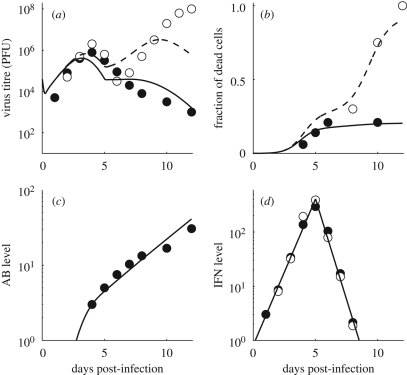
Best fit of the model with innate IR. Symbols show data from the IN study (Iwasaki & Nozima 1977) for both immunocompetent mice (filled circles) and mice treated with anti-IgM antibody (open circles). For the antibody levels, we added values for IgM and IgA and ignored IgG since the latter was found not to have an effect on the infection dynamics (Iwasaki & Nozima 1977). Best-fit parameter values are k = 1.8, κ = 1.8 × 10⁻², λ = 1.9 × 10⁻⁸; the other parameter values are given in table 2. Levels of IFN are fitted with the simple model log10 F(t) = 0.5388t − 0.08429 for t ≤ 5, log10 F(t) = −0.7435t + 6.328 for t > 5.
Figure 6.
Figure 6.
Best fit of the model with a time delay. Best-fit parameter values are τ = 1.3, k = 20, κ = 4.5 × 10⁻², λ = 1.5 × 10⁻²; the other parameter values are given in table 2. Filled circles, wild-type mice; open circles, anti-IgM mice.

Similar articles

Cited by

References

    1. Asquith B., Bangham C. R. M. 2007. Quantifying HTLV-I dynamics. Immunol. Cell Biol. 85, 280–286. (10.1038/sj.icb.7100050) - DOI - PubMed
    1. Baccam P., Beauchemin C., Macken C. A., Hayden F. G., Perelson A. S. 2006. Kinetics of influenza A virus infection in humans. J. Virol. 80, 7590–7599. (10.1128/JVI.01623-05) - DOI - PMC - PubMed
    1. Batista F. D., Harwood N. E. 2009. The who, how and where of antigen presentation to b cells. Nat. Rev. Immunol. 9, 15–27. (10.1038/nri2454) - DOI - PubMed
    1. Beauchemin C. A. A., McSharry J. J., Drusano G. L., Nguyen J. T., Went G. T., Ribeiro R. M., Perelson A. S. 2008. Modeling amantadine treatment of influenza A virus in vitro. J. Theor. Biol. 254, 439–451. (10.1016/j.jtbi.2008.05.031) - DOI - PMC - PubMed
    1. Bender B. S., Croghan T., Zhang L., Small P. A. 1992. Transgenic mice lacking class I major histocompatibility complex-restricted T cells have delayed viral clearance and increased mortality after influenza virus challenge. J. Exp. Med. 175, 1143–1145. (10.1084/jem.175.4.1143) - DOI - PMC - PubMed