


doi: 10.1086/599377.
Epidemiological evidence for the role of the hemoglobin receptor, hmbR, in meningococcal virulence
Affiliations
- PMID: 19476432
- PMCID: PMC2731217
- DOI: 10.1086/599377
Item in Clipboard
Epidemiological evidence for the role of the hemoglobin receptor, hmbR, in meningococcal virulence
J Infect Dis.
.
Abstract
The distribution of the hemoglobin receptor gene (hmbR) was investigated among disease and carriage Neisseria meningitidis isolates, revealing that the gene was detected at a significantly higher frequency among disease isolates than among carriage isolates. In isolates without hmbR, the locus was occupied by the cassettes exl2 or exl3 or by a "pseudo hmbR" gene, designated exl4. The hmbR locus exhibited characteristics of a pathogenicity island in published genomes of N. meningitidis, Neisseria gonorrhoeae, and Neisseria lactamica sequence type-640. These data are consistent with a role for the hmbR gene in meningococcal disease.
Figures
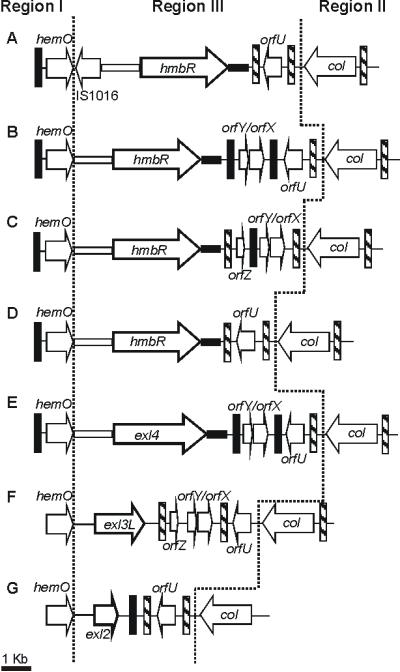
A. N. gonorrhoeae FA1090 [accession number AE004969]; B. N. meningitidis FAM18 [accession number AM421808]; C. N. meningitidis MC58 [accession number AE002098]; D. N. meningitidis Z2491 [accession number AL157959]; E. N. meningitidis NMC053442 [accession number CP000381]; F. N. lactamica ST-640 and G. N. meningitidis isolate GA0929 [accession number AF319532]. Annotation was derived from the published genome data available at TIGR, the Sanger institute and data published by Kahler et al [2]. Permission for use of the N. lactamica genome data was kindly given by Julian Parkhill at the Sanger Institute and genome data is available at http://www.sanger.ac.uk/Projects/N_lactamica// . Each ORF is represented by an arrow the direction of which indicating the theoretical direction of transcription. Thin black vertical bars indicate Correia elements, hatched vertical bars represent inverted repeats. Open horizontal blocks denote highly conserved 174 bp regions located at the 5′ end of the hmbR and exl4 ORFs. Black horizontal blocks represent 112 bp conserved regions located immediately after the hmbR or exl4 ORFs. Both conserved regions were not found in N. lactamica or N. meningitidis GA0929.
References
Publication types
MeSH terms
Substances
Grants and funding
LinkOut - more resources
Full Text Sources
Medical
