Comparative Study
. 2009 Spring;12(2):88-94.
doi: 10.1111/j.1751-7141.2009.00028.x.

Use of an electronic medical record to characterize cases of intermediate statin-induced muscle toxicity

Affiliations
Comparative Study

Use of an electronic medical record to characterize cases of intermediate statin-induced muscle toxicity

Ravi K Mareedu et al. Prev Cardiol. 2009 Spring.

Abstract

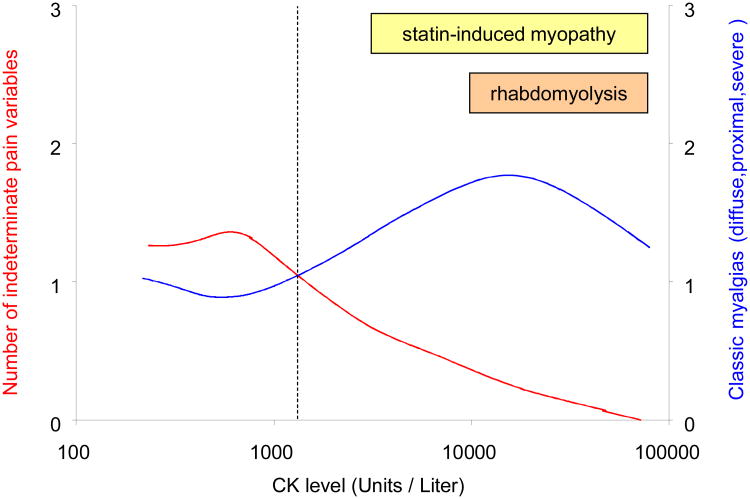
Statin use can be accompanied by a variety of musculoskeletal complaints. The authors describe the clinical characteristics of case patients who experienced adverse statin-induced musculoskeletal symptoms within a large population-based cohort in Central Wisconsin. Case status was determined based on elevated serum creatine kinase (CK) levels and the presence of at least 1 physician note reflecting an increased index of suspicion for statin intolerance. From the medical records of nearly 2 million unique patients, the authors identified more than 20,000 potential study patients ( approximately 1%) having CK data and at least 1 exposure to a statin drug. Manual screening was completed on 2227 patients with CK levels in the upper 10th percentile. Of those screened, 267 met inclusion criteria (12.0% eligibility) and 218 agreed to participate in a retrospective study characterizing the risk determinants of statin-induced muscle toxicity. Three categoric pain variables were graded retrospectively (distribution, location, and severity of pain). The presenting complaints of the case patients were extremely heterogeneous. The number of patients with a compelling pain syndrome (diffuse, proximal muscle pain of high intensity) increased at higher serum CK levels; the number of patients with indeterminate pain variables decreased at higher serum CK levels. The lines reflecting these relationships cross at a CK level of approximately 1175 U/L, approximately half the threshold level needed to make a clinical diagnosis of "myopathy" (ie, CK >10-fold the upper limit of normal).


Figures

Figure 1
Figure 1
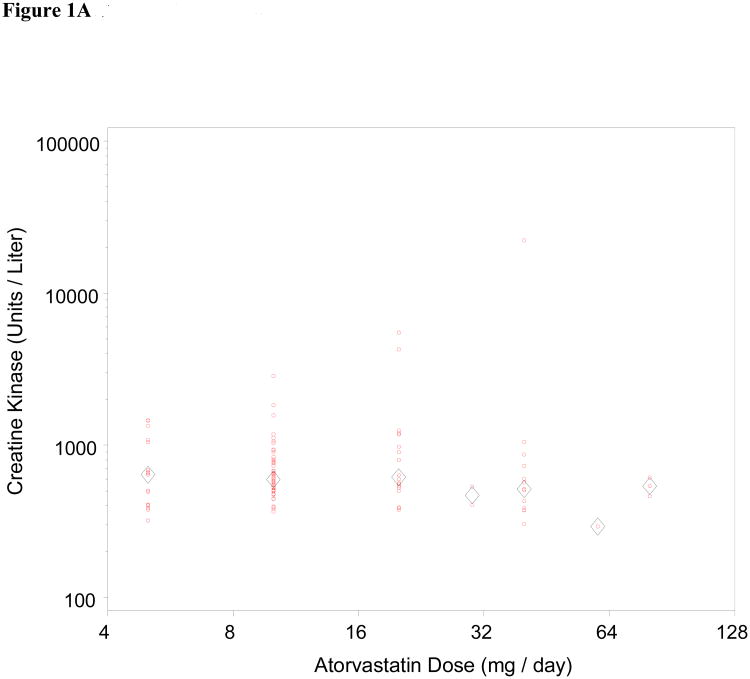
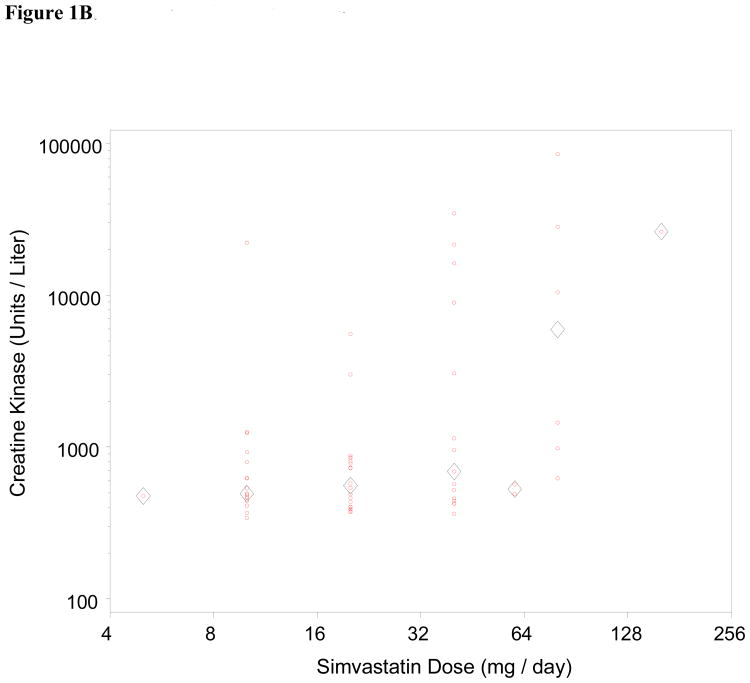
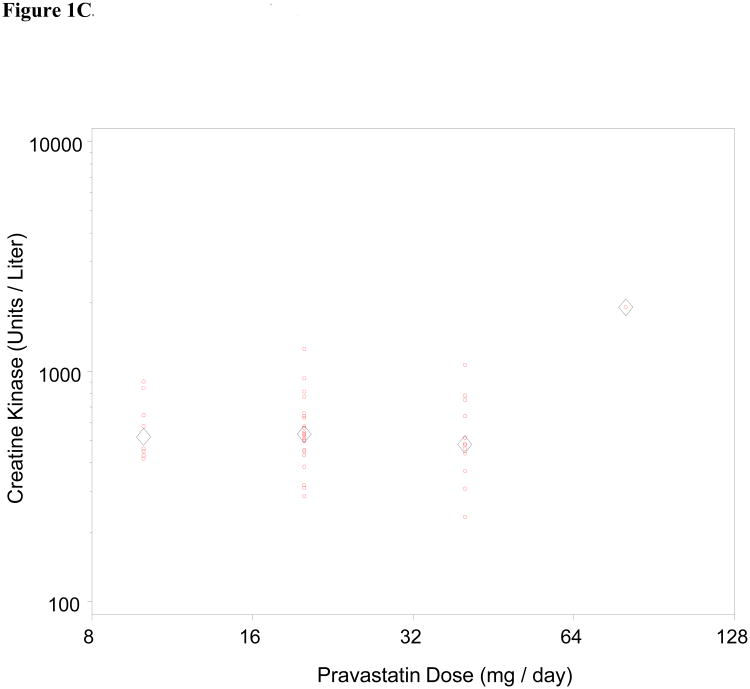
Dose dependence of statin myotoxicity. The CK level has been plotted against daily dose for atorvastatin (Fig 1A), simvastatin (Fig 1B), and pravastatin (Fig 1C). Circles represent individual patients; diamonds represent mean CK for each dose. The Spearman correlation of CK with dose is significant for the simvastatin cases (r = 0.35, p = 0.005). The correlations are not significant for the atorvastatin cases (r = -0.08, p = 0.41) or the pravastatin cases (r = -0.02, p = 0.90).
Figure 1
Figure 1
Dose dependence of statin myotoxicity. The CK level has been plotted against daily dose for atorvastatin (Fig 1A), simvastatin (Fig 1B), and pravastatin (Fig 1C). Circles represent individual patients; diamonds represent mean CK for each dose. The Spearman correlation of CK with dose is significant for the simvastatin cases (r = 0.35, p = 0.005). The correlations are not significant for the atorvastatin cases (r = -0.08, p = 0.41) or the pravastatin cases (r = -0.02, p = 0.90).
Figure 1
Figure 1
Dose dependence of statin myotoxicity. The CK level has been plotted against daily dose for atorvastatin (Fig 1A), simvastatin (Fig 1B), and pravastatin (Fig 1C). Circles represent individual patients; diamonds represent mean CK for each dose. The Spearman correlation of CK with dose is significant for the simvastatin cases (r = 0.35, p = 0.005). The correlations are not significant for the atorvastatin cases (r = -0.08, p = 0.41) or the pravastatin cases (r = -0.02, p = 0.90).
Figure 2
Figure 2
Correlation between serum CK level and pain variables in combination. Y-axis on left side (red) represents pain variables graded as “cannot determine”; Y-axis on right side (blue) represents one typical pain syndrome; X-axis represents the CK level. The number of subjects with an indeterminate pain syndrome decreases according to CK level (curved red line), whereas the number of subjects with the most commonly anticipated statin-induced myalgias (severe, diffuse pain within proximal muscles) increases by CK level (curved blue line). Each curved line represents a cubic spline created in SAS Graph (registered trademark of SAS Institute Inc.), using the penalized least squares method. The character of each line reflects a parameter which varies from 0 to 100. In the absence of graphic smoothing, each line would vary discontinuously between the bottom and the top. Conversely, full graphic smoothing would produce a straight line. We display values between these extremes, to identify trends in the data. The two lines shown here intersect at approximately 1,175 CK units per liter. This level is roughly equivalent to half of the current diagnostic threshold for “myopathy” (CK >10-fold ULN or approximately 2,000 CK units per liter).

References

    1. Thompson PD, Clarkson PM, Rosenson RS. An Assessment of Statin Safety by Muscle Experts. The American Journal of Cardiology. 2006;97(8, Supplement 1):S69–S76. - PubMed
    1. Wilke RA, Moore JH, Burmester JK. Relative impact of CYP3A genotype and concomitant medication on the severity of atorvastatin-induced muscle damage. Pharmacogenet Genomics. 2005;15(6):415–21. - PubMed
    1. Wilke RA, Reif DM, Moore JH. Combinatorial Pharmacogenetics. Nature Reviews Drug Discovery. 2005;4(11):911–8. - PubMed
    1. Wilke RA, Lin DW, Roden DM, et al. Identifying genetic risk factors for serious adverse drug reactions: current progress and challenges. Nature Reviews Drug Discovery. 2007;6(11):904–16. - PMC - PubMed
    1. SEARCH Collaborative Group. Link E, Parish S, Armitage J, Bowman L, Heath S, Matsuda F, Gut I, Lathrop M, Collins R. SLCO1B1 variants and statin-induced myopathy-a genomewide study. N Engl J Med. 2008;359(8):789–99. - PubMed

Publication types

MeSH terms

Substances