


Review
doi: 10.1016/j.neuron.2009.05.002.
Learning to encode timing: mechanisms of plasticity in the auditory brainstem
Affiliations
- PMID: 19477149
- PMCID: PMC2792730
- DOI: 10.1016/j.neuron.2009.05.002
Item in Clipboard
Review
Learning to encode timing: mechanisms of plasticity in the auditory brainstem
Neuron.
.
Abstract
Mechanisms of plasticity have traditionally been ascribed to higher-order sensory processing areas such as the cortex, whereas early sensory processing centers have been considered largely hard-wired. In agreement with this view, the auditory brainstem has been viewed as a nonplastic site, important for preserving temporal information and minimizing transmission delays. However, recent groundbreaking results from animal models and human studies have revealed remarkable evidence for cellular and behavioral mechanisms for learning and memory in the auditory brainstem.
Figures
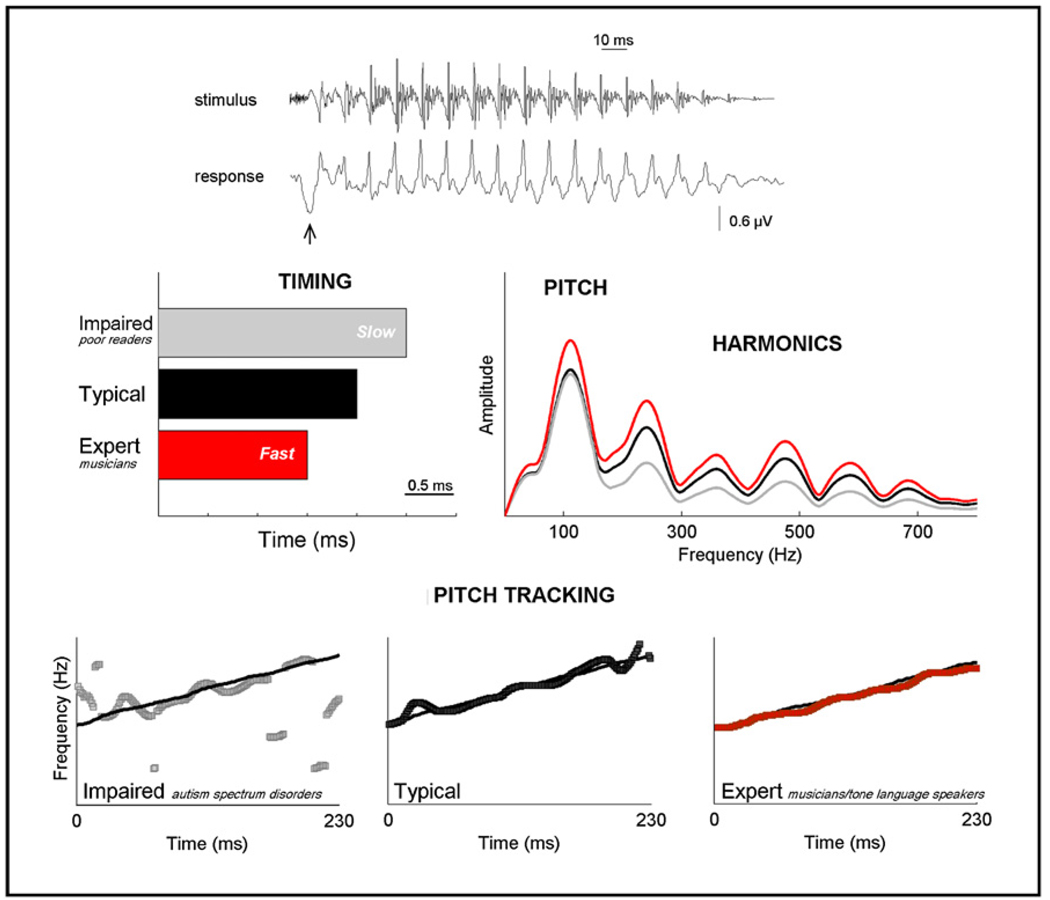
This figure provides a schematization of the findings that have emerged from nearly a decade of research on impaired (poor readers, autism spectrum disorders [ASD], typical, and expert (musicians, tonal language speakers) systems. (Top) Time-amplitude stimulus “da” and brainstem response waveform. The stimulus has been shifted by ~8 ms (approximate neural travel time) to increase visual coherence with the response. Following a sharp onset response (demarcated with an arrow), the primary periodicity of the syllable—the fundamental frequency (F0)—is clearly preserved in the response via phase locking. (Middle left) A significant subset of children with reading problems (8–12 years old) have atypical subcortical timing resulting in later (i.e., slower) responses. In contrast, musicians have more precise subcortical timing leading to earlier (i.e., faster) responses than nonmusicians. These temporal disruptions and enhancements occur on the order of tenths of milliseconds (x axis tic marks = 0.5 ms) to selective components of the response. (Middle right) A fast Fourier transform illustrates the frequency content of the response (the F0 and its harmonics). Musicians represent the pitch and harmonics of the stimulus more robustly and efficiently than their nonmusician counterparts. A different pattern is seen in a subgroup of children with reading impairments who demonstrate reduced neural encoding of the harmonics, despite normal pitch representation. (Bottom) By analyzing the brainstem response over small time bins, we can measure the precision with which brainstem nuclei phase-lock to the time-varying pitch of the stimulus, a phenomenon known as pitch tracking. In the three bottom panels, the thicker lines (gray, red) represent the pitch contour extracted from the brainstem response, and the thin black line, which is most apparent in the left panel, represents the pitch contour of the stimulus. Pitch contours were calculated using a running-window short-term Fourier analysis (40 ms time bins, 1 ms interval between the start of each consecutive bin). In these time-frequency graphs, the frequency with the largest magnitude for each given time bin is plotted. A subset of children with ASD showed poor pitch tracking relative to typically developing children, paralleling the prosodic deficit frequently occurring in autism. Musicians, on the other hand, show more accurate brainstem pitch tracking than nonmusicians.
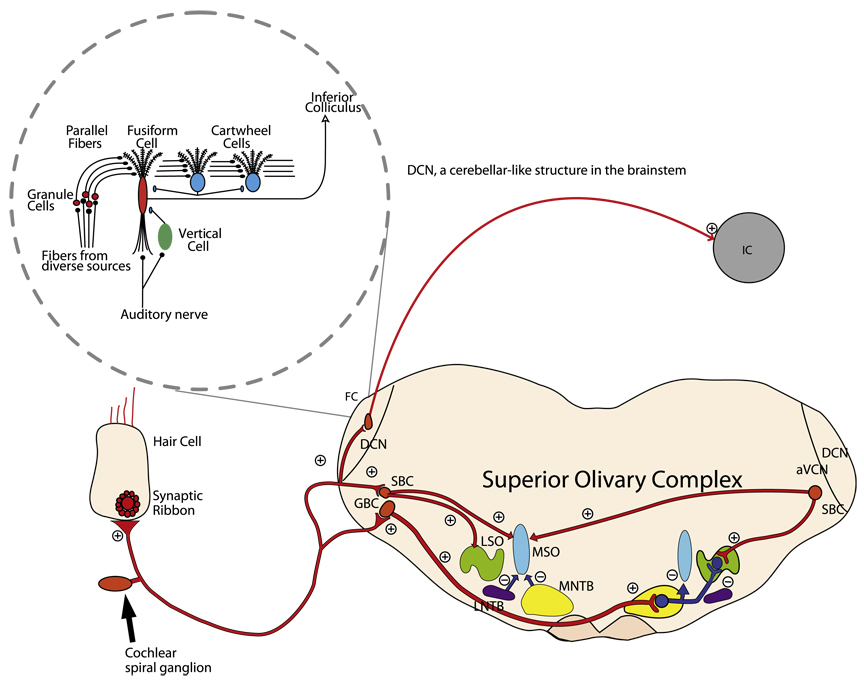
Sound coming from a lateral direction reaches one cochlea first, and then, with a short delay, the other cochlea, at a slightly attenuated intensity because the head acts as a sound barrier. The microsecond interaural time differences (ITDs) in the arrival of sound are used to determine the spatial location of low-frequency sounds, whereas differences in the intensity of sound arriving at each cochlea are used to locate high-frequency sounds. The superior olivary complex (SOC) of the mammalian brainstem is involved in computing sound localization from these two binaural cues, and the precise timing of action potential (AP) firing is thought to be crucial for this task. Auditory signals arriving at the cochlea are transmitted to the ipsilateral anterior ventral cochlear nucleus (aVCN) by excitatory synapses onto globular and spherical bushy cells (GBCs and SBCs). The synapse onto the SBC is the so-called endbulb of Held. The axons of the GBCs then cross the brainstem midline and synapse onto the principal cells of the contralateral medial nucleus of the trapezoid body (MNTB). These myelinated axons have a large diameter (4–12 µm), allowing a fast conduction velocity, and give rise to the calyx of Held, a glutamatergic synaptic terminal. The principal cells of the MNTB are glycinergic and project to the lateral superior olive (LSO). The LSO also receives excitatory input from SBCs of the ipsilateral aVCN. Discharge trains evoked by sound at the two cochleas therefore converge on LSO neurons as ipsilateral excitation (through the aVCN) and contralateral inhibition (through the MNTB). So, relative to the cochlear nuclei, excitation in the LSO is monosynaptic, whereas inhibition is disynaptic. However, the inhibitory input in the cat arrives in the LSO with a delay of only 200 µs after the excitatory input, and in the bat, inhibition can arrive even earlier than excitation. The precise timing of the two inputs is crucial in determining the response of the LSO to interaural intensity differences. It is at the level of the LSO that discharges evoked by interaural intensity differences are first represented as differences in the timing of excitatory and inhibitory inputs. So, the LSO is thought to function as a coincidence detector of binaural signals, whereas the main role of the MNTB is simply to act as a fast, sign-inverting relay station. Medial superior olive (MSO) neurons of low-frequency-hearing mammals compute the horizontal location of low-frequency sounds using the difference in the time required for a sound to propagate to each ear. These ITDs are submillisecond cues, the physiological range of which is dependent on the diameter of the animal’s head. The principal neurons of the MSO are able to extract these brief ITDs from converging binaural inputs that include an excitatory component from the ipsilateral and contralateral VCN and an inhibitory component from both the medial nucleus (MNTB) and lateral nucleus (LNTB) of the trapezoid body. Although the mechanism for extracting ITDs from these excitatory and inhibitory inputs has yet to be fully elucidated, ITD information is conveyed to higher auditory centers through a rate code. Brainstem nuclei are also important for sound localization on the vertical plane. In contrast to previous sound localization schemes that require binaural inputs, sound localization on the vertical plane is monaural. The shapes of the heads and ears of mammals are asymmetrical top-to-bottom and front-to-back. Reflections of sounds from these structures differ with the angle of incidence, producing cues for monaural sound localization in the vertical plane. Neurons in the dorsal cochlear nucleus (DCN) respond specifically to these spectral cues and integrate them with somatosensory, vestibular, and higher-level auditory information through parallel fiber inputs. The circuitry of the DCN has cerebellar-like features and differs significantly from other brainstem nuclei. DCN principal neurons project to the contralateral inferior colliculus (IC).
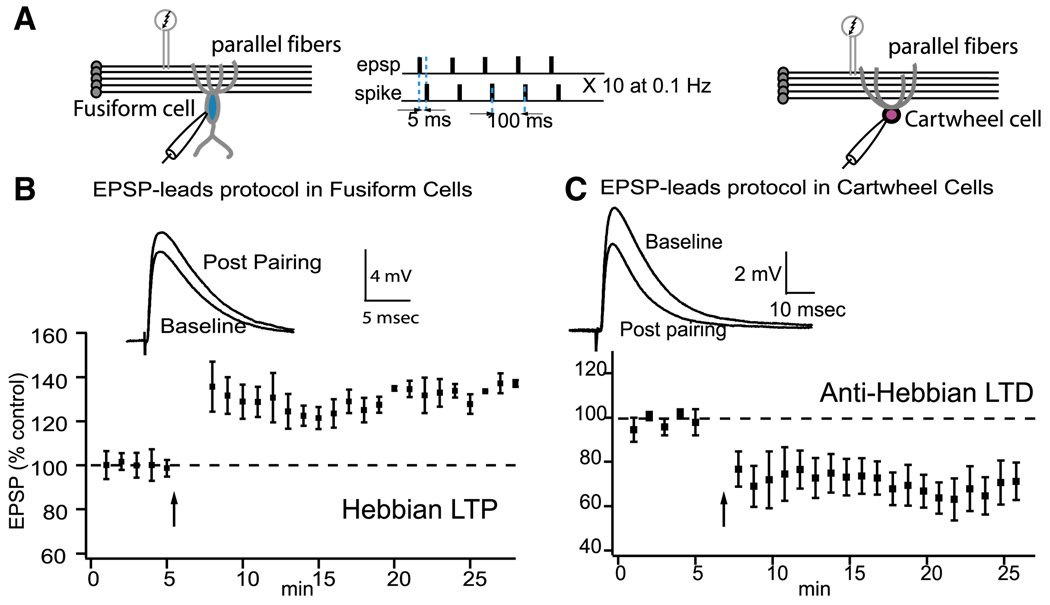
Long-term, cell-specific synaptic plasticity by time-dependent pairing of presynaptic and postsynaptic activity. (A) Plasticity was induced by a protocol of excitatory postsynaptic potential (EPSP)-spike pairs. (B) Representative traces of averaged EPSPs before and 15–20 min after pairing and time course of induced synaptic plasticity for fusiform cells. (C) Representative traces and time course of induced synaptic plasticity for cartwheel cells. The same protocol induces LTP in fusiform cells and LTD at cartwheel cells. These studies have demonstrated unique, opposing forms of spike-timing-dependent plasticity (STDP) at parallel fiber synapses onto fusiform and cartwheel cells. Error bars report ±SEM. Reproduced with permission from Tzounopoulos (2008).
References
-
- Ahissar M, Hochstein S. The reverse hierarchy theory of visual perceptual learning. Trends Cogn. Sci. 2004;8:457–464. - PubMed
-
- Akhoun I, Gallego S, Moulin A, Menard M, Veuillet E, Berger-Vachon C, Collet L, Thai-Van H. The temporal relationship between speech auditory brainstem responses and the acoustic pattern of the phoneme /ba/ in normal-hearing adults. Clin. Neurophysiol. 2008;119:922–933. - PubMed
-
- Bell CC, Han VZ, Sugawara Y, Grant K. Synaptic plasticity in a cerebellum-like structure depends on temporal order. Nature. 1997;387:278–281. - PubMed
Publication types
MeSH terms
Grants and funding
LinkOut - more resources
Full Text Sources
