Effectiveness of thigh-length graduated compression stockings to reduce the risk of deep vein thrombosis after stroke (CLOTS trial 1): a multicentre, randomised controlled trial
- PMID: 19477503
- PMCID: PMC2692021
- DOI: 10.1016/S0140-6736(09)60941-7
Effectiveness of thigh-length graduated compression stockings to reduce the risk of deep vein thrombosis after stroke (CLOTS trial 1): a multicentre, randomised controlled trial
Abstract
Background: Deep vein thrombosis (DVT) and pulmonary embolism are common after stroke. In small trials of patients undergoing surgery, graduated compression stockings (GCS) reduce the risk of DVT. National stroke guidelines extrapolating from these trials recommend their use in patients with stroke despite insufficient evidence. We assessed the effectiveness of thigh-length GCS to reduce DVT after stroke.
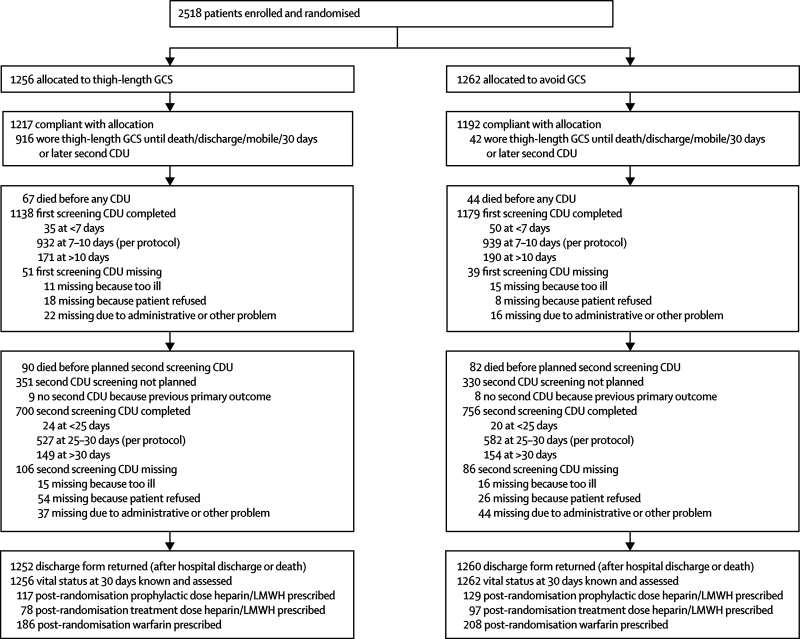
Methods: In this outcome-blinded, randomised controlled trial, 2518 patients who were admitted to hospital within 1 week of an acute stroke and who were immobile were enrolled from 64 centres in the UK, Italy, and Australia. Patients were allocated via a central randomisation system to routine care plus thigh-length GCS (n=1256) or to routine care plus avoidance of GCS (n=1262). A technician who was blinded to treatment allocation undertook compression Doppler ultrasound of both legs at about 7-10 days and, when practical, again at 25-30 days after enrolment. The primary outcome was the occurrence of symptomatic or asymptomatic DVT in the popliteal or femoral veins. Analyses were by intention to treat. This study is registered, number ISRCTN28163533.
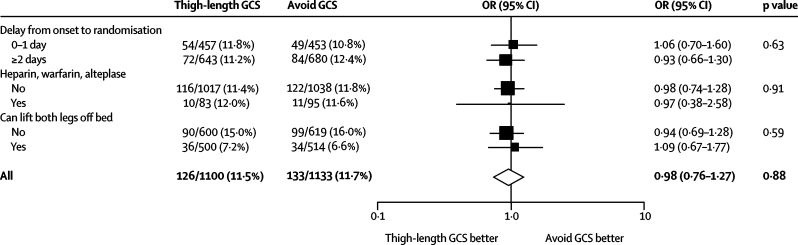
Findings: All patients were included in the analyses. The primary outcome occurred in 126 (10.0%) patients allocated to thigh-length GCS and in 133 (10.5%) allocated to avoid GCS, resulting in a non-significant absolute reduction in risk of 0.5% (95% CI -1.9% to 2.9%). Skin breaks, ulcers, blisters, and skin necrosis were significantly more common in patients allocated to GCS than in those allocated to avoid their use (64 [5%] vs 16 [1%]; odds ratio 4.18, 95% CI 2.40-7.27).
Interpretation: These data do not lend support to the use of thigh-length GCS in patients admitted to hospital with acute stroke. National guidelines for stroke might need to be revised on the basis of these results.
Funding: Medical Research Council (UK), Chief Scientist Office of Scottish Government, Chest Heart and Stroke Scotland, Tyco Healthcare (Covidien) USA, and UK Stroke Research Network.
Figures
Comment in
-
Thigh-length compression stockings and DVT after stroke.Lancet. 2009 Jun 6;373(9679):1923-4. doi: 10.1016/S0140-6736(09)60990-9. Epub 2009 May 26. Lancet. 2009. PMID: 19477504 No abstract available.
-
CLOTS: an opportunity missed.Lancet. 2009 Oct 3;374(9696):1143; author reply 1143-4. doi: 10.1016/S0140-6736(09)61732-3. Lancet. 2009. PMID: 19801084 No abstract available.
-
ACP Journal Club. Graduated compression stockings did not prevent deep venous thrombosis after stroke and increased skin complications.Ann Intern Med. 2009 Oct 20;151(8):JC4-9. doi: 10.7326/0003-4819-151-8-200910200-02009. Ann Intern Med. 2009. PMID: 19841446 No abstract available.
-
[Compression stockings do not reduce the risk of deep vein thrombosis in patients after stroke].Praxis (Bern 1994). 2009 Nov 4;98(22):1317-8. doi: 10.1024/1661-8157.98.22.1317. Praxis (Bern 1994). 2009. PMID: 20029787 German. No abstract available.
References
-
- House of Commons Health Committee . The prevention of venous thromboembolism in hospitalised patients. Second Report of Session 2004–05 Report, HC 99. The Stationery Office; London: 2005.
-
- Kelly J, Rudd A, Lewis RR, Coshall C, Moody A, Hunt BJ. Venous thromboembolism after acute ischemic stroke: a prospective study using magnetic resonance direct thrombus imaging. Stroke. 2004;35:2320–2355. - PubMed
-
- Sandercock PAG, Counsell C, Kamal AK. Anticoagulants for acute ischaemic stroke. Cochrane Database Syst Rev. 2008;4 CD000024. - PubMed
-
- Adams HP, Jr, del Zoppo G, Alberts M. Guidelines for the early management of adults with ischemic stroke. Stroke. 2007;38:1655–1711. - PubMed
-
- Royal College of Physicians . National Clinical Guidelines for Stroke 2004. Royal College of Physicians; London: 2004.
Publication types
MeSH terms
Associated data
Grants and funding
LinkOut - more resources
Full Text Sources
Other Literature Sources
Medical