. 2009 May;5(5):e1000445.
doi: 10.1371/journal.ppat.1000445. Epub 2009 May 29.

Structure-based stabilization of HIV-1 gp120 enhances humoral immune responses to the induced co-receptor binding site

Affiliations

Structure-based stabilization of HIV-1 gp120 enhances humoral immune responses to the induced co-receptor binding site

Barna Dey et al. PLoS Pathog. 2009 May.

Abstract

The human immunodeficiency virus type 1 (HIV-1) exterior envelope glycoprotein, gp120, possesses conserved binding sites for interaction with the primary virus receptor, CD4, and also for the co-receptor, generally CCR5. Although gp120 is a major target for virus-specific neutralizing antibodies, the gp120 variable elements and its malleable nature contribute to evasion of effective host-neutralizing antibodies. To understand the conformational character and immunogenicity of the gp120 receptor binding sites as potential vaccine targets, we introduced structure-based modifications to stabilize gp120 core proteins (deleted of the gp120 major variable regions) into the conformation recognized by both receptors. Thermodynamic analysis of the re-engineered core with selected ligands revealed significant stabilization of the receptor-binding regions. Stabilization of the co-receptor-binding region was associated with a marked increase in on-rate of ligand binding to this site as determined by surface plasmon resonance. Rabbit immunization studies showed that the conformational stabilization of core proteins, along with increased ligand affinity, was associated with strikingly enhanced humoral immune responses against the co-receptor-binding site. These results demonstrate that structure-based approaches can be exploited to stabilize a conformational site in a large functional protein to enhance immunogenic responses specific for that region.


Conflict of interest statement

The authors have declared that no competing interests exist.

Figures
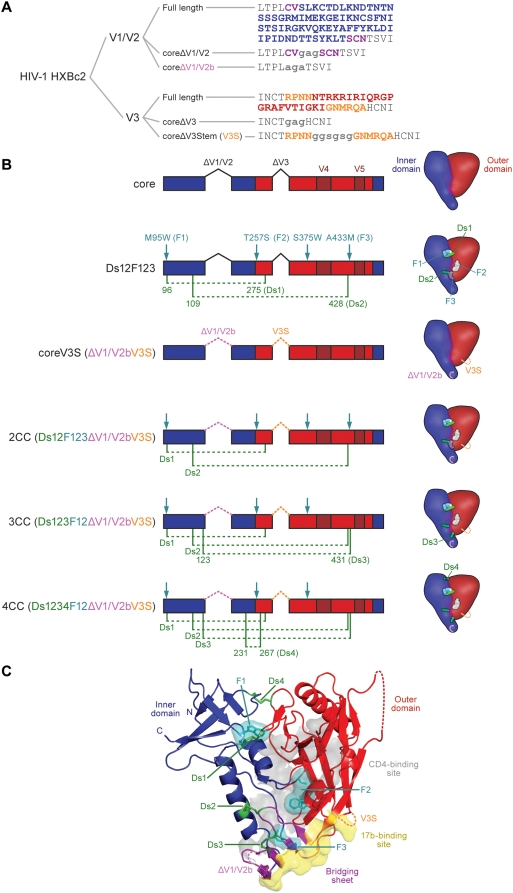
Figure 1
Figure 1. Structural elements of the HXBc2 gp120 core protein and its stabilized derivatives.
A. Amino acid sequences of the V1/V2 loop and the V3 loop as present in full-length gp120, in the previously crystallized core protein and in coreV3S protein. Linker sequences are in lower case. B. Linear diagram of core and coreV3S derivatives showing positions of V1/V2- and V3 loop deletions, cavity-filling mutations (F, teal arrows) and paired disulfide mutations (Ds, green dotted lines). The schematics depict surface models of each corresponding core derivative indicating relative positions of the mutations within inner domain (blue) and outer domain (red). C. Ribbon diagram of HXBc2 core gp120 crystal structure with all stabilizing mutations modeled on it. Indicated are the modifications of V1V2- and V3 loops (labeled dashed lines), the CD4 binding surface (translucent gray), the 17b epitope surface contacts (yellow) and the beta strands comprising the bridging sheet sub-domain (purple). Note the proximity of Ds2 and Ds3 to both the CD4 binding site and the bridging sheet. 17b is the prototypic co-receptor-binding-site-directed antibody, which inhibits gp120-CD4 interaction with co-receptor, and serves as surrogate for co-receptor N-terminal interaction with the gp120 core. Conserved V3 loop elements (not shown) also contribute to gp120-CD4-co-receptor interaction.
Figure 2
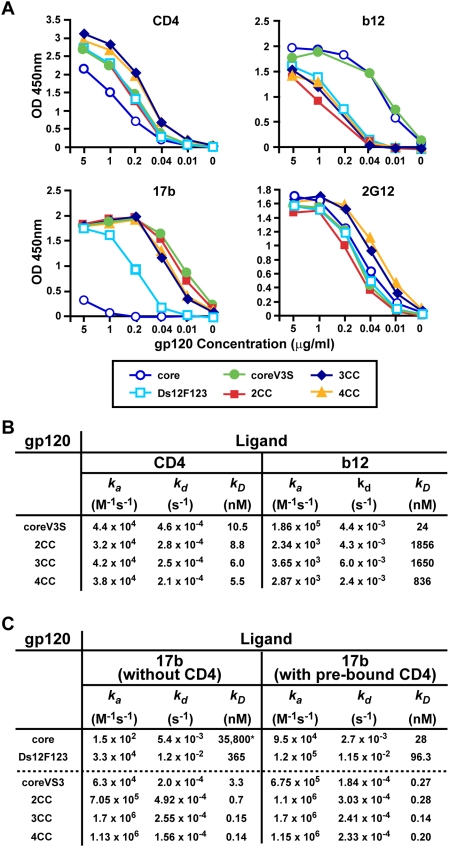
Figure 2. Antigenic analysis of unmodified and structurally stabilized core envelope variants by ELISA and SPR.
A. ELISA plates were coated with ligand (2 µg/ml), reacted with 5-fold serial dilutions of affinity-purified envelope glycoproteins (starting at 5 µg/ml) and detected with 1∶2500 dilution of rabbit immune sera raised against HXBc2 core protein (unmodified). Upper left, binding to soluble human CD4 (4-domain; Progenics); upper right, binding to b12; lower left, binding to 17b; lower right, binding to 2G12. Margins of error from duplicate wells were negligible in all cases. B and C. Binding rate constants for interactions of stabilized gp120 core proteins with sCD4, b12 and 17b. Approximately 500 RU each of 17b, sCD4 and b12 were coated on CM5 chip. Two-fold serial dilutions of each gp120 protein were allowed to bind to the surfaces for 3 min followed by dissociation for 5 min. The kinetic constants were obtained by fitting the curves to 1∶1 Langmuir binding model. B. Kinetics of CD4 and b12 interactions. C. Kinetics of 17b binding to gp120 variants without or with pre-exposure to 10-fold molar excess of sCD4. *Data obtained from very low binding interaction (maximum RU of 8.5).
Figure 3
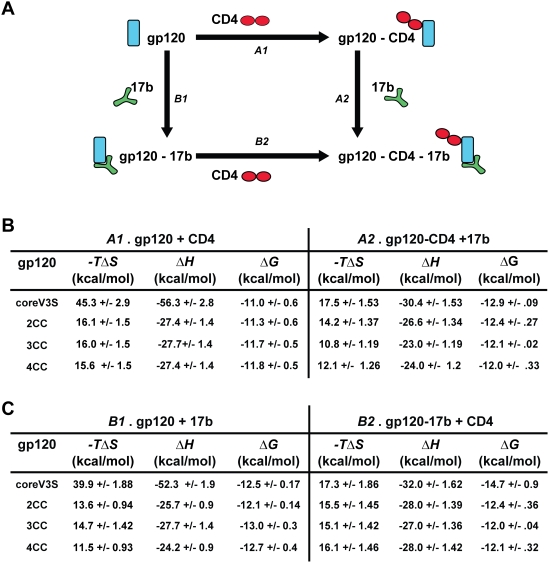
Figure 3. Thermodynamic values of sCD4 and 17b interactions with gp120 variants measured by ITC at 37°C.
A. Schematic of complete thermodynamic cycles showing two possible orders of reactions. B and C. Changes in enthalpy (ΔH), entropy (−TΔS) and free energy (ΔG) upon ligand interactions with gp120. B. Binding to CD4 (A1) followed by binding to 17b (A2). C. Binding of 17b (B1) followed by binding to CD4 (B2).
Figure 4
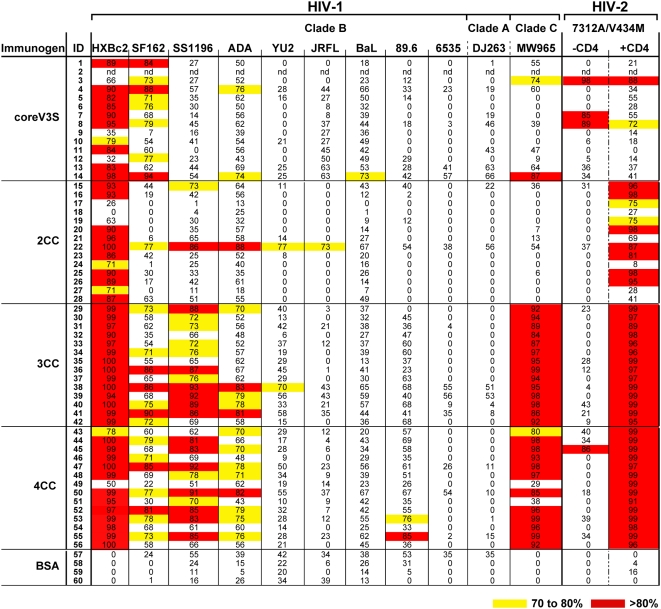
Figure 4. Neutralization profile of fivefold diluted rabbit immune sera tested against a panel of HIV-1 and HIV-2 isolates.
All sera tested were collected after four inoculations. Neutralization by preimmune sera was used as negative control for serum reactivity.
Figure 5
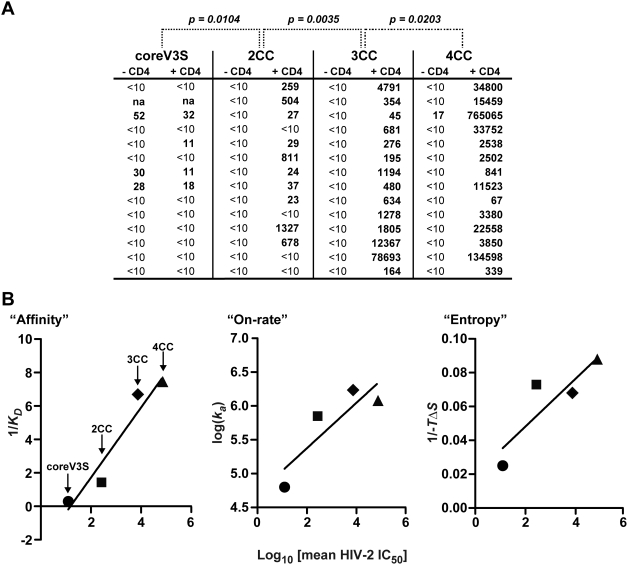
Figure 5. Statistical correlation of HIV-2 neutralization titers with kinetic and thermodynamic properties.
A. ID50 values of HIV-2 neutralization by rabbit immune sera, performed in the absence and presence of sCD4. The statistical significance (p value) of the increase in HIV-2-neutralization titer (in the presence of sCD4) with the increase in the number of stabilizing cysteines (2CC, 3CC, 4CC) was analyzed by Mann-Whitney test. B. Linear regression analysis showing correlations of HIV-2-neutralization titer with kinetic and thermodynamic parameters. Left, with reciprocal of affinity (1/kD); middle, with reciprocal of the association rate constant (1/ka); right, with the percent of epitope stabilization, as measured from the entropy change (−TΔS) relative to that of coreV3S.
Figure 6
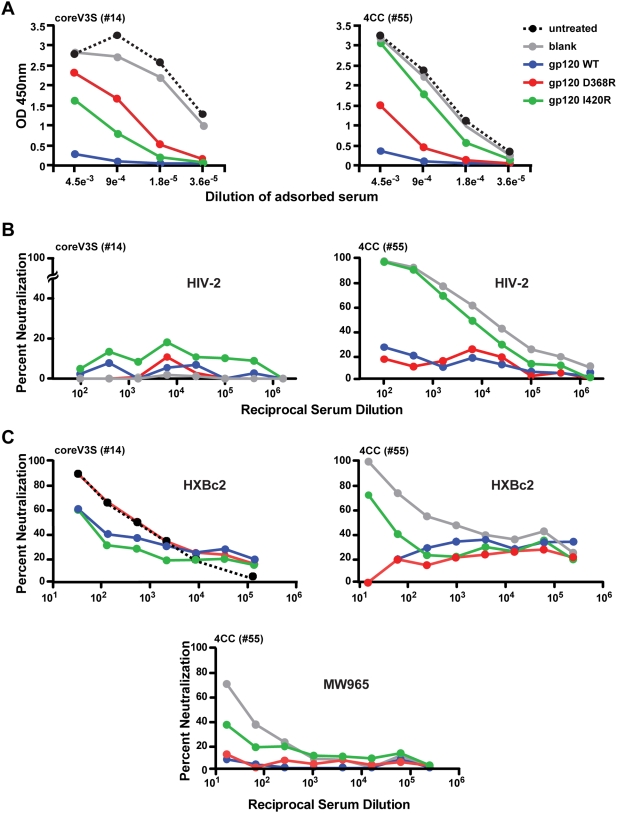
Figure 6. Percent neutralization of pseudotyped HIV isolates by differentially adsorbed flow-through fractions of rabbit immune sera.
A. ELISA experiments to determine gp120-binding titers of serum fractions following selective adsorptions. Immune sera from the unmodified (coreV3S) and the most-stabilized (4CC) immunogen groups were incubated with uncoated dynal beads (blank) or dynal beads coated with BSA or gp120WT or gp120-D368R or gp120-I420R proteins. Starting at 11-fold dilution, fivefold serial dilutions of the FTs, from these reactions were tested for binding to gp120 on ELISA plates. Untreated serum or serum FTs from reactions with blank beads and were used as positive controls and FTs after incubation with gp120 beads were used as negative controls for binding. B. Neutralization of HIV-2 7312/V434M isolate by immune sera FTs following differential adsorptions. Neutralization was performed in the presence of 0.5 µg/ml of soluble CD4 (sCD4). C. Neutralization of the HIV-1 clade B isolate, HXBc2 (top panels) and the clade C isolate, MW965 (bottom panel). Margins of error obtained from duplicate reactions were negligible.

References

    1. Pantaleo G, Koup RA. Correlates of immune protection in HIV-1 infection: what we know, what we don't know, what we should know. Nat Med. 2004;10:806–810. - PubMed
    1. Plotkin SA. Vaccines: correlates of vaccine-induced immunity. Clin Infect Dis. 2008;47:401–409. - PubMed
    1. Phogat S, Wyatt R. Rational modifications of HIV-1 envelope glycoproteins for immunogen design. Curr Pharm Des. 2007;13:213–227. - PubMed
    1. Wyatt R, Sodroski J. The HIV-1 envelope glycoproteins: fusogens, antigens, and immunogens. Science. 1998;280:1884–1888. - PubMed
    1. Myszka DG, Sweet RW, Hensley P, Brigham-Burke M, Kwong PD, et al. Energetics of the HIV gp120-CD4 binding reaction. Proc Natl Acad Sci U S A. 2000;97:9026–9031. - PMC - PubMed

Publication types