


Migration of whooper swans and outbreaks of highly pathogenic avian influenza H5N1 virus in eastern Asia
- PMID: 19479053
- PMCID: PMC2684635
- DOI: 10.1371/journal.pone.0005729
Migration of whooper swans and outbreaks of highly pathogenic avian influenza H5N1 virus in eastern Asia
Abstract
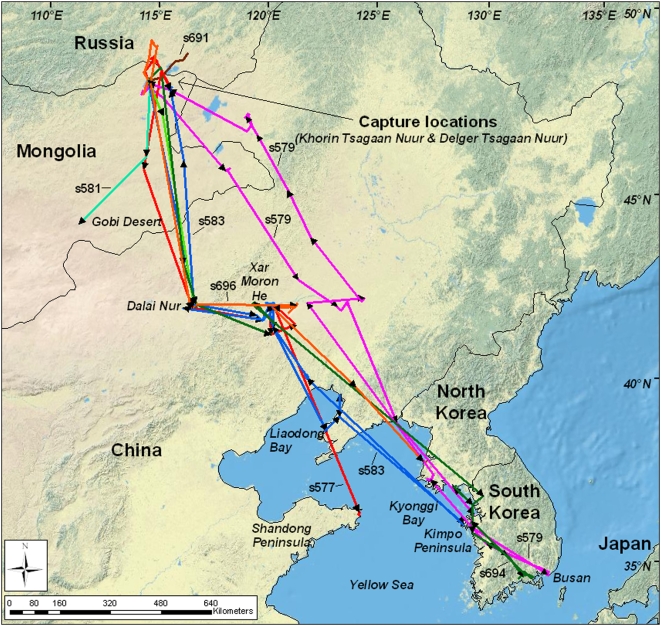
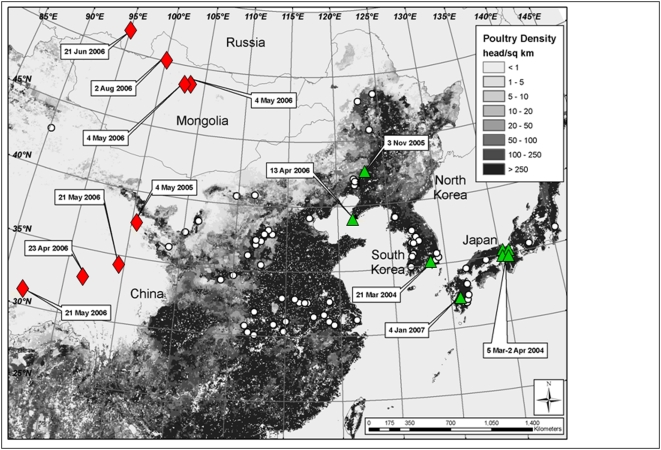
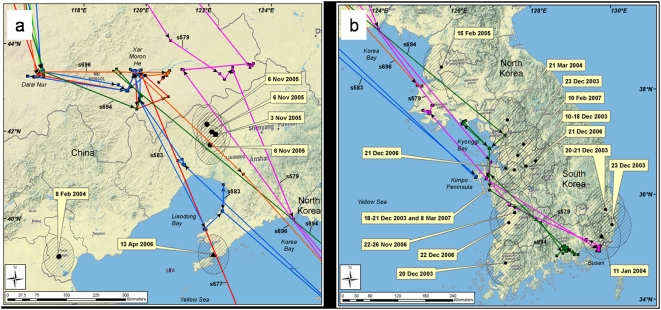
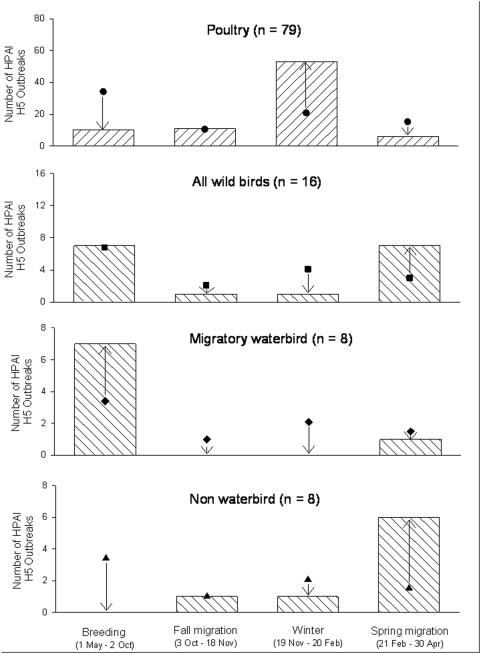
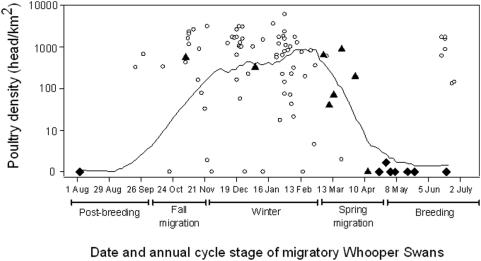
Evaluating the potential involvement of wild avifauna in the emergence of highly pathogenic avian influenza H5N1 (hereafter H5N1) requires detailed analyses of temporal and spatial relationships between wild bird movements and disease emergence. The death of wild swans (Cygnus spp.) has been the first indicator of the presence of H5N1 in various Asian and European countries; however their role in the geographic spread of the disease remains poorly understood. We marked 10 whooper swans (Cygnus cygnus) with GPS transmitters in northeastern Mongolia during autumn 2006 and tracked their migratory movements in relation to H5N1 outbreaks. The prevalence of H5N1 outbreaks among poultry in eastern Asia during 2003-2007 peaked during winter, concurrent with whooper swan movements into regions of high poultry density. However outbreaks involving poultry were detected year round, indicating disease perpetuation independent of migratory waterbird presence. In contrast, H5N1 outbreaks involving whooper swans, as well as other migratory waterbirds that succumbed to the disease in eastern Asia, tended to occur during seasons (late spring and summer) and in habitats (areas of natural vegetation) where their potential for contact with poultry is very low to nonexistent. Given what is known about the susceptibility of swans to H5N1, and on the basis of the chronology and rates of whooper swan migration movements, we conclude that although there is broad spatial overlap between whooper swan distributions and H5N1 outbreak locations in eastern Asia, the likelihood of direct transmission between these groups is extremely low. Thus, our data support the hypothesis that swans are best viewed as sentinel species, and moreover, that in eastern Asia, it is most likely that their infections occurred through contact with asymptomatic migratory hosts (e.g., wild ducks) at or near their breeding grounds.
Conflict of interest statement
Figures
References
-
- Chen H, Smith GJ, Zhang SY, Qin K, Wang J, Li KS, et al. Avian flu: H5N1 virus outbreak in migratory waterfowl. Nature. 2005;436:191–192. - PubMed
-
- Liu J, Xiao H, Lei F, Zhu Q, Qin K, et al. Highly pathogenic H5N1 influenza virus infection in migratory birds. Science. 2005;309:1206. - PubMed
-
- Whitworth D, Newman SH, Mundkur T, Harris P, editors. FAO. Wild birds and avian influenza: An introduction to applied field research and disease sampling techniques. 2007. FAO Animal Production and Health Manual, No. 5. Rome Italy. (Available: http://www.fao.org/avianflu)
-
- FAO. FAO EMPRES-I database. Emergency Centre for Transboundary Animal Diseases (ECTAD), Animal Health Service. Rome, Italy: Food and Agriculture Organization of the United Nations; 2008.
-
- OIE. 2008. Update on highly pathogenic avian influenza in animals: Type H5 and H7 (as of 20-08-2008; Available: http://www.oie.int/downld/AVIAN20INFLUENZA/A_AI-Asia.htm)
Publication types
MeSH terms
LinkOut - more resources
Full Text Sources
Medical
Miscellaneous
