


Review
doi: 10.1002/cm.20388.
Cytoskeletal pathologies of Alzheimer disease
Affiliations
- PMID: 19479823
- PMCID: PMC2754410
- DOI: 10.1002/cm.20388
Item in Clipboard
Review
Cytoskeletal pathologies of Alzheimer disease
Cell Motil Cytoskeleton.
2009 Aug.
Abstract
The histopathological hallmarks of Alzheimer disease are the extracellular amyloid plaques, composed principally of the amyloid beta peptide, and the intracellular neurofibrillary tangles, composed of paired helical filaments of the microtubule-associated protein, tau. Other histopathological structures involving actin and the actin-binding protein, cofilin, have more recently been recognized. Here we review new findings about these cytoskeletal pathologies, and, emphasize how plaques, tangles, the actin-containing inclusions and their respective building blocks may contribute to Alzheimer pathogenesis and the primary behavioral symptoms of the disease. Cell Motil. Cytoskeleton, 2009. (c) 2009 Wiley-Liss, Inc.
Figures
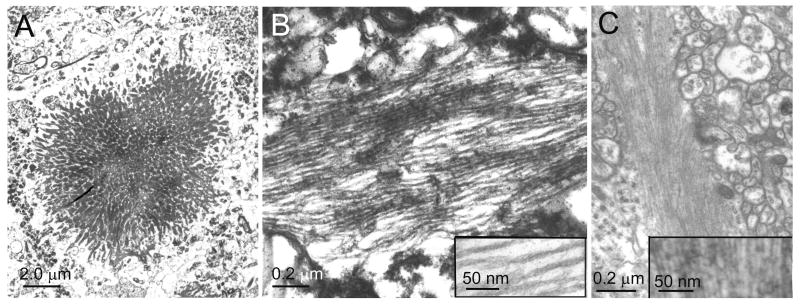
(A). Extracellular amyloid plaque. (B) Tau-containing 20 nm wide paired helical filaments; the twisted ribbon-like structure is better seen in the magnified inset. (C) A likely cofilin-actin rod with a morphology identical to those induced in rat brain organotypic slices (Davis et al., 2009). Inset at higher magnification shows filaments are thinner (8-9 nm) than paired helical filaments. Images were kindly provided by Judy Boyle (A and B) and George Perry and Sandra Siedlak (C).
References
-
- Agnew BJ, Minamide LS, Bamburg JR. Reactivation of phosphorylated actin depolymerizing factor and identification of the regulatory site. J Biol Chem. 1995;270:17582–17587. - PubMed
-
- Alzheimer A. Uber eine eigenartige Erkankung der Hirnrinde. Allgemeine Zeitschrift für Psychiatrie und phychish-Gerichtliche Medizin, (Berlin) 1907;64:146–148.
-
- Anderton BH, Breinburg D, Downes MJ, Green PJ, Tomlinson BE, Ulrich J, Wood JN, Kahn J. Monoclonal antibodies show that neurofibrillary tangles and neurofilaments share antigenic determinants. Nature. 1982;298:84–86. - PubMed
-
- Andreadis A. Tau gene alternative splicing: expression patterns, regulation and modulation of function in normal brain and neurodegenerative diseases. Biochim Biophys Acta. 2005;1739:91–103. - PubMed
-
- Andrianantoandro E, Pollard TD. Mechanism of actin filament turnover by severing and nucleation at different concentrations of ADF/cofilin. Mol Cell. 2006;24:13–23. - PubMed
Publication types
MeSH terms
Substances
Grants and funding
LinkOut - more resources
Full Text Sources
Other Literature Sources
Medical
