


Amyloid plaques in PSAPP mice bind less metal than plaques in human Alzheimer's disease
- PMID: 19481608
- PMCID: PMC2746706
- DOI: 10.1016/j.neuroimage.2009.05.063
Amyloid plaques in PSAPP mice bind less metal than plaques in human Alzheimer's disease
Abstract
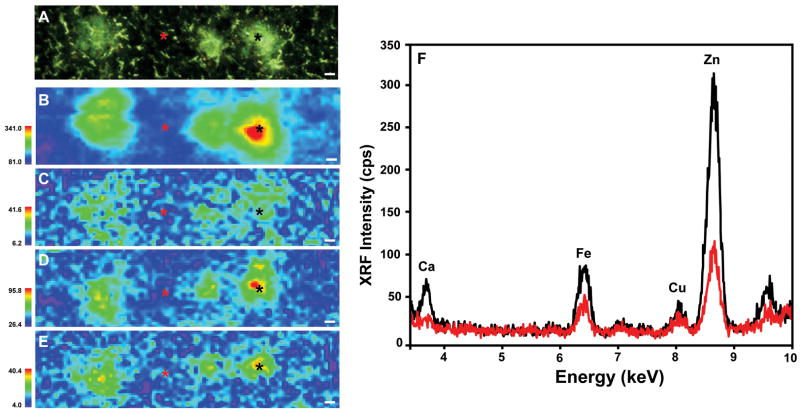
Amyloid beta (Abeta) is the primary component of Alzheimer's disease (AD) plaques, a key pathological feature of the disease. Metal ions of zinc (Zn), copper (Cu), iron (Fe), and calcium (Ca) are elevated in human amyloid plaques and are thought to be involved in neurodegeneration. Transgenic mouse models of AD also exhibit amyloid plaques, but fail to exhibit the high degree of neurodegeneration observed in humans. In this study, we imaged the Zn, Cu, Fe, and Ca ion distribution in the PSAPP transgenic mouse model representing end-stage AD (N=6) using synchrotron X-ray fluorescence (XRF) microprobe. In order to account for differences in density in the plaques, the relative protein content was imaged with synchrotron Fourier transform infrared microspectroscopy (FTIRM) on the same samples. FTIRM results revealed a 61% increase in protein content in the plaques compared to the surrounding tissue. After normalizing to protein density, we found that the PSAPP plaques contained only a 29% increase in Zn and there was actually less Cu, Fe, and Ca in the plaque compared to the surrounding tissue. Since metal binding to Abeta is thought to induce redox chemistry that is toxic to neurons, the reduced metal binding in PSAPP mice is consistent with the lack of neurodegeneration in these animals. These findings were in stark contrast to the high metal ion content observed in human AD plaques, further implicating the role of metal ions in human AD pathology.
Figures

References
-
- Arispe N, Pollard HB, Rojas E. The ability of amyloid β-protein [AβP (1–40)] to form Ca2+ channels provides a mechanism for neuronal death in Alzheimer’s disease. Ann N Y Acad Sci. 1994;747:256–266. - PubMed
-
- Atwood CS, Martins RN, Smith MA, Perry G. Senile plaque composition and posttranslational modification of amyloid-beta peptide and associated proteins. Peptides. 2002;23:1343–1350. - PubMed
-
- Atwood CS, Moir RD, Huang X, Scarpa RC, Bacarra NM, Romano DM, Hartshorn MA, Tanzi RE, Bush AI. Dramatic aggregation of Alzheimer Aβ by Cu(II) is induced by conditions representing physiological acidosis. J Biol Chem. 1998;273:12817–12826. - PubMed
-
- Atwood CS, Scarpa RC, Huang X, Moir RD, Jones WD, Fairlie DP, Tanzi RE, Bush AI. Characterization of copper interactions with alzheimer amyloid β peptides: identification of an attomolar-affinity copper binding site on amyloid β1–42. J Neurochem. 2000;75:1219–1233. - PubMed
-
- Borchelt DR, Ratovitski T, van Lare J, Lee MK, Gonzales V, Jenkins NA, Copeland NG, Price DL, Sisodia SS. Accelerated amyloid deposition in the brains of transgenic mice coexpressing mutant presenilin 1 and amyloid precursor proteins. Neuron. 1997;19:939–945. - PubMed
Publication types
MeSH terms
Substances
Grants and funding
LinkOut - more resources
Full Text Sources
Other Literature Sources
Medical
