


Oxytocin: the great facilitator of life
- PMID: 19482229
- PMCID: PMC2689929
- DOI: 10.1016/j.pneurobio.2009.04.001
Oxytocin: the great facilitator of life
Abstract
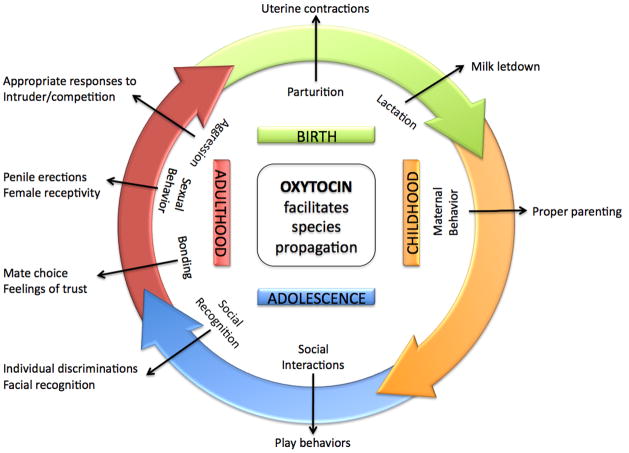
Oxytocin (Oxt) is a nonapeptide hormone best known for its role in lactation and parturition. Since 1906 when its uterine-contracting properties were described until 50 years later when its sequence was elucidated, research has focused on its peripheral roles in reproduction. Only over the past several decades have researchers focused on what functions Oxt might have in the brain, the subject of this review. Immunohistochemical studies revealed that magnocellular neurons of the hypothalamic paraventricular and supraoptic nuclei are the neurons of origin for the Oxt released from the posterior pituitary. Smaller cells in various parts of the brain, as well as release from magnocellular dendrites, provide the Oxt responsible for modulating various behaviors at its only identified receptor. Although Oxt is implicated in a variety of "non-social" behaviors, such as learning, anxiety, feeding and pain perception, it is Oxt's roles in various social behaviors that have come to the fore recently. Oxt is important for social memory and attachment, sexual and maternal behavior, and aggression. Recent work implicates Oxt in human bonding and trust as well. Human disorders characterized by aberrant social interactions, such as autism and schizophrenia, may also involve Oxt expression. Many, if not most, of Oxt's functions, from social interactions (affiliation, aggression) and sexual behavior to eventual parturition, lactation and maternal behavior, may be viewed as specifically facilitating species propagation.
Figures
References
-
- Abu-Elneel K, Liu T, Gazzaniga FS, Nishimura Y, Wall DP, Geschwind DH, Lao K, Kosik KS. Heterogeneous dysregulation of microRNAs across the autism spectrum. Neurogenetics. 2008;9:153–161. - PubMed
-
- Acher R, Chauvet J, Chauvet MT. Man and the chimaera. Selective versus neutral oxytocin evolution. Adv Exp Med Biol. 1995;395:615–627. - PubMed
-
- Agmo A, Choleris E, Kavaliers M, Pfaff DW, Ogawa S. Social and sexual incentive properties of estrogen receptor alpha, estrogen receptor beta, or oxytocin knockout mice. Genes, brain, and behavior. 2008;7:70–77. - PubMed
-
- Akerlund M, Bossmar T, Brouard R, Kostrzewska A, Laudanski T, Lemancewicz A, Serradeil-Le Gal C, Steinwall M. Receptor binding of oxytocin and vasopressin antagonists and inhibitory effects on isolated myometrium from preterm and term pregnant women. Br J Obstet Gynaecol. 1999;106:1047–1053. - PubMed
-
- Akerlund M, Carlsson AM, Melin P, Trojnar J. The effect on the human uterus of two newly developed competitive inhibitors of oxytocin and vasopressin. Acta Obstet Gynecol Scand. 1985;64:499–504. - PubMed
Publication types
MeSH terms
Substances
Grants and funding
LinkOut - more resources
Full Text Sources
Other Literature Sources
Molecular Biology Databases
Miscellaneous
