


New insights into ferritin synthesis and function highlight a link between iron homeostasis and oxidative stress in plants
- PMID: 19482877
- PMCID: PMC2859905
- DOI: 10.1093/aob/mcp128
New insights into ferritin synthesis and function highlight a link between iron homeostasis and oxidative stress in plants
Abstract
Background: Iron is an essential element for both plant productivity and nutritional quality. Improving plant iron content was attempted through genetic engineering of plants overexpressing ferritins. However, both the roles of these proteins in plant physiology, and the mechanisms involved in the regulation of their expression are largely unknown. Although the structure of ferritins is highly conserved between plants and animals, their cellular localization differs. Furthermore, regulation of ferritin gene expression in response to iron excess occurs at the transcriptional level in plants, in contrast to animals which regulate ferritin expression at the translational level.
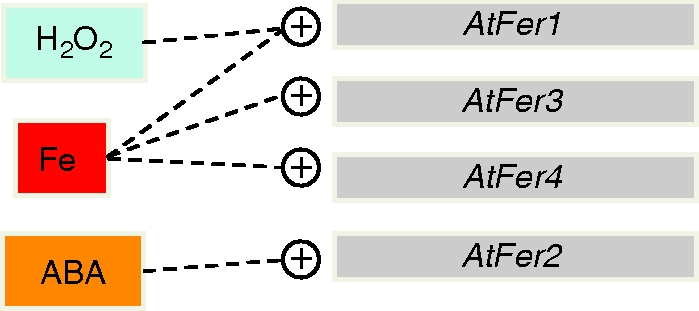
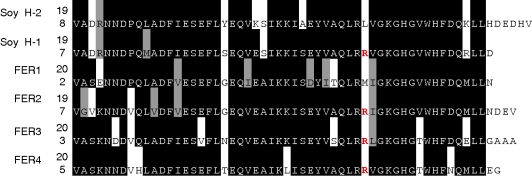
Scope: In this review, an overview of our knowledge of bacterial and mammalian ferritin synthesis and functions is presented. Then the following will be reviewed: (a) the specific features of plant ferritins; (b) the regulation of their synthesis during development and in response to various environmental cues; and (c) their function in plant physiology, with special emphasis on the role that both bacterial and plant ferritins play during plant-bacteria interactions. Arabidopsis ferritins are encoded by a small nuclear gene family of four members which are differentially expressed. Recent results obtained by using this model plant enabled progress to be made in our understanding of the regulation of the synthesis and the in planta function of these various ferritins.
Conclusions: Studies on plant ferritin functions and regulation of their synthesis revealed strong links between these proteins and protection against oxidative stress. In contrast, their putative iron-storage function to furnish iron during various development processes is unlikely to be essential. Ferritins, by buffering iron, exert a fine tuning of the quantity of metal required for metabolic purposes, and help plants to cope with adverse situations, the deleterious effects of which would be amplified if no system had evolved to take care of free reactive iron.
Figures


References
-
- Altuvia S, Almiron M, Huisman G, Kolter R, Storz G. The Dps promoter is activated by OxyR during growth and by IHF and sigma S in stationary phase. Molecular Microbiology. 1994;13:265–272. - PubMed
-
- Andrews SC. Iron storage in bacteria. Advances in Microbiological Physiology. 1998;40:281–351. - PubMed
-
- Andrews SC, Arosio P, Bottke H, et al. Structure, function and evolution of ferritins. Journal of Inorganic Biochemistry. 1992;47:161–174. - PubMed
-
- Andrews SC, Le Brun NE, Barynin V, et al. Site-directed replacement of the coaxial heme ligands of bacterioferritin generates heme-free variants. The Journal of Biological Chemistry. 1995;270:23268–23274. - PubMed
Publication types
MeSH terms
Substances
LinkOut - more resources
Full Text Sources
Medical
