. 2009 Jun;33(6):1485-97.
doi: 10.1183/09031936.00014009.

Pathogenesis of lung cancer signalling pathways: roadmap for therapies

Affiliations

Pathogenesis of lung cancer signalling pathways: roadmap for therapies

E Brambilla et al. Eur Respir J. 2009 Jun.

Abstract

Lung cancer is the major cancer killer worldwide, and 5-yr survival is extremely poor (<or=15%), accentuating the need for more effective therapeutic strategies. Significant advances in lung cancer biology may lead to customised therapy based on targeting specific genes and pathways. The main signalling pathways that could provide roadmaps for therapy include the following: growth promoting pathways (Epidermal Growth Factor Receptor/Ras/PhosphatidylInositol 3-Kinase), growth inhibitory pathways (p53/Rb/P14(ARF), STK11), apoptotic pathways (Bcl-2/Bax/Fas/FasL), DNA repair and immortalisation genes. Epigenetic changes in lung cancer contribute strongly to cell transformation by modifying chromatin structures and the specific expression of genes; these include DNA methylation, histone and chromatin protein modification, and micro-RNA, all of which are responsible for the silencing of tumour suppressor genes while enhancing expression of oncogenes. The genetic and epigenetic pathways involved in lung tumorigenesis differ between smokers and nonsmokers, and are tools for cancer diagnosis, prognosis, clinical follow-up and targeted therapies.


Figures

FIGURE 1
FIGURE 1
Epidermal growth factor receptor (EGFR) pathway. Ligands, such as epidermal growth factor (EGF), transforming growth factor (TGF)-α, or others, bind to the homo- and heterodimer kinase domain (TK), resulting in activation and receptor transphosphorylation. This creates docking sites for the adaptor proteins, Grb2 and Sos, which recruit Ras and phosphatidylinositol 3-kinase (PI3K), leading to the formation of two major signalling pathway branches, Ras/MAPK and PI3K/Akt. These networks result in, amongst others, proliferation, evasion of apoptosis and angiogenesis. MAPK: mitogen-activated kinase-like protein.
FIGURE 2
FIGURE 2
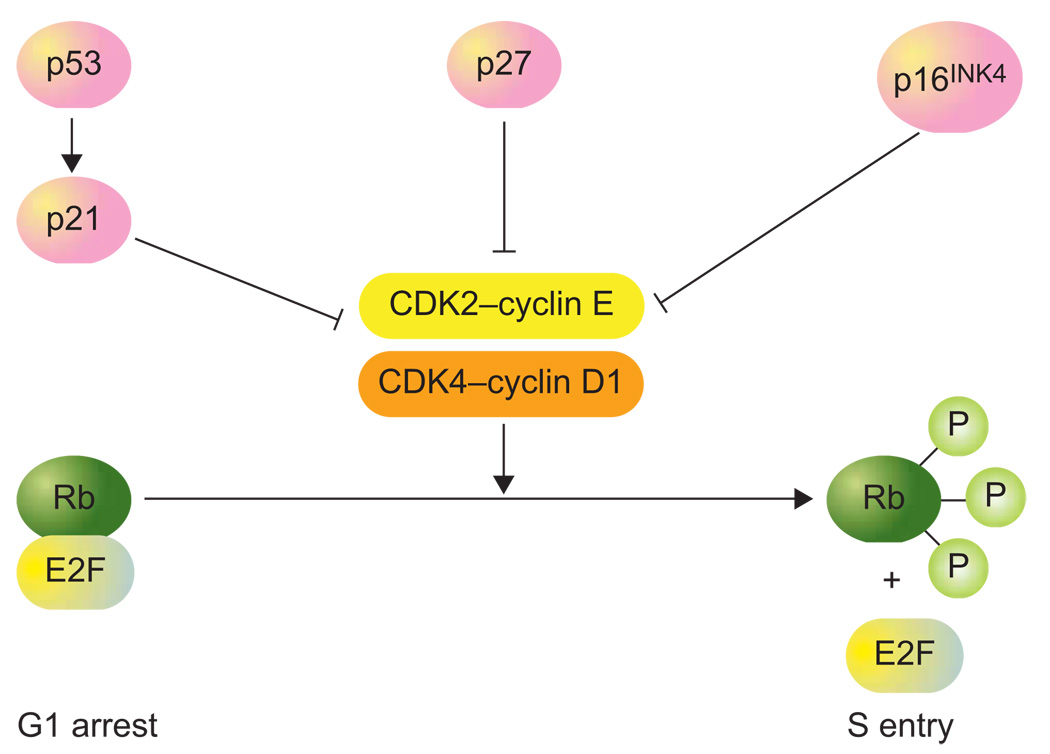
The retinoblastoma gene product (Rb) pathway. Rb is the main downstream effector of p53 in the control of G1 arrest. This Rb function depends on the level of phosphorylation of Rb, which is achieved by cyclin-dependent kinases (CDK) 2 and 4 in complex with either cyclin E or cyclin D1. These kinases complexes are retro-controlled by the following CDK inhibitors: p21 (the transcriptional target of p53), p16 (INK4β) and p27 (kip1). Phosphorylated Rb releases E2F1 from binding to Rb, which allows E2F1 transcriptional activities on S-phases genes target and disrupt the G1 checkpoint. Loss of functional CDK inhibitors p53, activation/gain of cyclin D1 or cyclin E, and Rb loss all result in E2F1 activation and disruption of the G1 checkpoint.
FIGURE 3
FIGURE 3
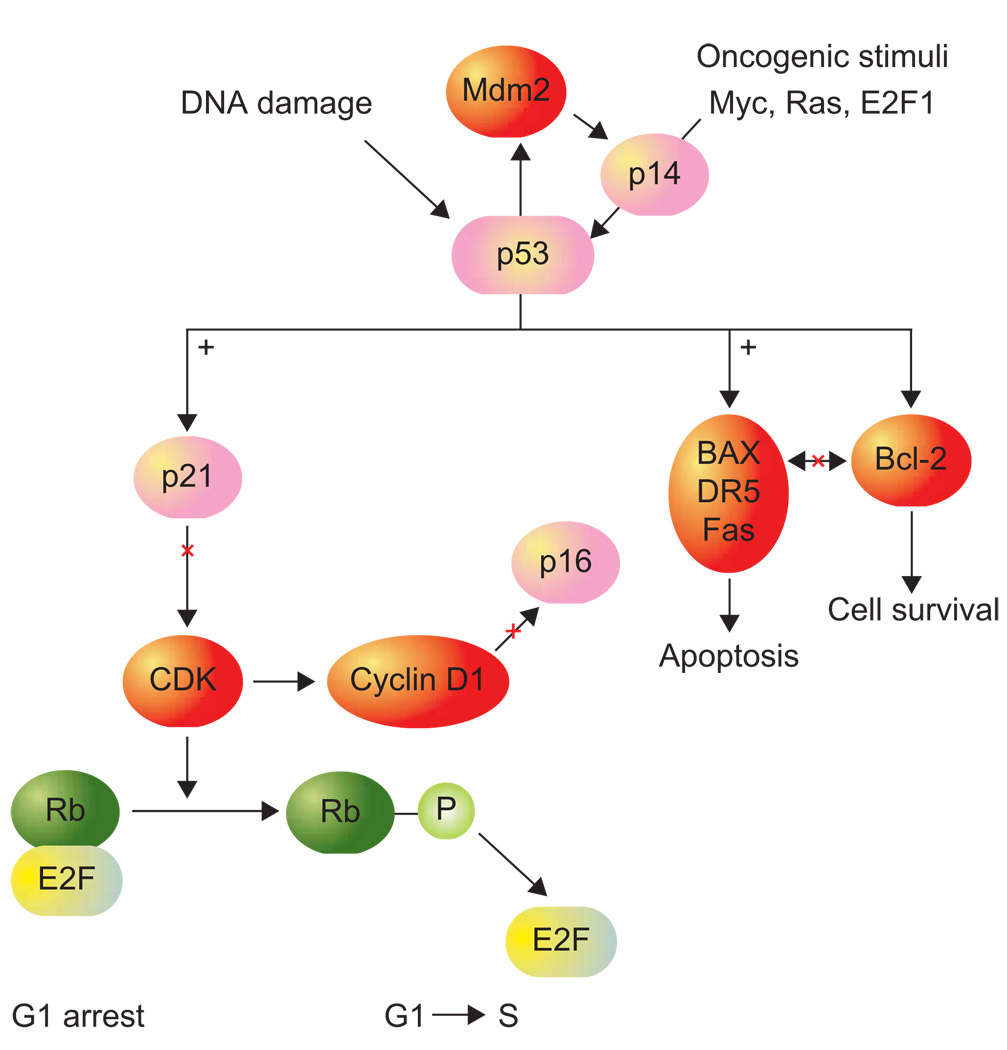
The p53 pathway. p53 is a sensor of cell stress, such as DNA damage and oncogenic stimuli, and functions as a transcription factor. Its target genes play roles in the control of the G1 arrest pathway (retinoblastoma gene product (Rb)/cyclin-dependent kinase (CDK) inhibitor/E2F1), susceptibility to apoptosis (Bax/Bcl-2), and control of the tumour necrosis factor receptor-like apoptosis inducing ligand (TRAIL) receptor 5 (DR5), Fas. It also enters into a DNA repair protein complex with proliferation cell nuclear antigen (PCNA). Mdm2 is an upstream regulator of p53, which governs its cytoplasmic shuttling protein, ubiquitin, ligation and degradation, and p14ARF, which sequesters Mdm2 in the nucleoli, thus allowing p53 transcriptional activity.

References

    1. Jemal A, Siegel R, Ward E, et al. Cancer statistics, 2006. CA Cancer J Clin. 2006;56:106–130. - PubMed
    1. Sun S, Schiller JH, Gazdar AF. Lung cancer in never smokers–a different disease. Nat Rev Cancer. 2007;7:778–790. - PubMed
    1. Bach PB, Kelley MJ, Tate RC, et al. Screening for lung cancer: a review of the current literature. Chest. 2003;123 Suppl. 1:72S–82S. - PubMed
    1. Henschke CI, Yankelevitz DF, Libby DM, et al. Survival of patients with stage I lung cancer detected on CT screening. N Engl J Med. 2006;355:1763–1771. - PubMed
    1. Ding L, Getz G, Wheeler DA, et al. Somatic mutations affect key pathways in lung adenocarcinoma. Nature. 2008;455:1069–1075. - PMC - PubMed

Publication types