


Proton pump inhibitors exert anti-allergic effects by reducing TCTP secretion
- PMID: 19484128
- PMCID: PMC2684640
- DOI: 10.1371/journal.pone.0005732
Proton pump inhibitors exert anti-allergic effects by reducing TCTP secretion
Abstract
Background: Extracellular translationally controlled tumor protein (TCTP) is known to play a role in human allergic responses. TCTP has been identified outside of macrophages, in activated mononuclear cells, and in biological fluids from allergic patients. Even TCTP devoid of signal sequences, is secreted to extracellular environment by an yet undefined mechanism. This study is aimed at understanding the mechanism of TCTP release and its regulation. A secondary goal is to see if inhibitors of TCTP release can serve as potential anti-allergic asthmatic drugs.
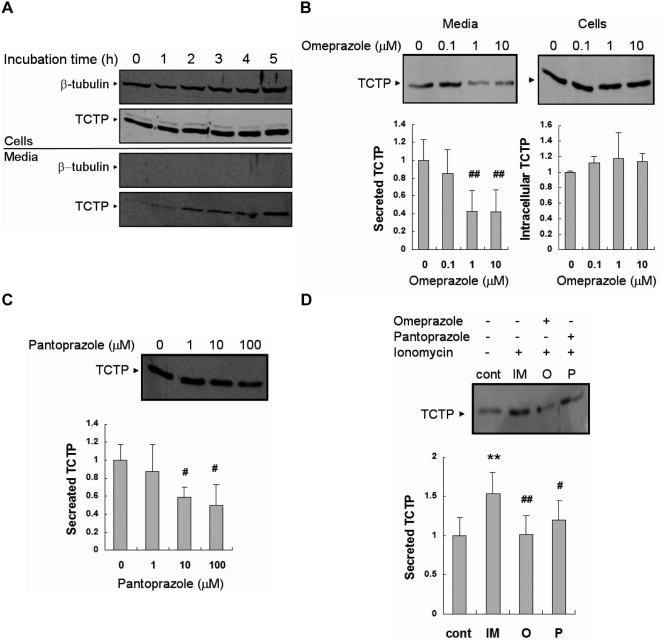
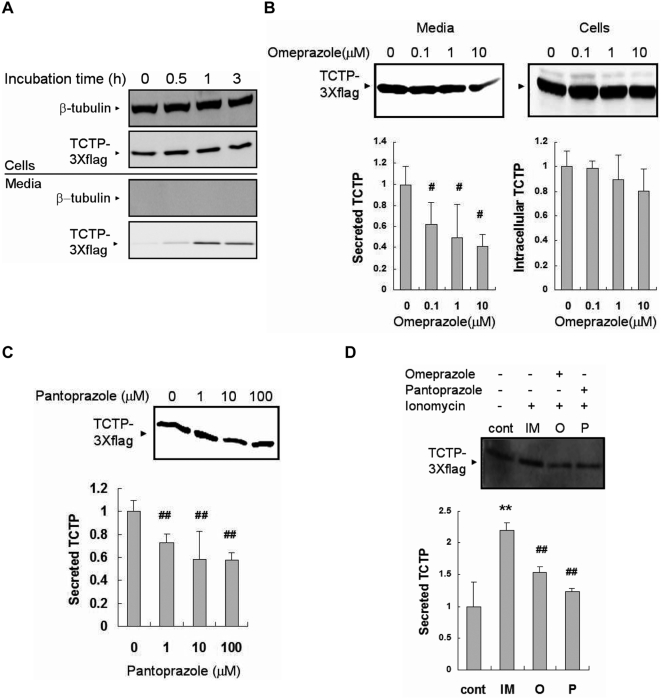
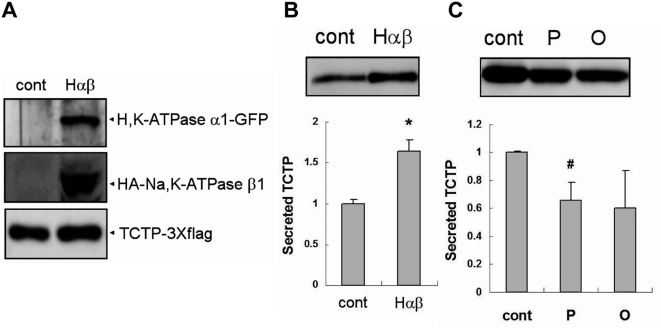
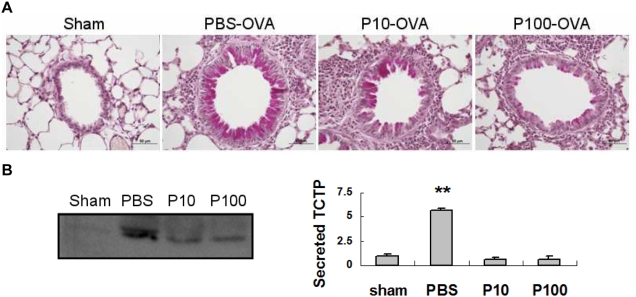
Methodology/principal findings: Using Western blotting assay in HEK293 and U937 cells, we found that TCTP secretion is reduced by omeprazole and pantoprazole, both of which are proton pump inhibitors. We then transfected HEK293 cells with proton pump expression vectors to search for the effects of exogeneously overexpressed H(+)/K(+)-ATPase on the TCTP secretion. Based on these in vitro data we checked the in vivo effects of pantoprazole in a murine model of ovalbumin-induced allergy. Omeprazole and pantoprazole reduced TCTP secretion from HEK293 and U937 cells in a concentration-dependent fashion and the secretion of TCTP from HEK293 cells increased when they over-expressed H(+)/K(+)-ATPase. In a murine model of ovalbumin-induced allergy, pretreatment with pantoprazole reduced infiltration of inflammatory cells, increased goblet cells, and increased TCTP secretion induced by OVA challenge.
Conclusion: Since Omeprazole and pantoprazole decrease the secretion of TCTP which is associated with the development of allergic reaction, they may have the potential to serve as anti-allergic (asthmatic) drugs.
Conflict of interest statement
Figures
References
-
- Nielsen H, Johnsen A, Sanchez J, Hochstrasser D, Schiøtz P. Identification of a basophil leukocyte interleukin-3-regulated protein that is identical to IgE-dependent histamine-releasing factor. Allergy. 1998;53:642–652. - PubMed
-
- Teshima S, Rokutan K, Nikawa T, Kishi K. Macrophage colony-stimulating factor stimulates synthesis and secretion of a mouse homolog of a human IgE-dependent histamine-releasing factor by macrophages in vitro and in vivo. J Immunol. 1998;161:6356–6366. - PubMed
-
- MacDonald S, Rafnar T, Langdon J, Lichtenstein L. Molecular identification of an IgE-dependent histamine-releasing factor. Science. 1995;269:688–690. - PubMed
-
- Liu M, Proud D, Lichtenstein L, MacGlashan D, Schleimer R, et al. Human lung macrophage-derived histamine-releasing activity is due to IgE-dependent factors. J Immunol. 1986;136:2588–2595. - PubMed
Publication types
MeSH terms
Substances
LinkOut - more resources
Full Text Sources
Other Literature Sources
