


Discerning tumor status from unstructured MRI reports--completeness of information in existing reports and utility of automated natural language processing
- PMID: 19484309
- PMCID: PMC2837158
- DOI: 10.1007/s10278-009-9215-7
Discerning tumor status from unstructured MRI reports--completeness of information in existing reports and utility of automated natural language processing
Abstract
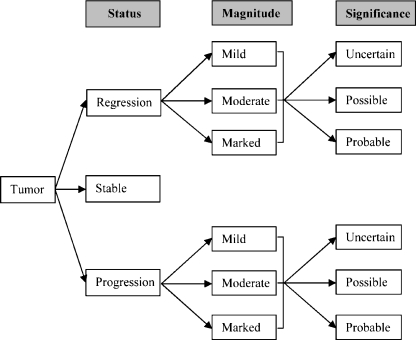
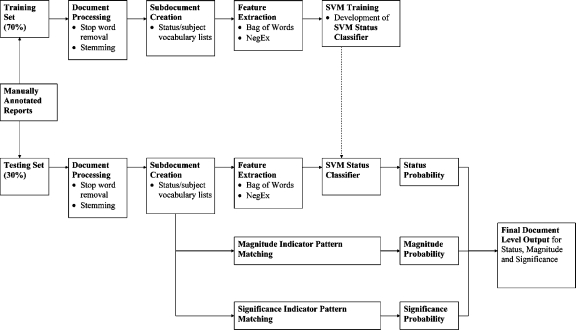
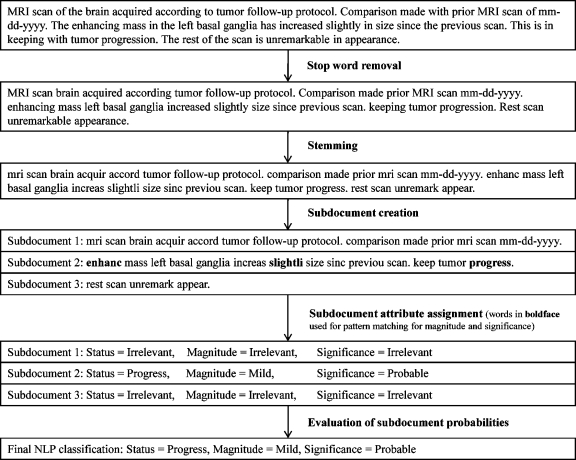
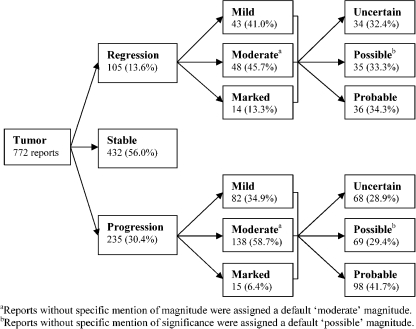
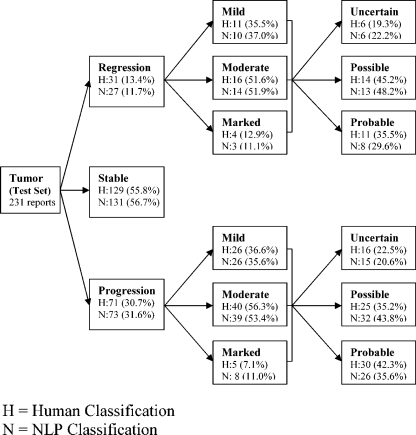
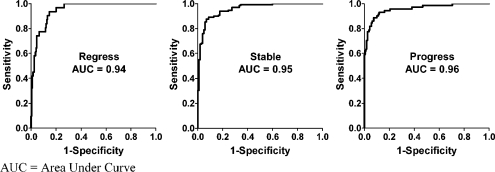
Information in electronic medical records is often in an unstructured free-text format. This format presents challenges for expedient data retrieval and may fail to convey important findings. Natural language processing (NLP) is an emerging technique for rapid and efficient clinical data retrieval. While proven in disease detection, the utility of NLP in discerning disease progression from free-text reports is untested. We aimed to (1) assess whether unstructured radiology reports contained sufficient information for tumor status classification; (2) develop an NLP-based data extraction tool to determine tumor status from unstructured reports; and (3) compare NLP and human tumor status classification outcomes. Consecutive follow-up brain tumor magnetic resonance imaging reports (2000--2007) from a tertiary center were manually annotated using consensus guidelines on tumor status. Reports were randomized to NLP training (70%) or testing (30%) groups. The NLP tool utilized a support vector machines model with statistical and rule-based outcomes. Most reports had sufficient information for tumor status classification, although 0.8% did not describe status despite reference to prior examinations. Tumor size was unreported in 68.7% of documents, while 50.3% lacked data on change magnitude when there was detectable progression or regression. Using retrospective human classification as the gold standard, NLP achieved 80.6% sensitivity and 91.6% specificity for tumor status determination (mean positive predictive value, 82.4%; negative predictive value, 92.0%). In conclusion, most reports contained sufficient information for tumor status determination, though variable features were used to describe status. NLP demonstrated good accuracy for tumor status classification and may have novel application for automated disease status classification from electronic databases.
Figures
References
-
- Automatic Content Extraction (ACE) Evaluation. Available at http://www.nist.gov/speech/tests/ace/. Accessed 17 Nov 2008
-
- Message Understanding Conference (MUC) and Information Extraction. Available at http://www.itl.nist.gov/iaui/894.02/related_projects/muc/index.html. Accessed 17 Nov 2008
-
- Meystre SM, Savova GK, Kipper-Schuler KC, Hurdle JF: Extracting information from textual documents in the electronic health record: a review of recent research. Yearb Med Inform, pp 128–144, 2008 - PubMed
-
- Hripcsak G, Friedman C, Alderson PO, DuMouchel W, Johnson SB, Clayton PD. Unlocking clinical data from narrative reports: a study of natural language processing. Ann Intern Med. 1995;122(9):681–688. - PubMed
-
- Thomas BJ, Ouellette H, Halpern EF, Rosenthal DI. Automated computer-assisted categorization of radiology reports. AJR Am J Roentgenol. 2005;184(2):687–690. - PubMed
Publication types
MeSH terms
LinkOut - more resources
Full Text Sources
Medical
