


Adjunctive chemotherapeutic suppression of mutans streptococci in the setting of severe early childhood caries: an exploratory study
- PMID: 19486465
- PMCID: PMC2855972
- DOI: 10.1111/j.1752-7325.2009.00118.x
Adjunctive chemotherapeutic suppression of mutans streptococci in the setting of severe early childhood caries: an exploratory study
Abstract
Objectives: This investigational study assessed the suppressive effect of 10 percent povidone iodine (PI) coupled with elimination of active carious lesions on salivary mutans streptococci (MS) populations in children with severe early childhood caries (S-ECC).
Methods: 77 children (38 females, 39 males) were treated for S- ECC in one session; a 0.2 ml PI solution was applied to the dentition after dental surgery was completed and immediately wiped off. The subjects aged from 2 to 5 years (mean = 3.78 years) at baseline. Whole nonstimulated saliva samples were obtained at baseline, 30 days, 60 days, and 90 days post dental surgery. Samples were placed on ice and processed within 2 hours. The MS level in each sample was expressed as colony forming units (CFUs) per ml of saliva.
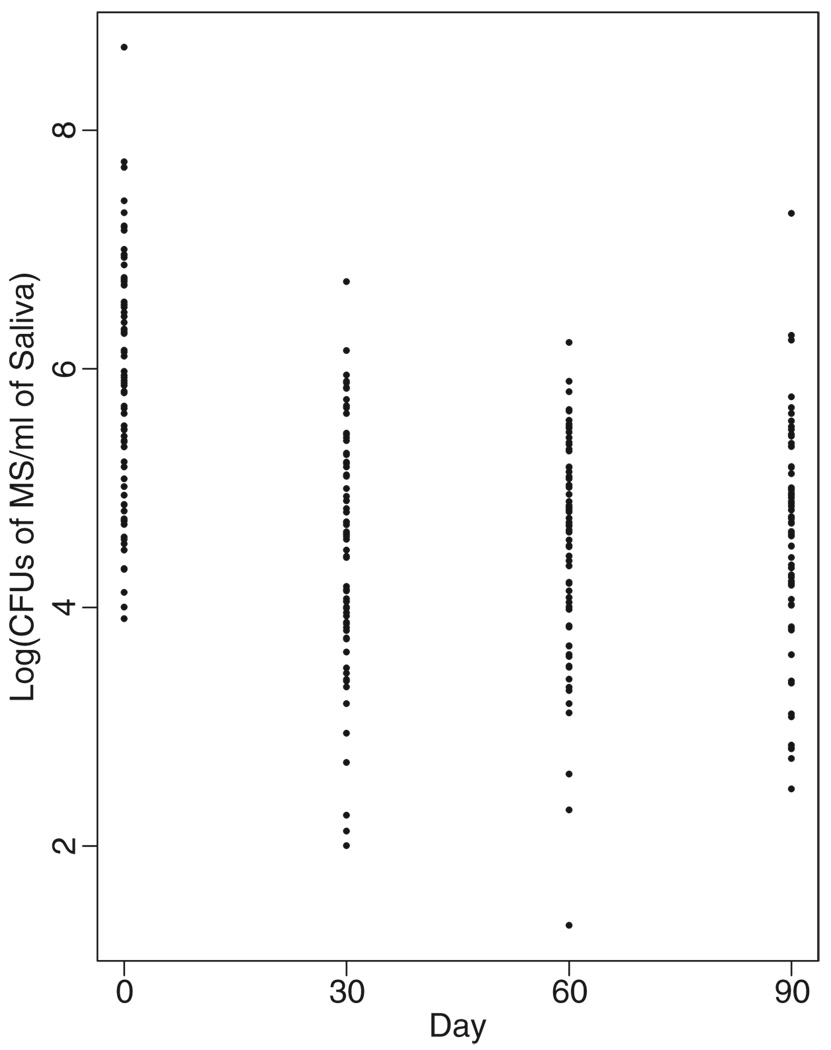
Results: Approximately 50 percent of subjects had a >95 percent reduction in CFU/ml of saliva at each time point after baseline. The percentages of subjects with a >50 percent reduction in MS level were 85 percent at 30 days, 83 percent at 60 days, 84 percent at 90 days. The median (25th, 75th percentiles) CFUs/ml of saliva counts were 8.40 x 10(5) (1.49 x 10(5), 5.00 x 10(6)) at baseline (n= 77), 4.12 x 10(4) (8.40 x 10(3), 1.89 x 10(5)) at 30 days (n = 74), 4.62 x 10(4) (7.00 x 10(3), 1.36 x 10(5)) at 60 days (n = 70), and 5.09 x 10(4) (1.16 x 10(4), 1.00 x 10(5)) at 90 days (n = 70). The changes from baseline to 30 days, 60 days, and 90 days were statistically significant (P < 0.0001).
Conclusions: PI coupled with dental surgery has a significant suppressive effect on salivary MS levels in the setting of S-ECC for at least 90 days. These data strongly suggest that treatment with PI may be an important adjunct to dental surgery for S-ECC.
Figures
References
-
- Milnes AR. Description and epidemiology of nursing caries. J Public Health Dent. 1996;56:38–50. - PubMed
-
- American Academy of Pediatric Dentistry. Definition of early childhood caries (ECC) Pediatr Dent. 2007;29:13.
-
- Berkowitz RJ. Etiology of nursing caries: a microbiologic perspective. J Public Health Dent. 1996;56:51–54. - PubMed
-
- Albert RJ, Cantin RY, Cross HG, Castaldi CR. Nursing caries in the Inuit children of the Keewatin. J Can Dent Assoc. 1988;54:751–758. - PubMed
-
- Holt RD, Joels D, Winter GB The Camden study. Caries in pre-school children. Br Dent J. 1982;153:107–109. - PubMed
Publication types
MeSH terms
Substances
Grants and funding
LinkOut - more resources
Full Text Sources
Medical
Research Materials
Miscellaneous
