


doi: 10.1016/j.bpj.2009.03.038.
Cytoskeletal polymer networks: viscoelastic properties are determined by the microscopic interaction potential of cross-links
Affiliations
- PMID: 19486695
- PMCID: PMC2711496
- DOI: 10.1016/j.bpj.2009.03.038
Item in Clipboard
Cytoskeletal polymer networks: viscoelastic properties are determined by the microscopic interaction potential of cross-links
Biophys J.
.
Abstract
Although the structure of cross-linking molecules mainly determines the structural organization of actin filaments and with that the static elastic properties of the cytoskeleton, it is largely unknown how the biochemical characteristics of transiently cross-linking proteins (actin-binding proteins (ABPs)) affect the viscoelasticity of actin networks. In this study, we show that the macroscopic network response of reconstituted actin networks can be traced back to the microscopic interaction potential of an individual actin/ABP bond. The viscoelastic response of cross-linked actin networks is set by the cross-linker off-rate, the binding energy, and the characteristic bond length of individual actin/ABP interactions.
Figures
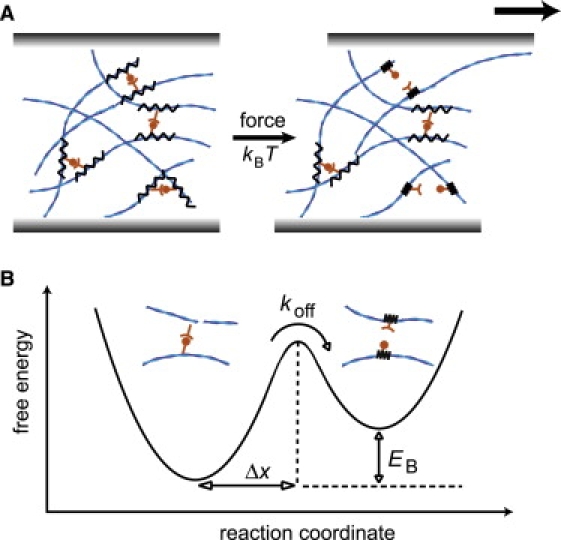
(A) In cross-linked actin networks, a transient bond can unbind because of thermal activation, kBT, or upon force application. (B) The transient actin/ABP cross-link can be characterized by an interaction potential. The key parameters are the cross-linker off-rate, koff, the binding energy, EB, and the position of the transition state, Δx.
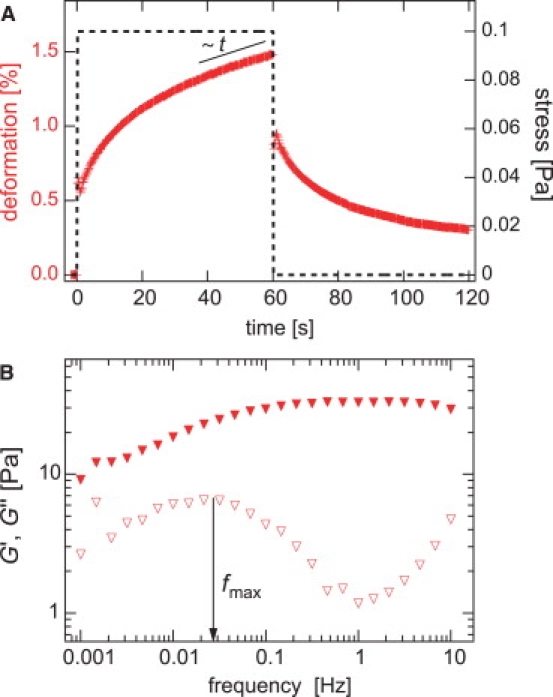
The transient nature of actin/HMM cross-links dictates the viscoelastic response of the macroscopic network. (A) A stress pulse of 0.1 Pa height and 60 s duration is applied to a transiently cross-linked actin/HMM network (R = 0.1, ca = 9.5 μM) and the resulting deformation is recorded. This step-stress experiment reveals significant creep behavior at timescales of ≈40–60 s. (B) Extended frequency spectrum of a transiently cross-linked actin/HMM network (R = 0.1, ca = 9.5 μM). A clear maximum in the viscous dissipation is located at fmax ≈ 0.03 Hz.
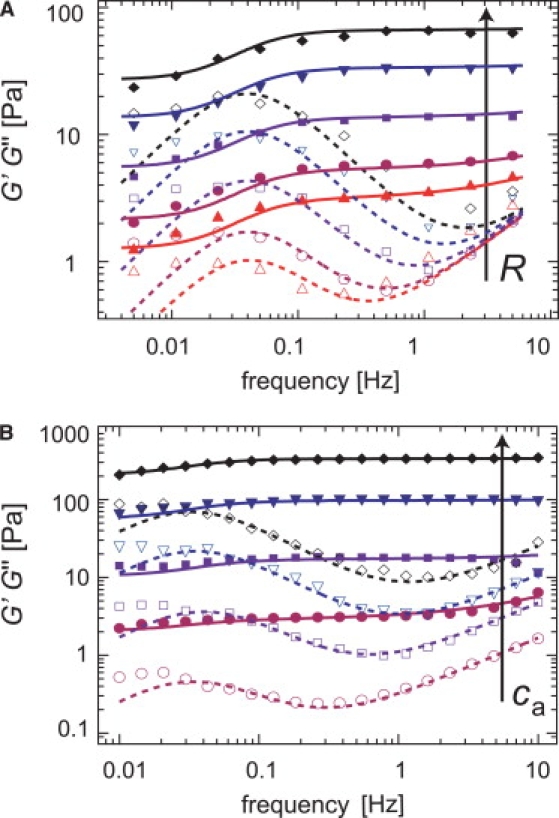
Either a cross-linker concentration series (A, fixed ca = 19 μM, variable R = 0.0076, 0.0152, 0.0385, 0.0714, and 0.143) or an actin concentration series (B, fixed R = 0.1, variable ca = 4.75 μM, 9.5 μM, 19 μM, and 28.5 μM) can be employed to extract the cross-linker off-rate from the viscoelastic spectrum of transiently cross-linked actin/HMM networks. Solid symbols denote G′(f), open symbols denote G″(f). The solid and dashed lines represent a global best fit using Eqs. 1 and 2 as described in the Appendix.
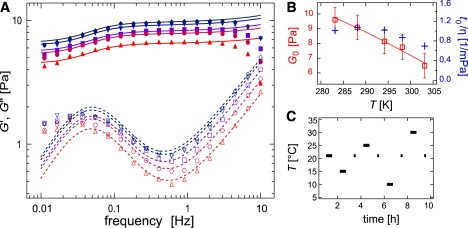
(A) Frequency response of actin/HMM networks (ca = 9.5 μM, R = 0.1) at distinct temperatures (10°C (◇) up to 30°C (▵)). Solid symbols denote G′(f), open symbols denote G″(f). The solid and dashed lines represent the model used to evaluate the macromechanical response, as described in Lieleg et al. (13). (B) Plateau modulus G0 (□) and the normalized time t0/η (+) as a function of temperature. The character η denotes the viscosity of water. (C) Temperature-oscillation protocol as described in the article. Frequency sweeps (bars) are taken at 21°C, 15°C, 25°C, 10°C, and 30°C. Before the next temperature jump is initiated, the network is brought back to its initial temperature of 21°C to assure reversibility (dots).
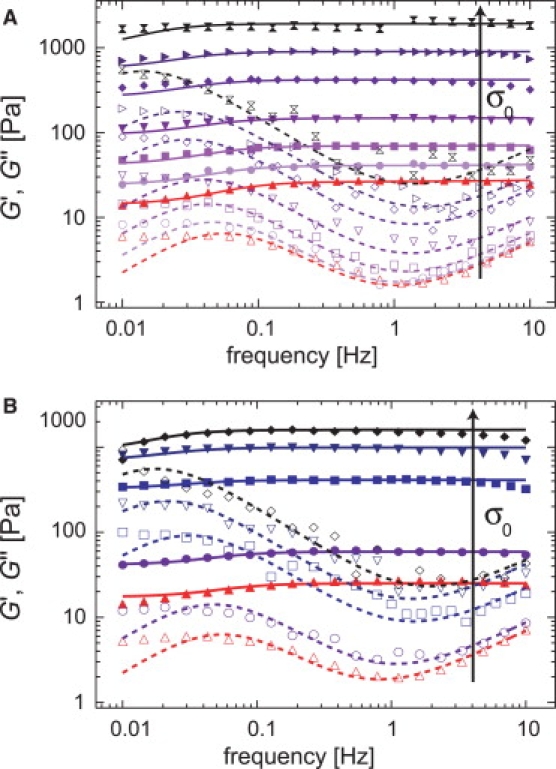
Frequency response of actin/HMM networks (ca = 9.5 μM) at distinct levels of prestress σ0. Solid symbols denote G′(f), open symbols denote G″(f). The solid and dashed lines represent the model used to evaluate the macromechanical response, as described in Lieleg et al. (13). (A) R = 0.1: σ0 = 0 Pa (upright triangles), 0.5 Pa, 1 Pa, 2 Pa, 5 Pa, 10 Pa, and σ0 = 20 Pa (crosses), (B) R = 0.2: σ0 = 0 Pa (upright triangles), 1 Pa, 5 Pa, 10 Pa, and σ0 = 15 Pa (diamonds). The maximum level of prestress is chosen in such a way that the networks still show complete relaxation to their original (unstressed) state upon stress release.
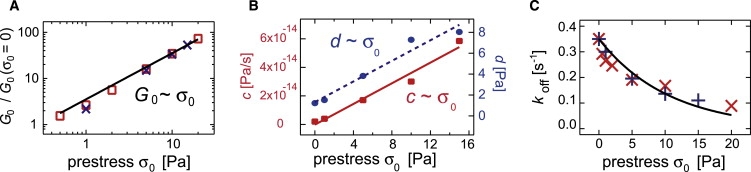
Fitting parameters for prestressed actin/HMM networks as obtained for the data sets depicted in Fig. 5, A and B. (A) Enhancement of the network elasticity G0/G0(σ0 = 0) as a function of prestress σ0. A linear relation is observed for both cross-linker densities (R = 0.1 (squares) and R = 0.2 (crosses)). (B) Stress relaxation parameter c and single filament relaxation parameter d increase linear with the prestress σ0. (C) Cross-linker off-rate koff as a function of prestress for two different actin/HMM networks (R = 0.1 (×) and R = 0.2 (+)).
References
-
- Xu J., Wirtz D., Pollard T. Dynamic cross-linking by α-actinin determines the mechanical properties of actin filament networks. J. Biol. Chem. 1998;273:9570–9576. - PubMed
-
- Wang N., Tolic-Norrelykke I., Chen J., Mijailovich S., Butler J. Cell prestress. I. Stiffness and prestress are closely associated in adherent contractile cells. Am. J. Physiol. Cell Physiol. 2002;282:C606–C616. - PubMed
-
- Bausch A.R., Kroy K. A bottom-up approach to cell mechanics. Nature Phys. 2006;2:231–238.
-
- Head D.A., Levine A., MacKintosh F. Distinct regimes of elastic response and deformation modes of cross-linked cytoskeletal and semiflexible polymer networks. Phys. Rev. E Stat. Nonlin. Soft Matter Phys. 2003;68 061907–1–15. - PubMed
-
- Wilhelm J., Frey E. Elasticity of stiff polymer networks. Phys. Rev. Lett. 2003;91:108103. - PubMed
Publication types
MeSH terms
Substances
LinkOut - more resources
Full Text Sources
Other Literature Sources
