Comment
doi: 10.1083/jcb.200904125.
Epigenetics, Wnt signaling, and stem cells: the Pygo2 connection
Affiliations
- PMID: 19487452
- PMCID: PMC2711585
- DOI: 10.1083/jcb.200904125
Item in Clipboard
Comment
Epigenetics, Wnt signaling, and stem cells: the Pygo2 connection
J Cell Biol.
.
Abstract
Stem cells use both transcriptional and epigenetic mechanisms to control gene expression and regulate tissue development and homeostasis. In this issue, Gu et al. (Gu, B., P. Sun, Y. Yuan, R.C. Moraes, A. Li, A. Teng, A. Agrawal, C. Rhéaume, V. Bilanchone, J.M. Veltmaat, et al. 2009. J. Cell Biol. 185:811-826) reveal an important link between these two mechanisms in mammary epithelial stem cells by showing that transcriptional activation of beta-catenin downstream of Wnt signaling can be regulated epigenetically through a chromatin remodeling factor, Pygo2.
Figures
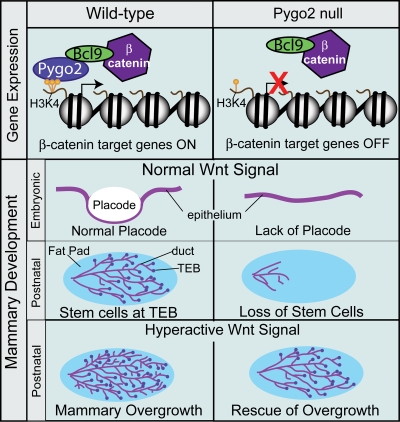
Pygo2 regulates Wnt signaling during mammary gland development. Pygo2 promotes trimethylation (yellow) of lysine 4 of histone H3 (H3K4) and synergistically binds these residues and BCL9–β-catenin complexes to activate β-catenin target genes in mammary epithelium. Loss of Pygo2 in mice results in embryonic defects of mammary progenitor cells and placode (white circle) formation. In addition, loss of Pygo2 results in postnatal defects in mammary ductal networks caused by the lack of stem cells in TEBs (purple circles). Pygo2-null mammary glands rescue mammary overgrowth phenotypes when Wnt signaling is hyperactivated.
Comment on
-
Pygo2 expands mammary progenitor cells by facilitating histone H3 K4 methylation.J Cell Biol. 2009 Jun 1;185(5):811-26. doi: 10.1083/jcb.200810133. J Cell Biol. 2009. PMID: 19487454 Free PMC article.
References
-
- Andl T., Reddy S., Gaddapara T., Millar S. 2002. WNT signals are required for the initiation of hair follicle development.Dev. Cell. 2:643–653 - PubMed
-
- Belenkaya T.Y., Han C., Standley H.J., Lin X., Houston D.W., Heasman J. 2002. pygopus Encodes a nuclear protein essential for wingless/Wnt signaling.Development. 129:4089–4101 - PubMed
-
- Chu E.Y., Hens J., Andl T., Kairo A., Yamaguchi T.P., Brisken C., Glick A., Wysolmerski J.J., Millar S.E. 2004. Canonical WNT signaling promotes mammary placode development and is essential for initiation of mammary gland morphogenesis.Development. 131:4819–4829 - PubMed
Publication types
MeSH terms
Substances
Grants and funding
LinkOut - more resources
Full Text Sources
Medical