. 2009 Aug;182(4):1089-100.
doi: 10.1534/genetics.109.103630. Epub 2009 Jun 1.

A Drosophila resource of transgenic RNAi lines for neurogenetics

Affiliations

A Drosophila resource of transgenic RNAi lines for neurogenetics

Jian-Quan Ni et al. Genetics. 2009 Aug.

Abstract

Conditional expression of hairpin constructs in Drosophila is a powerful method to disrupt the activity of single genes with a spatial and temporal resolution that is impossible, or exceedingly difficult, using classical genetic methods. We previously described a method (Ni et al. 2008) whereby RNAi constructs are targeted into the genome by the phiC31-mediated integration approach using Vermilion-AttB-Loxp-Intron-UAS-MCS (VALIUM), a vector that contains vermilion as a selectable marker, an attB sequence to allow for phiC31-targeted integration at genomic attP landing sites, two pentamers of UAS, the hsp70 core promoter, a multiple cloning site, and two introns. As the level of gene activity knockdown associated with transgenic RNAi depends on the level of expression of the hairpin constructs, we generated a number of derivatives of our initial vector, called the "VALIUM" series, to improve the efficiency of the method. Here, we report the results from the systematic analysis of these derivatives and characterize VALIUM10 as the most optimal vector of this series. A critical feature of VALIUM10 is the presence of gypsy insulator sequences that boost dramatically the level of knockdown. We document the efficacy of VALIUM as a vector to analyze the phenotype of genes expressed in the nervous system and have generated a library of 2282 constructs targeting 2043 genes that will be particularly useful for studies of the nervous system as they target, in particular, transcription factors, ion channels, and transporters.


Figures

F<sc>igure</sc> 1.—
Figure 1.—
(A) Strategy for optimization and (B) VALIUM vectors used in this study.
F<sc>igure</sc> 2.—
Figure 2.—
Head-to-head orientation produces a more potent knockdown than tail-to-tail orientation. (A) The phenotype associated with C96-Gal4, Notch-hp flies is more severe in the head-to-head orientation than in the tail-to-tail orientation. We used the phenotypic classification described in Ni et al. (2008) to quantify the severity of the wing phenotypes. Class 1: wild type or a few bristles missing. Class 2: margin bristles missing but no notches. Class 3: moderate wing notching. Class 4: extensive wing notching. Class 5: most of the wing margin is missing. Flies were raised at different temperatures and the phenotypes in males vs. females were scored separately. (B) Comparison of the en-Gal4, hp phenotypes associated with head-to-head vs. tail-to-tail orientation for dlg1, dpp, RacGap, dome, and egfr. Flies were raised at 25°.
F<sc>igure</sc> 3.—
Figure 3.—
hsp70 is an effective core promotor. (A) In the C96-Gal4, Notch-hp assay, the hsp70 core promotor generates stronger Notch RNAi phenotypes than the DSCP promotor. (B) Similar conclusions were obtained using a luciferase assay. Luciferase lines were crossed with two different act5C-Gal4 insertions [(1) act5C-Gal4/CyO and (2) act5C-Gal4/TM6B,Tb] and with (3) tub-Gal4/TM6B,Tb. Luciferase activity was measured in 2-day-old adult males at 25°. Note that both act5C-Gal4 drivers have similar strengths and that the tub-Gal4 driver is ∼2.5 times stronger than the act5C-Gal4 drivers.
F<sc>igure</sc> 4.—
Figure 4.—
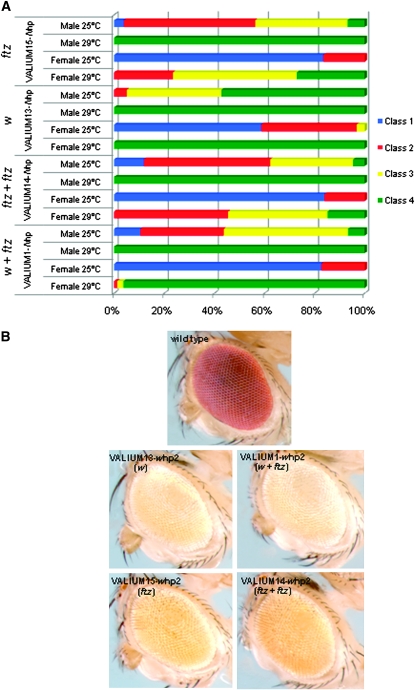
The white intron alone is sufficient for effective knockdown by RNAi. We compared the efficacy of hairpins against Notch and white, respectively (A and B), in vectors that contain both the white and ftz introns (VALIUM1, w + ftz), only the white intron (VALIUM13, w), two ftz introns (VALIUM14, ftz + ftz), and only one ftz intron (VALIUM15, ftz). C96-Gal4;Notch-hp flies were grown at 25° and at 29°. GMR-Gal4; white-hp flies were raised at 25° and the eye color was examined after adult flies eclosed.
F<sc>igure</sc> 5.—
Figure 5.—
The recombination method improves vector efficiency. (A) The recombination method introduces additional sequences into the vector, which is not the case when using the MCS ligation approach. (B) Phenotypes of C96-Gal4; Notch-hp flies grown at either 25° or 29°. Introduction of the Notch-hp sequence using the recombination system leads to stronger RNAi phenotypes than using the MCS strategy. (C) Eye phenotypes of GMR-Gal4;white-hp flies at 25° soon after emergence. The phenotype obtained with VALIUM9-white-hp is stronger than that obtained with VALIUM14-white-hp. Similar results were reached when two different hairpins against the white gene were tested. Data are shown here for only the white-hp2 sequence.
F<sc>igure</sc> 6.—
Figure 6.—
Insulator sequences significantly improve vector efficacy. (A and B) VALIUM 10 is a better vector than either VALIUM1 or VALIUM9 using either the C96-Gal4;Notch-hp or the GMR-Gal4;white-hp assays. Note that in the Notch assay, a class 5 phenotype (see Figure 2A) characterized by very reduced wing size is observed. The RNAi phenotypes of Notch-hp and white-hp were much stronger with VALIUM10, demonstrating the potency of the insulators. Interestingly, VALIUM17 behaves as well as VALIUM10 in the Notch-hp assay but not in the white-hp assay (see text). (C) To monitor both the basal and the induced levels of transgene expression in the various VALIUM vectors, we examined the expression of UAS-luciferase introduced into VALIUM1, -9, or -10, either in the absence of Gal4 or in the presence of act5C-Gal4. Note that the VALIUM1 and VALIUM9 luciferase constructs differ only by a few base pairs (see DataS1) and as expected behave similarly in all assays.
F<sc>igure</sc> 7.—
Figure 7.—
Increasing the number of Insulator sequences does not significantly improve vector efficacy. We compared the efficacy of a Notch hairpin when insulated by zero (VALIUM9 at attP2), two [VALIUM10 at attP2, VALIUM9 at su(Hw)attP1 and su(Hw)attP4], and four [VALIUM10 at su(Hw)attP1 and su(Hw)attP4] gypsy sequences. Flies were raised at 25°.
F<sc>igure</sc> 8.—
Figure 8.—
RNAi phenotypes in the nervous system. Electron micrograph (EM) of (A) control cn bw, (B) cn bw; GMR-Gal4, (C) eyes shut (eys) mutant, (D) eys RNAi, (E) chaoptic (chp) mutant, and (F) chp RNAi. Note the similarity of the phenotypes generated from either the null mutations or expression of the RNAi construct. (G) Electroretinogram (ERG) following a 20-sec white light pulse of Canton S (control), arrestin2 (arr2) RNAi, and inactivation no afterpotential C (inaC) RNAi. Note that the termination of the ERG response is much slower in either arr2 or inaC RNAi flies, which is consistent with the previously described mutant phenotypes (http://flybase.org/).

References

    1. Achara, J. K., K. Jalink, R. W. Hardy, V. Hartenstein and C. S. Zuker, 1997. InsP3 receptor is essential for growth and differentiation but not for vision in Drosophila. Neuron 18 881–887. - PubMed
    1. Bao, S., and R. Cagan, 2006. Fast cloning inverted repeats for RNA interference. RNA 12 2020–2024. - PMC - PubMed
    1. Barolo, S., L. A. Carver and J. W. Posakony, 2000. GFP and beta-galactosidase transformation vectors for promoter/enhancer analysis in Drosophila. Biotechniques 29 726–732. - PubMed
    1. Brand, A. H., and N. Perrimon, 1993. Targeted gene expression as a means of altering cell fates and generating dominant phenotypes. Development 118 401–415. - PubMed
    1. Dietzl, G., D. Chen, F. Schnorrer, K. C. Su, Y. Barinova et al., 2007. A genome-wide transgenic RNAi library for conditional gene inactivation in Drosophila. Nature 448 151–156. - PubMed

Publication types

LinkOut - more resources