doi: 10.1101/gad.1791009.
Molecular orchestration of differentiation and function of regulatory T cells
Affiliations
- PMID: 19487568
- PMCID: PMC2763538
- DOI: 10.1101/gad.1791009
Item in Clipboard
Molecular orchestration of differentiation and function of regulatory T cells
Genes Dev.
.
Abstract
During the last decade, a unique mechanism of negative regulation of immune responses and inflammation by a dedicated population of so-called regulatory T cells (Treg) has become a focus of intensive investigation. Through the discovery of transcription factor Foxp3 as a central molecular determinant of differentiation and function of Treg cells, the complex biology of these cells, including maintenance of immunological tolerance to "self" and regulation of immune responses to pathogens, commensals, and tumors, has become amenable to mechanistic studies. In this review, we discuss the molecular aspects of Treg cell lineage commitment, maintenance, and function.
Figures
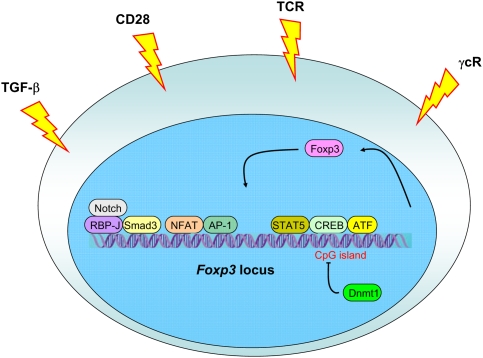
Regulation of Foxp3 expression. Foxp3 induction is dependent on an increased TCR signal strength combined with stimulation through CD28, and common γ chain cytokine receptors. TGF-β receptor signaling is required for differentiation of peripheral Treg cells, whereas its involvement in Treg differentiation in the thymus is subject of debate. As a consequence, corresponding downstream transcriptional factors are recruited to the Foxp3 locus leading to Foxp3 expression. Foxp3 itself is also suggested to stabilize its own expression. Moreover, complete demethylation of a CpG island within a conserved intronic noncoding Foxp3 element is also required for stable Foxp3 expression, whereas methylation of this CpG island by Dnmt1 in TGF-β-induced Treg cells likely results in a loss of Foxp3.
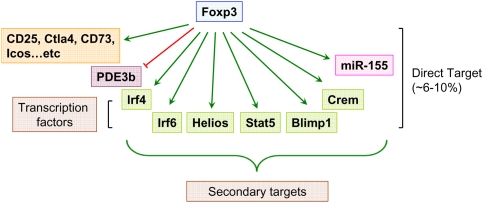
Foxp3-dependent transcriptional program. Foxp3 acts as both transcriptional activator and repressor. Whereas more genes are up-regulated by Foxp3 (green) in Treg cells, a number of genes are down-regulated (red) in a Foxp3-dependent manner. Genome-wide analysis of Foxp3-binding sites revealed that a relatively small fraction (∼6%–10%) of Foxp3-dependent genes are direct targets of Foxp3. In addition, Foxp3 controls Treg cell transcriptional program indirectly through modulating expression of a set of genes encoding transcription factors and miRNA.
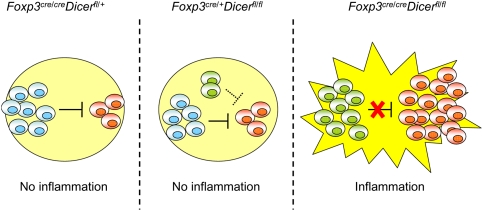
miRNA-dependent gene regulation preserves Treg suppressor function in inflammatory settings. miRNA depletion due to ablation of Dicer in Treg cells (green) results in impaired homeostasis and attenuated suppressor function in a healthy heterozygous Dicerfl/flFoxp3cre/+ female mice cohabited by Dicer-deficient (green) Dicer-sufficient Treg cells (blue). (Middle panel) Nevertheless, Dicer-deficient Treg cells (green) are still able to suppress self-reactive effector T cells (red), albeit less efficiently than their wild-type counterparts. (Left panel) Consequently, the mice remain healthy and show no sign of inflammation, similar to their wild-type littermates (Dicerfl/+Foxp3cre/cre). (Right panel) In Dicerfl/flFoxp3cre mice, lack of Dicer-sufficient Treg cells results in an inflammation and a complete loss of suppressor capacity of Dicer-deficient Treg cells. This failure of suppressor function in face of inflammation ultimately leads to fatal immune lesions indistinguishable from that in Treg-deficient mice.
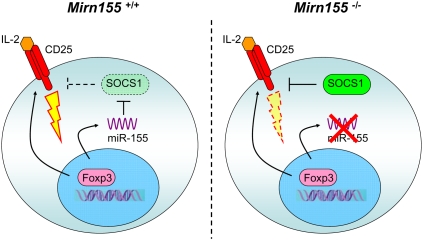
miR-155-dependent regulation of Treg cell homeostasis. In addition to CD25, Foxp3 induces high level of miR-155 expression to ensure increased IL-2 responsiveness through miR-155-mediated down-regulation of the SOCS1 protein (left panel). In the absence of miR-155 (right panel), increased amounts of the SOCS1 protein attenuate IL-2R signaling, leading to diminished STAT5 phosphorylation and diminished competitive fitness.
References
-
- Apostolou I, Sarukhan A, Klein L, von Boehmer H. Origin of regulatory T cells with known specificity for antigen. Nat Immunol. 2002;3:756–763. - PubMed
-
- Bachmann MF, Kohler G, Ecabert B, Mak TW, Kopf M. Cutting edge: Lymphoproliferative disease in the absence of CTLA-4 is not T cell autonomous. J Immunol. 1999;163:1128–1131. - PubMed
-
- Baron U, Floess S, Wieczorek G, Baumann K, Grutzkau A, Dong J, Thiel A, Boeld TJ, Hoffmann P, Edinger M, et al. DNA demethylation in the human FOXP3 locus discriminates regulatory T cells from activated FOXP3+ conventional T cells. Eur J Immunol. 2007;37:2378–2389. - PubMed
Publication types
MeSH terms
Substances
Grants and funding
LinkOut - more resources
Full Text Sources
Other Literature Sources