


Circulating fibroblast growth factor-21 is elevated in impaired glucose tolerance and type 2 diabetes and correlates with muscle and hepatic insulin resistance
- PMID: 19487637
- PMCID: PMC2713625
- DOI: 10.2337/dc09-0684
Circulating fibroblast growth factor-21 is elevated in impaired glucose tolerance and type 2 diabetes and correlates with muscle and hepatic insulin resistance
Abstract
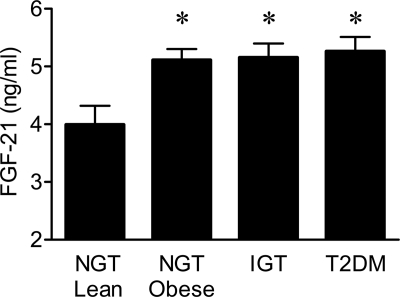
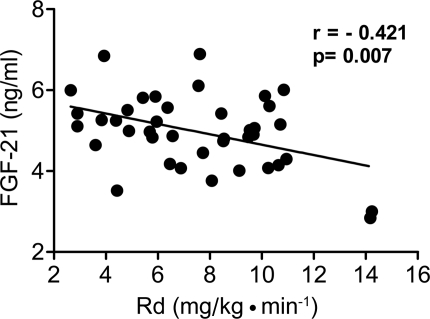
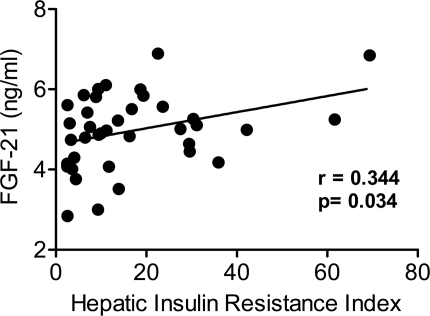
OBJECTIVE Fibroblast growth factor (FGF)-21 is highly expressed in the liver and regulates hepatic glucose production and lipid metabolism in rodents. However, its role in the pathogenesis of type 2 diabetes in humans remains to be defined. The aim of this study was to quantitate circulating plasma FGF-21 levels and examine their relationship with insulin sensitivity in subjects with varying degrees of obesity and glucose tolerance. RESEARCH DESIGN AND METHODS Forty-one subjects (8 lean with normal glucose tolerance [NGT], 9 obese with NGT, 12 with impaired fasting glucose [IFG]/impaired glucose tolerance [IGT], and 12 type 2 diabetic subjects) received an oral glucose tolerance test (OGTT) and a hyperinsulinemic-euglycemic clamp (80 mU/m(2) per min) combined with 3-[(3)H] glucose infusion. RESULTS Subjects with type 2 diabetes, subjects with IGT, and obese subjects with NGT were insulin resistant compared with lean subjects with NGT. Plasma FGF-21 levels progressively increased from 3.9 +/- 0.3 ng/ml in lean subjects with NGT to 4.9 +/- 0.2 in obese subjects with NGT to 5.2 +/- 0.2 in subjects with IGT and to 5.3 +/- 0.2 in type 2 diabetic subjects. FGF-21 levels correlated inversely with whole-body (primarily reflects muscle) insulin sensitivity (r = -0.421, P = 0.007) and directly with the hepatic insulin resistance index (r = 0.344, P = 0.034). FGF-21 levels also correlated with measures of glycemia (fasting plasma glucose [r = 0.312, P = 0.05], 2-h plasma glucose [r = 0.414, P = 0.01], and A1C [r = 0.325, P = 0.04]). CONCLUSIONS Plasma FGF-21 levels are increased in insulin-resistant states and correlate with hepatic and whole-body (muscle) insulin resistance. FGF-21 may play a role in pathogenesis of hepatic and whole-body insulin resistance in type 2 diabetes.
Figures
References
-
- Bottcher RT, Niehrs C: Fibroblast growth factor signaling during early vertebrate development. Endocr Rev 2005; 26: 63– 77 - PubMed
-
- Huang X, Yu C, Jin C, Yang C, Xie R, Cao D, Wang F, McKeehan WL: Forced expression of hepatocyte-specific fibroblast growth factor 21 delays initiation of chemically induced hepatocarcinogenesis. Mol Carcinog 2006; 45: 934– 942 - PubMed
-
- Goetz R, Beenken A, Ibrahimi OA, Kalinina J, Olsen SK, Eliseenkova AV, Xu C, Neubert TA, Zhang F, Linhardt RJ, Yu X, White KE, Inagaki T, Kliewer SA, Yamamoto M, Kurosu H, Ogawa Y, Kuro-o M, Lanske B, Razzaque MS, Mohammadi M: Molecular insights into the klotho-dependent, endocrine mode of action of fibroblast growth factor 19 subfamily members. Mol Cell Biol 2007; 27: 3417– 3428 - PMC - PubMed
-
- Kharitonenkov A, Wroblewski VJ, Koester A, Chen YF, Clutinger CK, Tigno XT, Hansen BC, Shanafelt AB, Etgen GJ: The metabolic state of diabetic monkeys is regulated by fibroblast growth factor-21. Endocrinology 2007; 148: 774– 781 - PubMed
-
- Fu L, John LM, Adams SH, Yu XX, Tomlinson E, Renz M, Williams PM, Soriano R, Corpuz R, Moffat B, Vandlen R, Simmons L, Foster J, Stephan JP, Tsai SP, Stewart TA: Fibroblast growth factor 19 increases metabolic rate and reverses dietary and leptin-deficient diabetes. Endocrinology 2004; 145: 2594– 2603 - PubMed
MeSH terms
Substances
LinkOut - more resources
Full Text Sources
Other Literature Sources
Medical
Research Materials
