Review
. 2009 Jul;10(7):478-88.
doi: 10.1038/nrg2529.

Understanding what determines the frequency and pattern of human germline mutations

Affiliations
Review

Understanding what determines the frequency and pattern of human germline mutations

Norman Arnheim et al. Nat Rev Genet. 2009 Jul.

Abstract

Surprising findings about human germline mutation have come from applying new technologies to detect rare mutations in germline DNA, from analysing DNA sequence divergence between humans and closely related species, and from investigating human polymorphic variation. In this Review we discuss how these approaches affect our current understanding of the roles of sex, age, mutation hot spots, germline selection and genomic factors in determining human nucleotide substitution mutation patterns and frequencies. To enhance our understanding of mutation and disease, more extensive molecular data on the human germ line with regard to mutation origin, DNA repair, epigenetic status and the effect of newly arisen mutations on gamete development are needed.


Figures
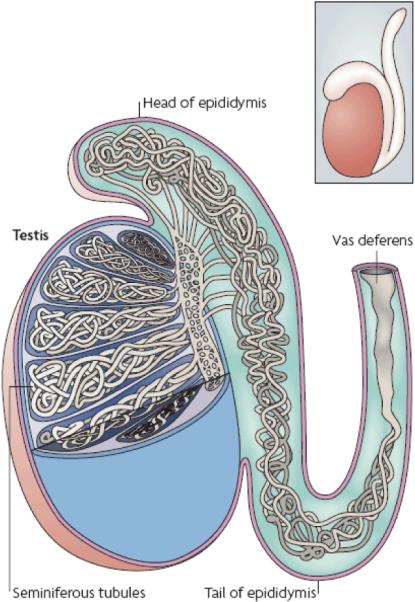
Figure 1
Figure 1. Human testis and epididymis
A whole testis with epididymis attached is shown in the inset box. A cross-section through the epididymis and partial exposure of the interior of the testis shows the seminiferous tubules. The testis is oriented with respect to the head and tail of the epididymis. The lumen of each tubule provides a pathway for sperm to reach the epididymis and the vas deferens.
Figure 2
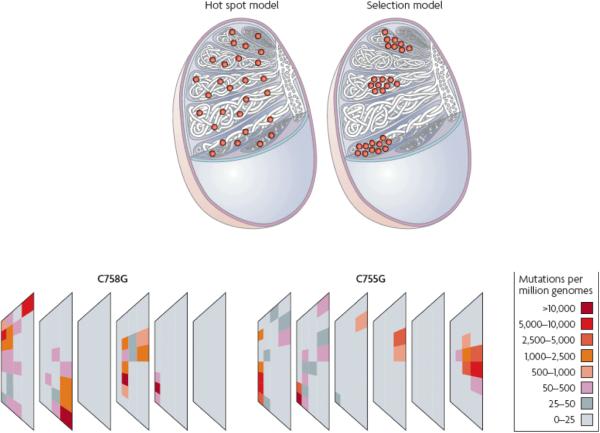
Figure 2. Distribution of mutations at a single nucleotide site in the testis
A. The distribution of mutations (orange dots) at a single nucleotide site in the testis expected according to the hot spot model; a uniform distribution in the tubules is predicted. B. The distribution of the Apert syndrome 755C>G or 758C>G mutants in one dissected human testis from a 62 year old donor. The testis was divided into six slices and each slice divided into the 32 pieces from which DNA was isolated. A separate aliquot was used to study each of the mutations. The orientation of the testis is relative to the head (on the left, slice 1) and tail (on the right, slice 6) of the epididymis whose long axis runs along the upper surface (slices 1-6). The mutation frequency is color-coded. (The distribution of high frequency pieces is not overly represented on the perimeter of the slices, see26, 27). C. The clusters observed by testis dissection, shown here as orange dots, could be explained if a few rare mutations each provide the affected self-renewing spermatogonial cells (SrAp) with a proliferative selective advantage.
Figure 3
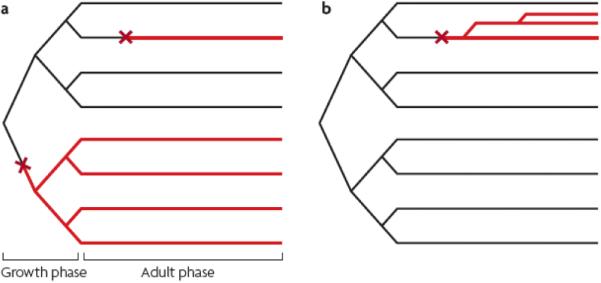
Figure 3. Mutation hot spot and selection models of germline cell divisions
The mutation hot spot (a) and selection (b) models of germline cell division. In each case there is a growth phase and an adult phase. Two independent mutation events (red X) are shown in (a). The mutation in the adult phase produces one mutated SrAp cell lineage (red line), whereas the mutation event in the growth phase produces four mutated SrAp cell lineages. In the selection model (b) one mutation event in the adult phase produces three mutated SrAp cell lineages (from two symmetric rather than asymmetric cell divisions) that would form a cluster within the testis.

References

    1. Weatherall DJ. The global problem of genetic disease. Ann Hum Biol. 2005;32:117–22. - PubMed
    1. Hassold T, Hall H, Hunt P. The origin of human aneuploidy: where we have been, where we are going. Hum Mol Genet. 2007;16(Spec No 2):R203–8. - PubMed
    1. Pacchierotti F, Adler ID, Eichenlaub-Ritter U, Mailhes JB. Gender effects on the incidence of aneuploidy in mammalian germ cells. Environ Res. 2007;104:46–69. - PubMed
    1. Rosenbusch BE. Mechanisms giving rise to triploid zygotes during assisted reproduction. Fertil Steril. 2008;90:49–55. - PubMed
    1. Ellegren H. Microsatellites: simple sequences with complex evolution. Nat Rev Genet. 2004;5:435–45. - PubMed

Publication types